
Time:2025-11-20 Browse: 1
During the design and manufacturing process of touchscreen sensors, a visual artifact known as "Moiré pattern" poses a significant challenge to product quality. This article provides an in-depth analysis of the causes of Moiré patterns in touchscreen sensors and systematically outlines effective solutions.
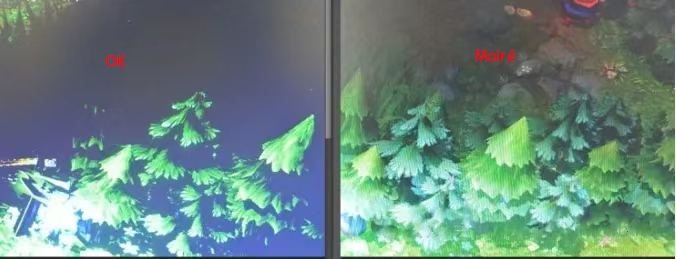
1. What is a Moiré Pattern and What is its Physical Cause?
A Moiré pattern is a visual phenomenon in physics. When two periodic or quasi-periodic patterns are superimposed at a certain angle, frequency, or phase, a new, lower-frequency, coarser interference pattern emerges. In the context of a touchscreen, the following three elements combine to produce Moiré patterns:
① The pattern of the touchscreen sensor: Whether it is a traditional ITO (indium tin oxide) square mesh or an advanced metal mesh, it is inherently composed of numerous fine, regularly arranged conductive units forming a periodic pattern.
② The pixel array of the display: LCD or OLED displays themselves consist of millions of RGB sub-pixels arranged in a strict matrix.
③ The superposition of the two: When the touchscreen sensor is closely laminated on top of the display, these two layers of periodic patterns are superimposed. The human eye or a camera, acting as the "observer," then perceives this third pattern—the Moiré pattern.
2. Specific Harms Caused by Moiré Patterns
Moiré patterns are by no means merely "unattractive"; they trigger a series of cascading issues.
●Degraded Display Quality: Watermark-like ripples, flickering, or irregular color bands appear on the screen, severely disrupting users' viewing experience. This is particularly noticeable when displaying solid colors or striped patterns.
●Touch Performance Interference: For touch technologies relying on optical sensing or fine capacitance changes, the periodic brightness and color variations caused by Moiré patterns may be misinterpreted by sensors as touch signals, leading to cursor jitter, false touches, or touch failure.
●Reduced Product Perceived Quality: Any display defects are often attributed to product quality issues, damaging brand reputation and market acceptance.
3. Core Design Strategies for Systematically Avoiding Moiré Patterns
Avoiding Moiré patterns is a systematic engineering process that spans the entire lifecycle of a touchscreen—from design and manufacturing to integration. The core idea is to disrupt the periodicity of at least one of the periodic structures.
Solution 1: Fine-tuning the Physical Parameters of the Sensor Pattern**
When it is impossible to completely change the pattern, the physical parameters can be precisely calculated and adjusted so that the pattern "avoids" the periodicity of the display pixels.
●Adjusting the Pattern Pitch
Principle: Pitch refers to the distance between repeating units of the pattern. Using simulation software, find a Sensor Pitch that is "least compatible" with the target display's pixel Pitch. Ideally, the Sensor Pitch should be much smaller or much larger than the pixel Pitch, causing the resulting Moiré pattern frequency to be so high that it becomes indistinguishable to the human eye. This requires close collaboration with display manufacturers to obtain accurate pixel parameters and extensive simulation iterations during the early design phase.
●Rotating the Sensor Pattern Angle
Principle: Rotate the Sensor pattern by a specific angle relative to the display's pixel array. When two grids are superimposed at an angle other than 0⁰ or 90⁰, the frequency of the resulting Moiré pattern changes. Typically, a small angle (e.g., 5⁰–15⁰) can significantly reduce Moiré patterns. However, too large an angle may introduce new optical issues or increase routing complexity.
Solution 2: Optimizing the Sensor Pattern Design—From "Regular" to "Random"
This is the most fundamental and effective solution. By altering the structure of the Sensor pattern itself, strong periodic interference with the display's pixel array can be prevented.
●Using Randomized Metal Mesh
Principle: Abandon traditional regular patterns such as equilateral rhombuses or squares, and instead use carefully designed polygonal meshes with randomized node positions (e.g., Voronoi diagrams).
Advantages: Since the mesh no longer has a single dominant periodic frequency, it does not generate stable, noticeable low-frequency Moiré patterns when superimposed with the display's pixel array. Even if interference occurs, the resulting patterns are very fine and chaotic, making them difficult for the human eye to detect and appearing instead as uniform noise.
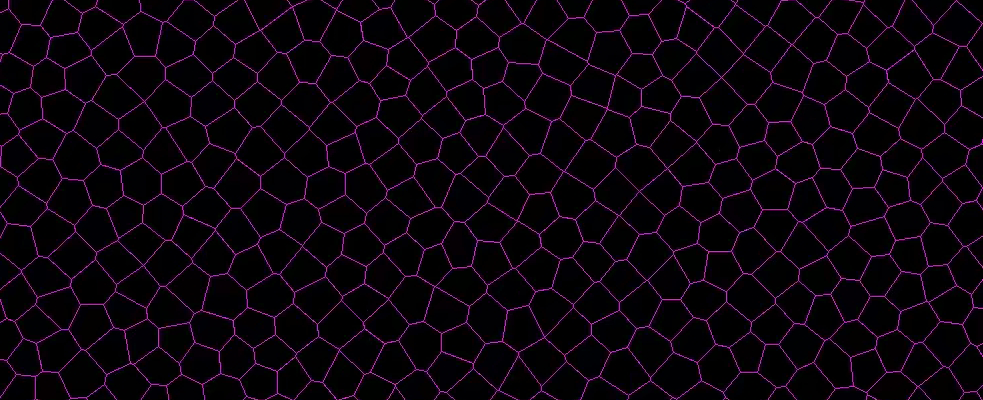
Challenge: The design algorithms for random patterns are more complex, requiring an optimal balance between electrical performance (e.g., impedance uniformity) and optical performance.
● Designing Irregular Patterns
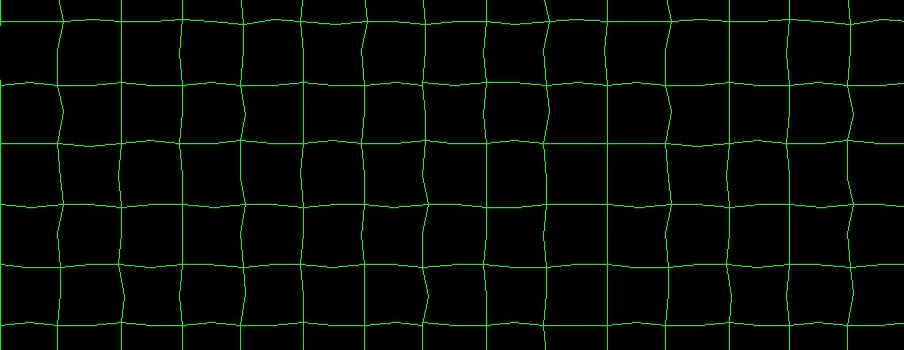
In addition to completely random patterns, other aperiodic layouts—such as wavy, zigzag, or fractal patterns—can also effectively disrupt periodicity.
Solution 3: Optical Compensation through Materials and Processes
① Utilizing High-Precision Materials: Employing emerging transparent conductive materials such as silver nanowires or carbon nanotubes, whose inherently random network structures possess anti-Moiré characteristics. Replacing traditional ITO with metal mesh allows for line widths of just a few micrometers—significantly smaller than pixel dimensions—rendering the sensor pattern itself "less visible" and thereby reducing interference intensity.
② Optimizing OCA Optically Clear Adhesive: Selecting OCA with a refractive index better matched to glass and polarizers minimizes interlayer reflections, thereby suppressing Moiré patterns exacerbated by optical interference to a certain extent.
Solution 4: Pre-emptive Simulation and Verification
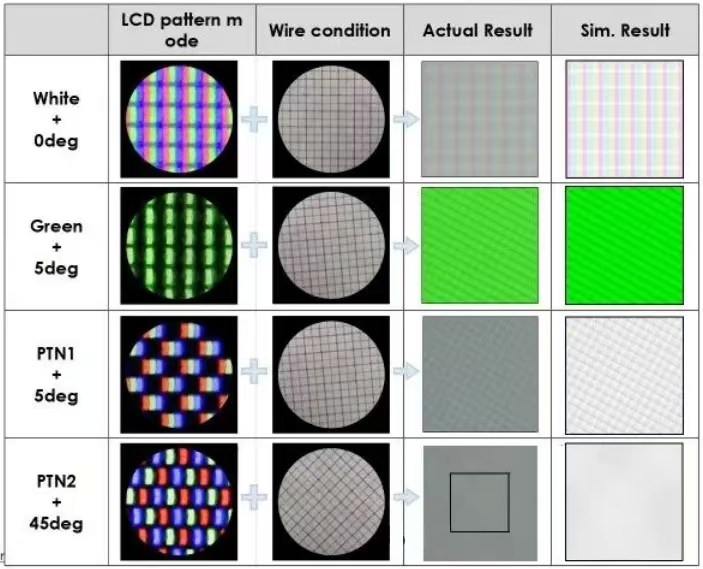 In the development process of touchscreens, simulation-first has become standard practice. By utilizing professional optical simulation software, the designed sensor pattern can be virtually superimposed onto the display pixels prior to mold fabrication and manufacturing, enabling prediction and visualization of potential Moiré patterns. This allows engineers to quickly adjust parameters and compare different design options on the computer, significantly saving time and cost.