Time:2025-11-27 Browse: 1
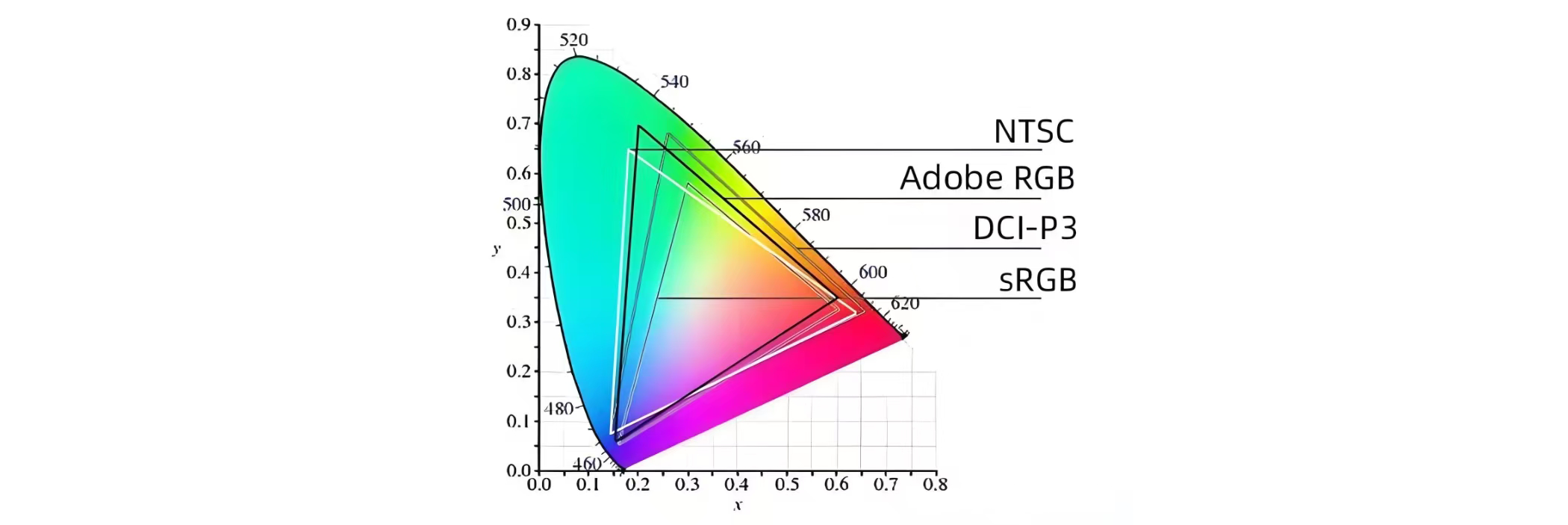
NTSC, sRGB, DCI-P3, and Adobe RGB are all referred to as color gamuts, but they belong to different color gamut standards.
1. What is Color Gamut?
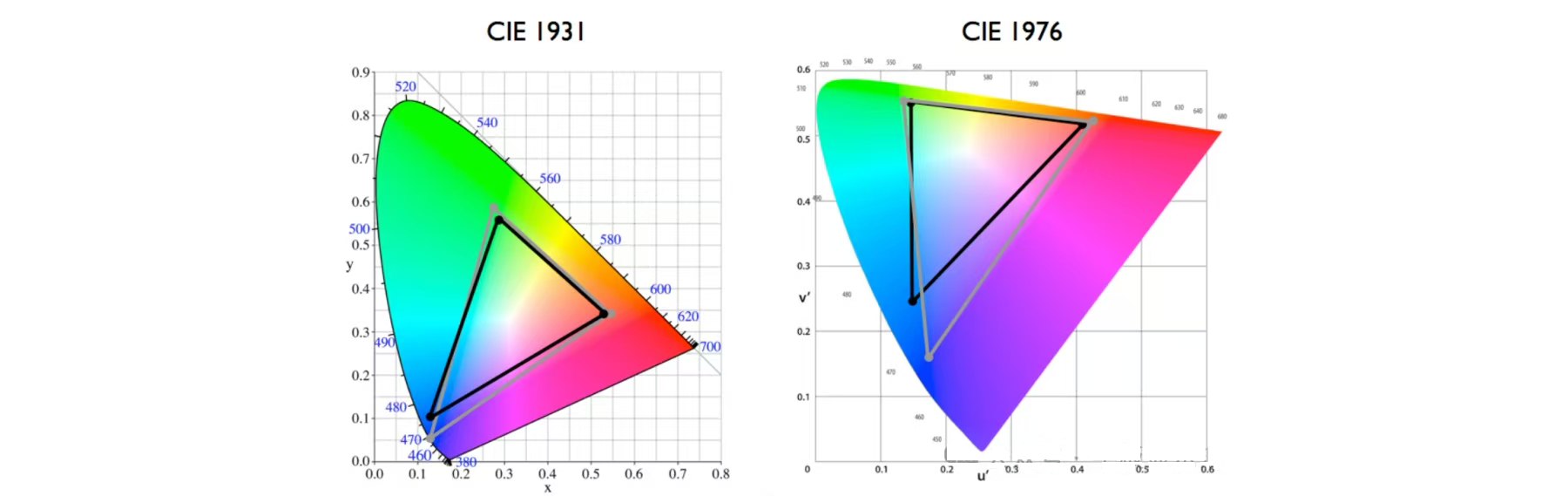
Color gamut, also known as color space (Color space), was developed in 1931 when the International Commission on Illumination (CIE) color scientists attempted to derive theoretical primary colors mathematically from real primary colors based on the RGB model. They aimed to create a new color system so that industries such as pigments, dyes, and printing could precisely specify product colors. One of the outcomes is the CIE 1931 chromaticity diagram (also known as the "horseshoe diagram" in the industry). This diagram maps all visible colors by the human eye into a coordinate system, forming the color space shown in the figure above. Thus, we can accurately define a specific color using a set of data.
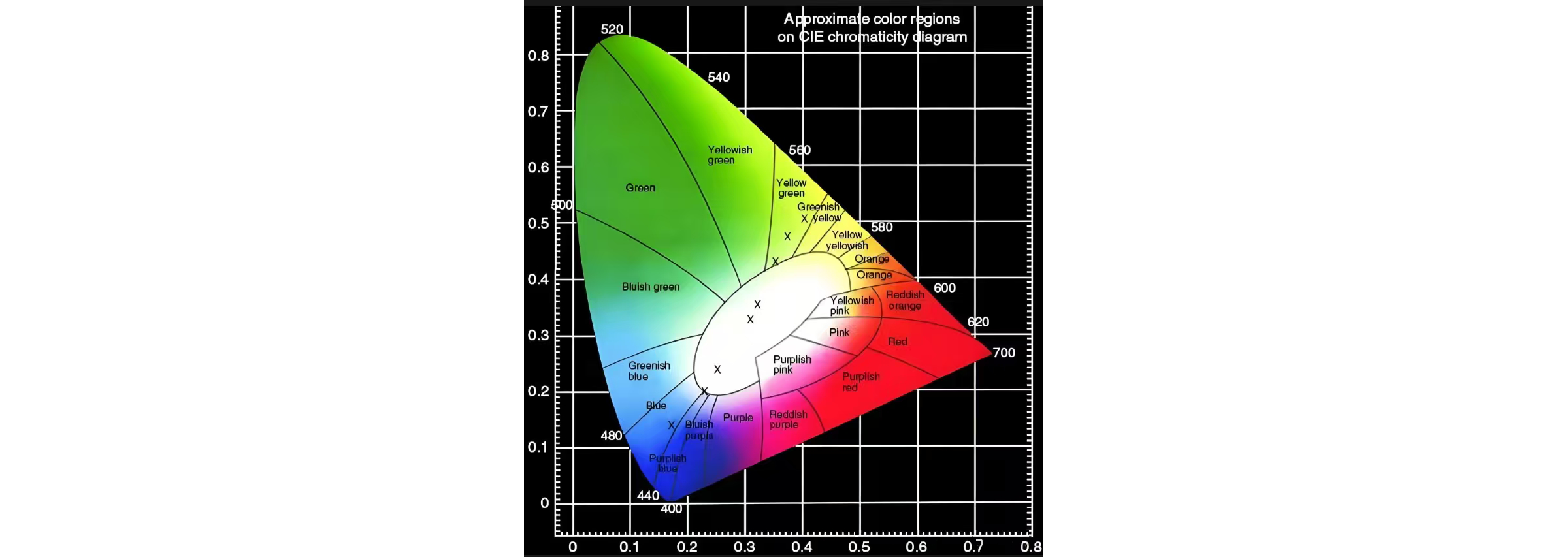
A color gamut is a method for encoding colors, referring to the range of colors that a particular color representation system can express, or the total sum of colors a technical system can produce. Standards such as sRGB, NTSC, and Adobe RGB define "smaller color spaces" within the broader CIE 1931 chromaticity diagram. In this diagram, the color gamut a flat-panel display can reproduce is represented by the triangular area formed by connecting the red, green, and blue (RGB) points. The larger this triangular area, the wider the display's color gamut, resulting in more vivid and saturated colors.
The CIE 1931 chromaticity diagram essentially maps the full spectrum of colors visible to the human eye. However, further research revealed that perceived color differences within the CIE 1931 color space are not uniform; in other words, equal distances in the space do not correspond to equal perceived color differences. To address this issue, a new color space, the CIE 1976 chromaticity diagram, was introduced.
The CIE 1976 color space was designed to better align with human visual perception and is also known as the "CIE 1976 u'v'" chromaticity diagram.
2. NTSC (National Television Standards Committee) is a color space defined for television broadcasting. The NTSC, or the National Television System Committee, established a television standard consisting of a set of broadcast transmission protocols used in countries like the United States and Japan.
The NTSC color gamut standard was the first to be widely adopted in the display industry. If a display product does not explicitly specify which color gamut standard it uses, it is generally assumed to be referencing the NTSC standard.

NTSC = (S_color ÷ S_NTSC) × 100%
where S_color is the color gamut area of a specific standard, and S_NTSC is the standard NTSC gamut area. In the CIE 1931 chromaticity diagram, the standard NTSC gamut area (S_NTSC) is 0.1582.
3. sRGB represents the standard RGB primary colors and is one of the earliest color gamut standards. Its color space is based on independent color coordinates, ensuring that colors maintain consistency across different devices during transmission, regardless of the devices' inherent color characteristics. sRGB was jointly developed by HP and Microsoft in 1996 and remains the default color space for Windows systems and most native software. It establishes a common color language for displays, printers, scanners, and other computer peripherals and applications. Most digital image-capturing device manufacturers now support the sRGB standard, as do nearly all printing and projection imaging devices. However, sRGB has not been universally adopted in displays—currently, only some high-end display brands or (high-end models) support the sRGB standard.
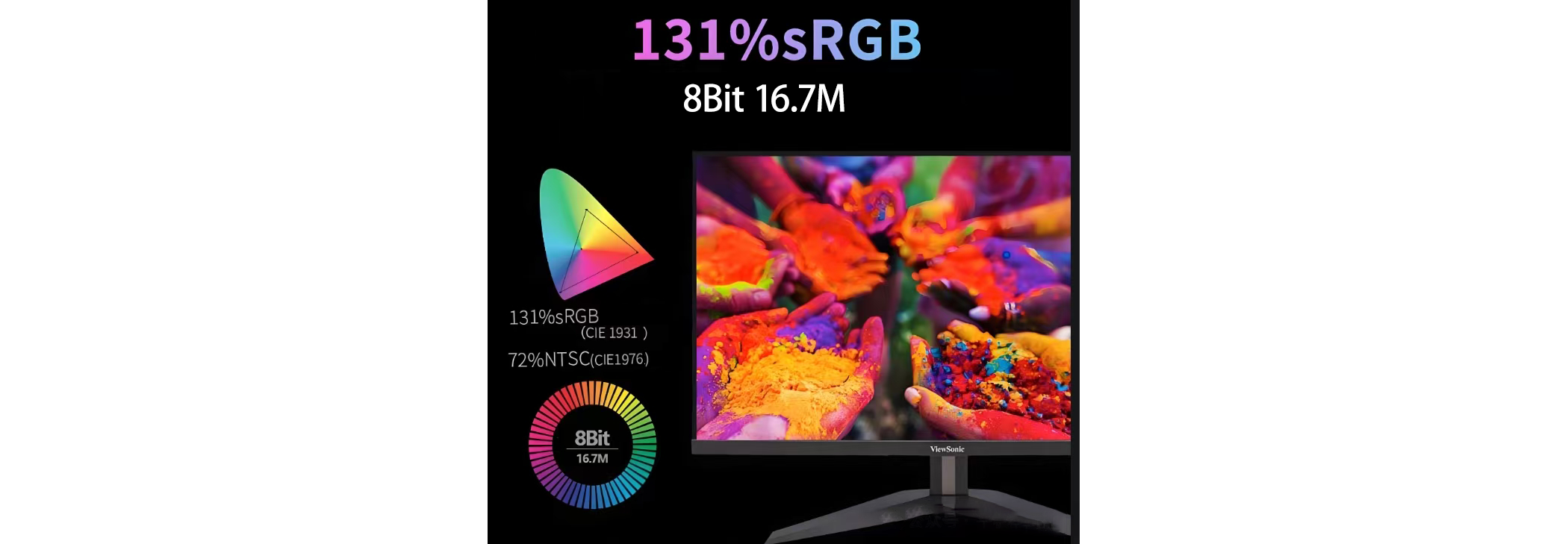
Its coverage range is relatively small. Most mid-to-high-end laptop screens on the market today can achieve 100% sRGB coverage, which translates to approximately 72% NTSC.
It is important to note that NTSC does not fully encompass sRGB, and there is no direct equivalent conversion between the two. The approximation "100% sRGB ≈ 72% NTSC" refers to the relationship between their gamut areas, not a simple numerical equivalence.

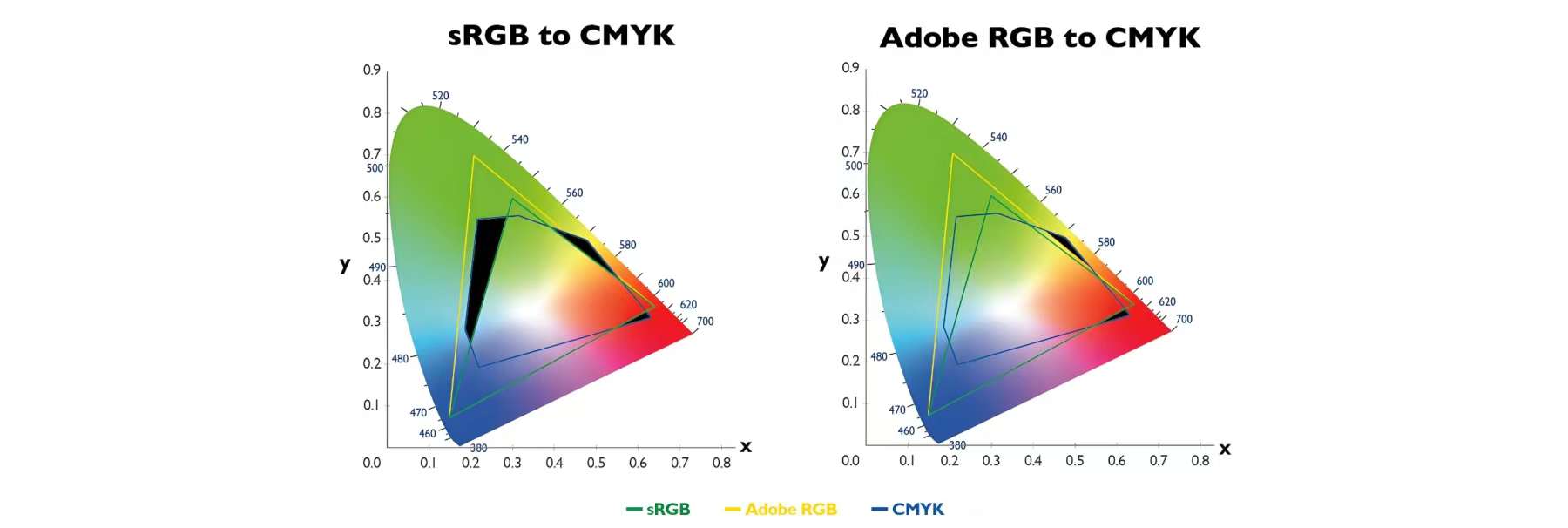
4. Adobe RGB is a color space introduced by professional software developer Adobe in 1998. It was originally designed to encompass both sRGB and CMYK (a color space commonly used in printing), so that digital photos could be properly displayed and edited on computers and also printed with accurate, lossless colors.
Compared to sRGB, Adobe RGB covers a broader range of colors and is favored by designers, thus it is widely used in professional photography and post-production fields. Adobe RGB has a larger area than both sRGB and CMYK, offering a wider color gamut and excellent color gradation. With a broader color range than sRGB, it can display more vivid colors, making it more popular among professional designers, illustrators, and similar professionals.