
Time:2025-12-04 Browse: 1
The issue of black blobs in TFT-LCD liquid crystal displays is very common in LCD modules and can cause serious adverse effects. The causes of black blobs are numerous, making the problem particularly challenging to address. This article primarily reviews the mechanisms behind black blob formation in LCD liquid crystal and outlines common countermeasures.
1. Why are LCD black blobs more severe in grayscale images than in white images?
First, let's review the display principle of LCD modules. When power is applied to the LCD, a voltage difference forms between the pixel electrode (Pixel ITO) and the common electrode (COM ITO). This voltage difference causes the liquid crystal at the corresponding pixel location to rotate. Different voltage differences result in different rotation angles of the liquid crystal, leading to variations in the transmittance of the LCD. Consequently, this results in different displayed images (black, gray, white).
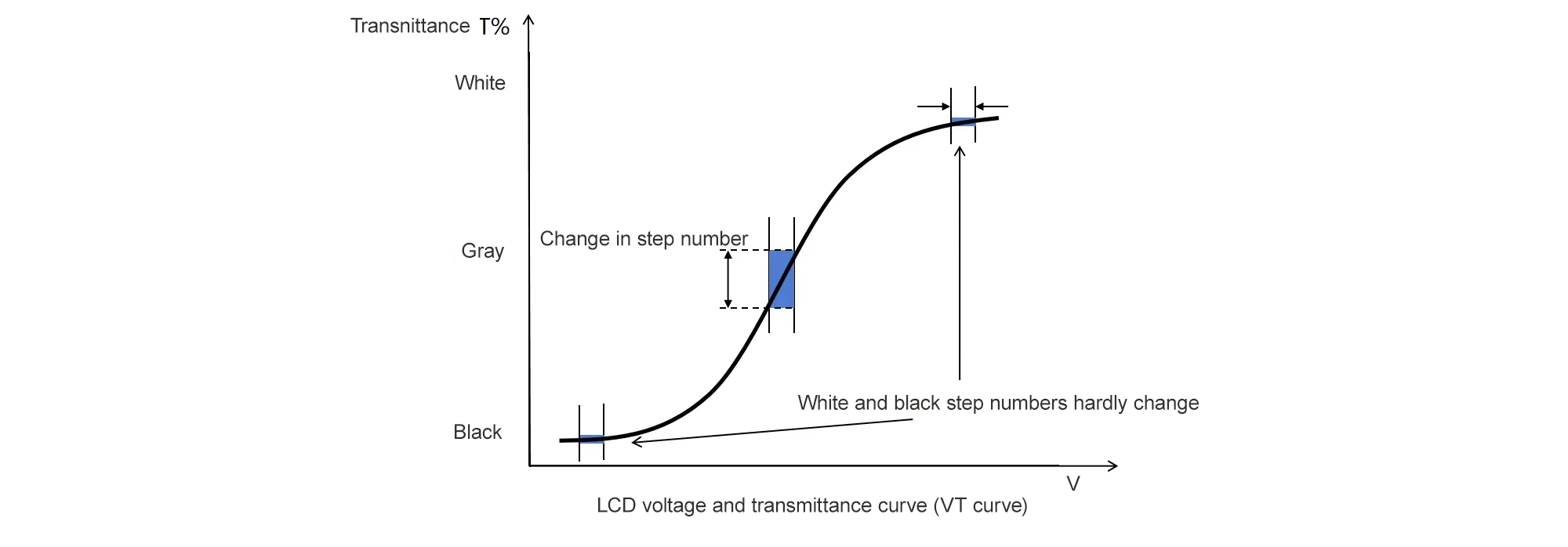
From the LCD voltage versus transmittance (V-T) characteristic curve, it can be observed that the curve is nonlinear. The slope in the low-voltage region (corresponding to low gray levels) is very steep. Due to this large slope, even a slight voltage fluctuation is greatly amplified, resulting in a noticeable difference in LCD transmittance. This is one of the reasons why LCD black blobs are more pronounced in gray-scale images than in white images.
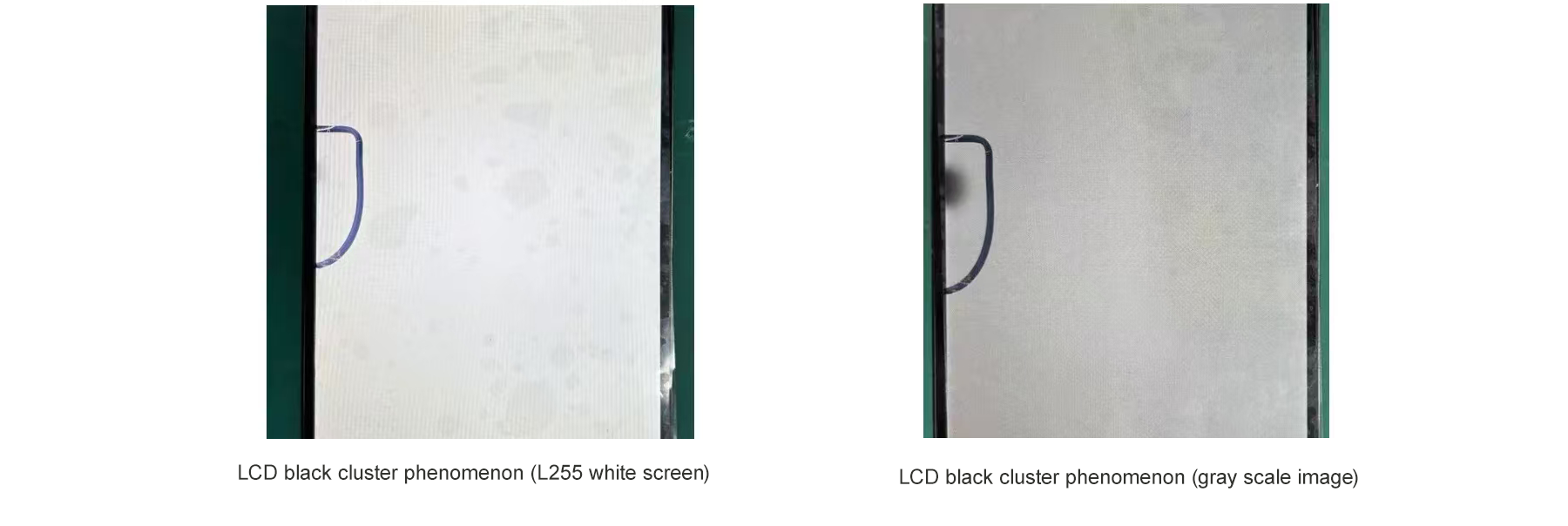
On the other hand, the characteristics of human vision are also related, as the sensitivity to brightness varies in different lighting environments.
2. Common Monitoring and Excitation Methods for LCD Black Blobs
For some relatively minor LCD black blob defects, the defect phenomenon may become less noticeable or even disappear after a period of time, making subsequent analysis inconvenient. Therefore, certain excitation methods are employed to reproduce the black blob phenomenon. These excitation methods are aimed at reproducing the black blob defect in products already exhibiting such issues and to determine whether the black blob defect is caused by damage to the LCD frame adhesive's sealing integrity. After all, there are other types of bubbles in LCD modules, such as air bubbles within the LCD Cell (related to outgassing, cell vacuum level, etc.) and vacuum bubbles within the LCD Cell (related to Cell Gap, liquid crystal quantity, etc.).
① High-Temperature Testing: The size of black blobs in defective LCD products increases under high-temperature conditions (80–85°C). When the frame adhesive's sealing of the LCD panel deteriorates, the volume of bubbles increases under high temperatures,挤压 the liquid crystal area and thereby enlarging the black blob area. Meanwhile, under high temperatures, the viscosity of the liquid crystal decreases, fluidity increases, and the diffusion rate of contaminants (such as moisture, oxygen) accelerates, leading to an expanded contamination range and more pronounced black blobs. The high-temperature excitation is mainly conducted in a high-temperature test chamber, as the chamber provides more uniform heating for the LCD; of course, if conditions are limited, a high-temperature hot plate method can also be used for excitation, although the uniformity of heating will be poorer.
Core Summary of High-Temperature Excitation Leading to Larger Black Blobs: High Temperature → Increased Bubble Volume + Accelerated Contaminant Diffusion → Enlarged or More Pronounced Black Blob Area.
② High-Temperature and High-Humidity Testing: The size of black blobs in defective LCD products changes under high-temperature and high-humidity conditions (80–85°C/90–95%RH). When the frame adhesive's sealing of the LCD display panel deteriorates, a large amount of moisture enters the liquid crystal cell under high-temperature and high-humidity conditions, causing the bubble volume to increase and the black blob area and severity to worsen.
Core Summary of High-Temperature and High-Humidity Excitation Leading to Larger Black Blobs: High Temperature and High Humidity → Increased Bubble Volume → Enlarged or More Pronounced Black Blob Area.
③ Boiling/Water Cooking Test / PCT (Pressure Cooker Test): The size of black blobs in defective LCD products increases under Pressure Cooker Test (PCT) or boiling/water cooking test conditions. The mechanism for enlarging black blobs under boiling/PCT conditions is similar to that under high-temperature and high-humidity conditions, but the boiling/PCT test conditions are more severe, which can further shorten the excitation time for reproducing the LCD black blob defect.
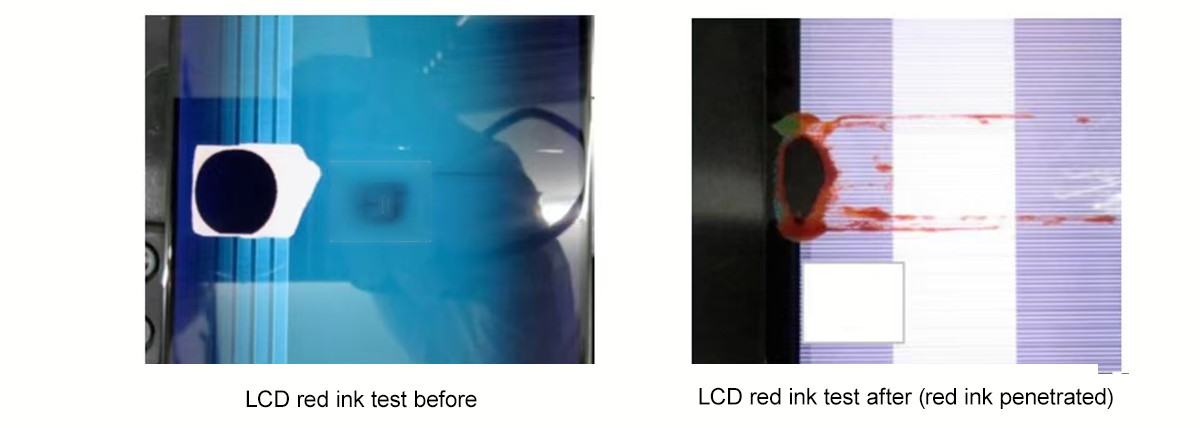
④ Red Ink Vacuum Test: After the red ink vacuum test on defective LCD products with black blobs, the red ink penetrates into the LCD cell, and simultaneously, the volume of the black blobs increases.
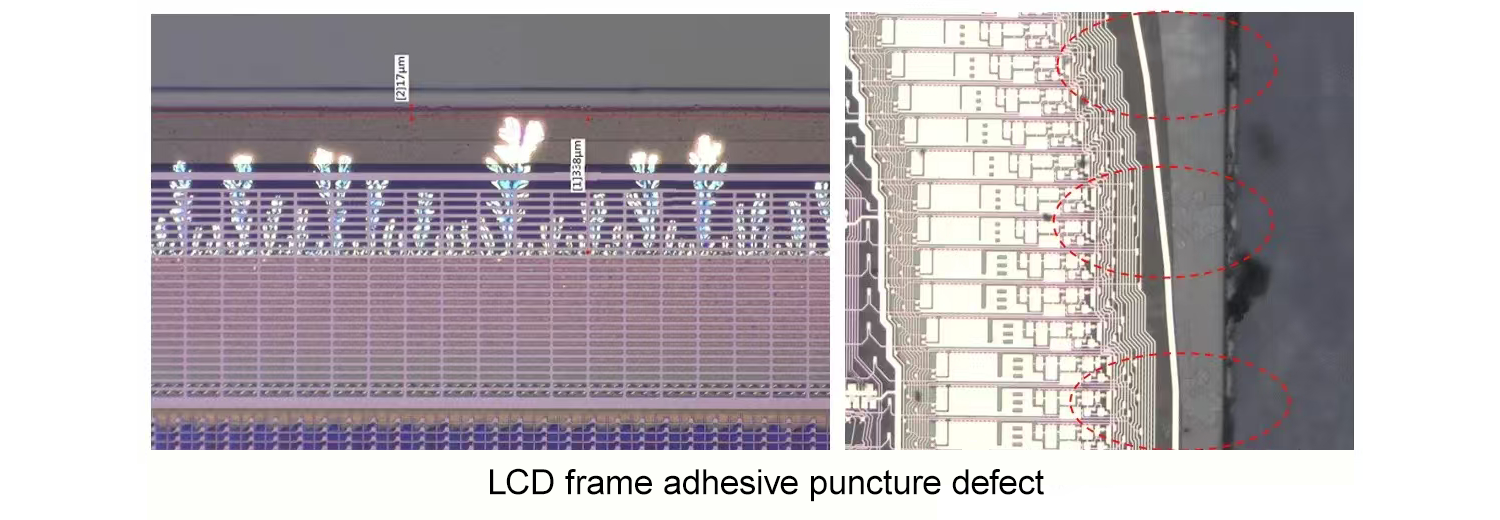
⑤ Observation of frame adhesive puncture under microscope: When it is uncertain whether the LCD black blob defect is caused by the sealing issue of the LCD frame sealant, a microscope can be used to check whether there is any puncture defect in the LCD frame sealant. If the frame sealant has been punctured by the liquid crystal, the LCD black blob defect can basically be identified as being caused by a sealing problem of the LCD frame sealant. Punctures in the LCD frame sealant are unavoidable in the ODF process; only by optimizing the process of the LCD panel can the width of the frame sealant puncture be reduced. If the puncture width of the LCD frame sealant is ≤1/3 of the frame sealant width, it is judged as OK; if the puncture width of the LCD frame sealant is >1/3 of the frame sealant width, it is judged as NG.
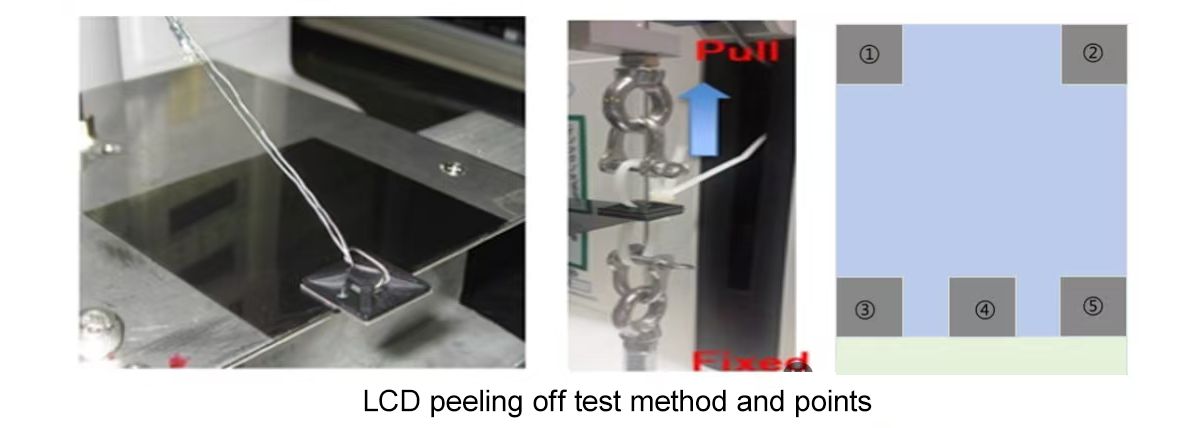
⑥ The LCD frame sealant peeling off test is the most common method for evaluating the adhesive strength of the LCD frame sealant. When the LCD frame sealant is damaged, when the sealant type is inappropriate, or when the combination of sealant, PI alignment layer, and liquid crystal is unsuitable, the peel strength between the TFT glass and CF glass of the LCD panel will deteriorate, resulting in a failed LCD frame sealant peeling off test. Industry standards typically require the LCD frame sealant peeling off test result to be ≥10 kgf, with more stringent requirements being ≥15 kgf. The peeling off test is generally conducted at five designated points.
⑦ Low-Temperature Testing: The size of LCD black blobs decreases under low-temperature conditions (-20°C to -40°C). When the sealing integrity of the LCD panel's frame adhesive deteriorates, the principle of thermal expansion and contraction causes bubbles to shrink at low temperatures. Simultaneously, the viscosity of the liquid crystal increases, slowing down the diffusion rate of contaminants, which leads to a reduction in the size of the black blobs. Additionally, while black blobs expand under high-temperature conditions, when the product is removed from the high-temperature chamber and gradually returns to room temperature over time, the size of the black blobs slowly decreases.
Core Summary of Low-Temperature Excitation Leading to Smaller Black Blobs: Low Temperature → Bubble Volume Contraction + Slowed Contaminant Diffusion → Reduced Black Blob Area.