Time:2025-12-11 Browse: 1
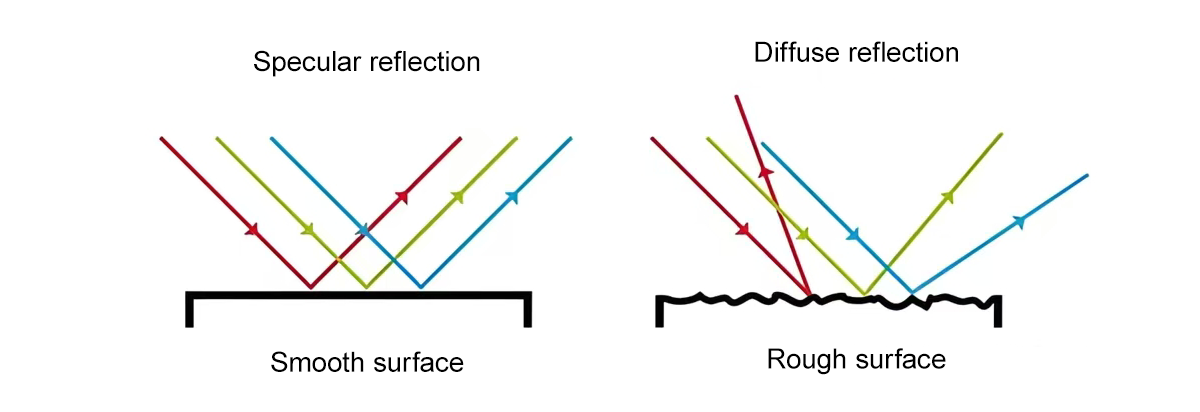
In current display products, there is a growing number of items featuring Anti-Glare (AG) surface treatment. This technology is now widely used in educational products, EDP electronic paper front-light products, automotive displays, industrial displays, and medical display products.In this presentation, I will share insights on the following key parameters of AG glass:Surface Roughness&Transmittance or Haze& Gloss&Sparkle (or Flash Points)& Reflectance.
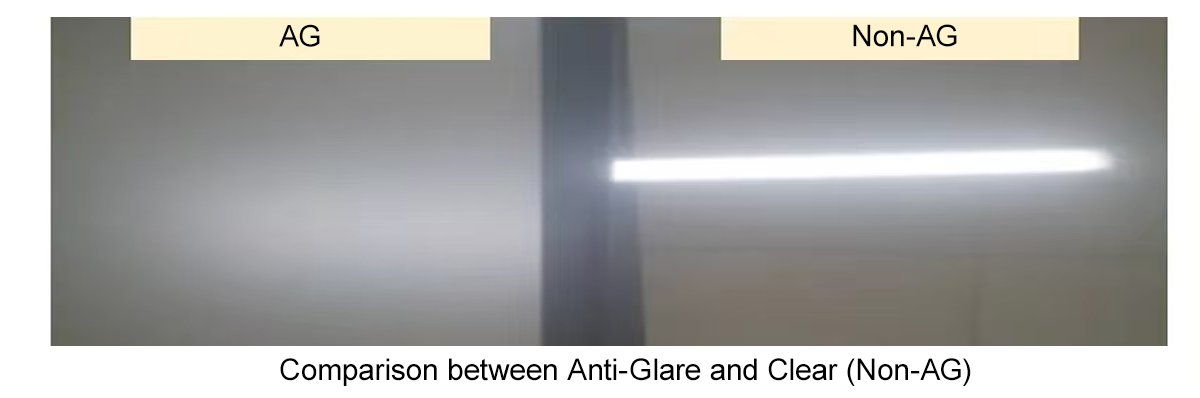
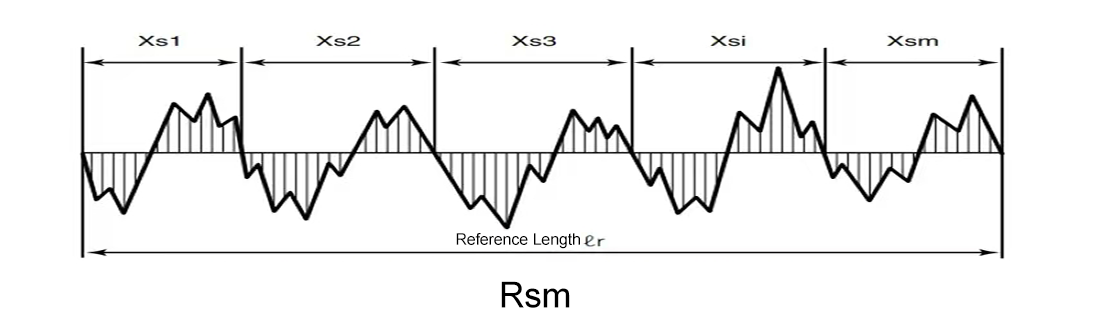
1. AG Glass Roughness:Roughness generally refers to the height difference between the uneven peaks and valleys formed on the surface of AG glass. The main physical parameters used to characterize roughness are: Ra (Height) and Rsm (Spacing/Length).
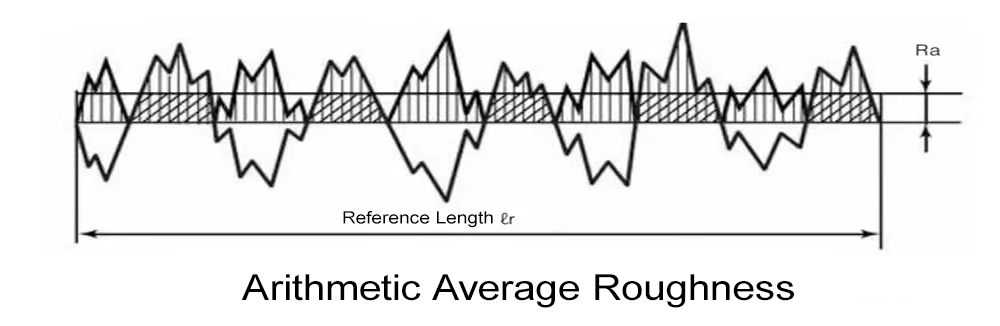
① Ra (Height):The complete definition of the Ra value is the arithmetical mean deviation of the assessed profile. It represents the average of the absolute values of the distances between all peaks/valleys and the mean line within the evaluation length (or sampling length).
The Ra value characterizes the average height difference of the profile peaks and valleys, representing the overall degree of surface unevenness.
Under normal circumstances, the Ra value determines both the optical properties and the tactile feel of the AG glass cover panel.
●If the Ra value is too small: Haze will be too low, resulting in weakened anti-glare performance.
●If the Ra value is too large: Haze will be too high, causing the image to become overly blurred and reducing clarity.
Ra Value Control Standards for AG Glass Cover Panels in Display Applications
For AG glass cover panels used in display products, there are different control requirements for the Ra value. Taking chemically-etched AG glass as an example, the specific Ra value requirements are as follows:
●Smartphones: The Ra value is generally required to be between 0.03 ~ 0.07 µm.
●Tablets & Automotive Displays: The Ra value is generally required to be between 0.15 ~ 0.25 µm.
●Industrial Displays, Learning Machines & Eye-Protection Products: The Ra value is generally required to be between 0.3 ~ 0.5 µm.
●Non-Display Applications (e.g., Phone Rear Covers, Touchpads): The Ra value is generally required to be between 0.5 ~ 1.2 µm.
2. Rsm (Spacing/Length): The Average Width of Profile Elements
The Rsm value represents the average distance along the center line between adjacent profile peaks and valleys within the sampling length.
●Small Rsm Value: Indicates a very fine and uniform surface texture with a small pitch between peaks and valleys.
- Optical Performance: It effectively eliminates glare while maximizing image sharpness and contrast.
- Tactile Feel: The surface feels more delicate, smooth, and premium to the touch.
●Large Rsm Value: Indicates a relatively coarse and sparse surface texture with a wider pitch between peaks and valleys.
- Optical Performance: It can cause uneven light scattering, leading to halos, a grainy appearance, or glare. Image clarity decreases when displaying fine details.
- Tactile Feel: The surface feels slightly rougher when touched.
2. AG Glass Haze and Transmittance
These are two critical technical specifications. Haze determines the image sharpness and anti-glare performance of the display module, while Transmittance determines the brightness of the display module.
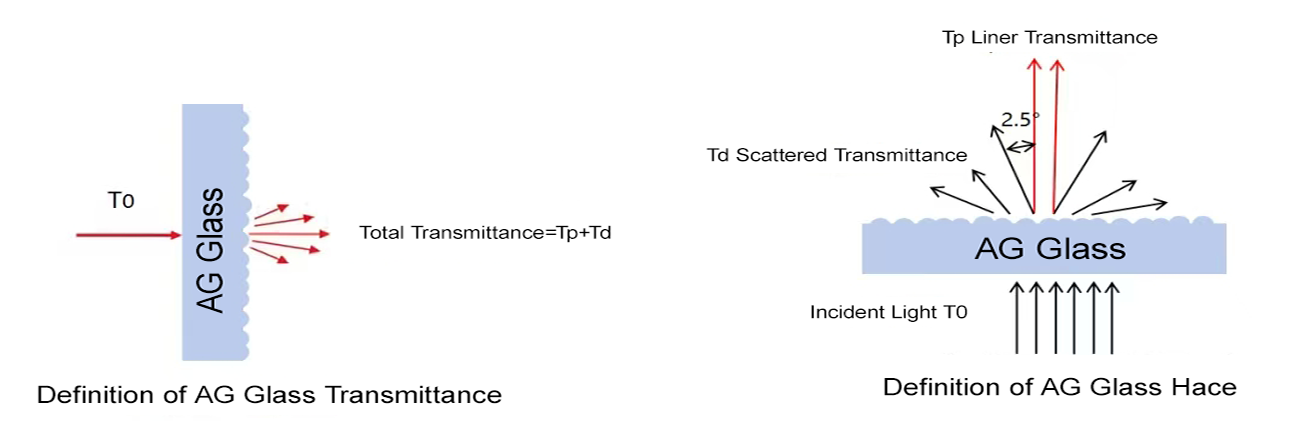
① Transmittance:AG Glass Transmittance refers to the phenomenon where light undergoes scattering both on the surface and inside the glass when a beam of light is perpendicularly incident upon AG glass.
It is defined as the ratio of the transmitted luminous flux (Tt) to the incident luminous flux (T0), primarily evaluating the ability of light to penetrate the AG glass. It is usually expressed as:T% = Tt/T0%.
For AG glass cover panels used in display products, the transmittance is generally required to be ≥ 80% ~ 90%. A higher transmittance value results in a brighter display module.
② Haze :AG Glass Haze refers to the ratio of the scattered luminous flux (light deviating from the direct transmission path by more than 2.5⁰) to the total transmitted luminous flux when light passes through the glass. It is primarily used to evaluate the light scattering capability of the AG glass, usually expressed as:H% = Td/Tt%.
The controlled range for haze in display applications is quite broad. Different application fields have specific requirements for haze values. Taking chemically-etched AG glass as an example, the specific requirements are as follows:
●Smartphones (High Clarity): Haze is generally required to be between 1.5% ~ 5%.
●Tablets & Automotive Displays: Haze is generally required to be between 5.0% ~ 10%.
●Industrial Displays, Learning Machines & Eye-Protection Products: Haze is generally required to be between 15% ~ 50%.
For current mainstream educational tablets, the standard haze control requirement for AG glass cover panels is generally (30% ~ 35%) ± 5%.
3. AG Glass Gloss
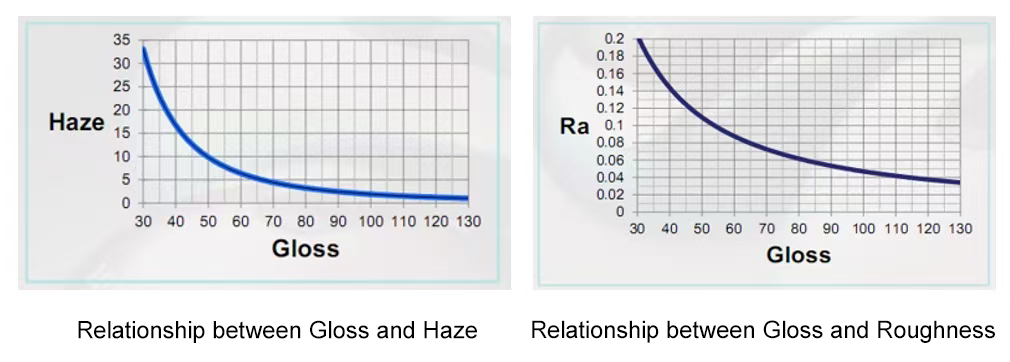
This refers to the physical quantity measuring the ability of the glass surface to reflect light, which corresponds to the brightness effect perceived by the human eye. The level of gloss is correlated with haze, anti-glare performance, and surface roughness (Ra).
① Relationship between Gloss, Haze, and Anti-Glare Performance:
● High Gloss: Results in lower haze and poorer anti-glare performance.
● Low Gloss: Results in higher haze and better anti-glare performance.
② Relationship between Gloss and Surface Roughness (Ra):
●High Ra Value: (Large起伏 in profile peaks and valleys) leads to lower gloss.
●Low Ra Value: (Small起伏 in profile peaks and valleys) leads to higher gloss.
For AG glass cover panels used in display products, there are different control requirements for gloss. Taking chemically-etched AG glass as an example, the specific gloss value requirements are as follows:
●Smartphones (High Clarity): Gloss is generally required to be between 120 ~ 140 GU. This range offers excellent sharpness and transparency but provides poor anti-glare performance.
●Tablets & Automotive Displays: Gloss is generally required to be between 100 ~ 120 GU. This range provides good sharpness and transparency with moderate anti-glare performance.
●Industrial Displays, Learning Machines & Eye-Protection Products: Gloss is generally required to be between 15 ~ 50 GU. This range achieves a relative balance between anti-glare performance and image clarity.
Currently, for educational products, the mainstream gloss control requirement is generally 18 ~ 25 GU.
4. AG Glass Sparkle (Flash Points)
Sparkle refers to an optical interference phenomenon that occurs when an AG glass cover panel is laminated with a display module.
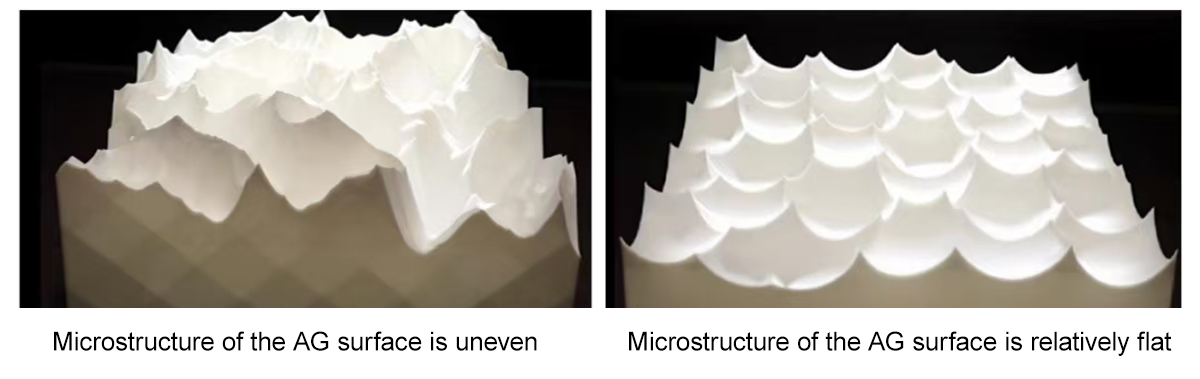
Mechanism of Sparkle Generation:When an AG glass cover panel is laminated with a high-resolution display module, if the parameters of the AG glass surface treatment process (e.g., chemical etching, spray coating) are not well controlled, the micro-structures on the glass surface will have excessively large height differences and uneven distribution. This causes optical interference between the micro-structures of the AG glass and the pixels of the high-resolution display module, ultimately resulting in a visual disturbance on the screen that appears as "graininess."
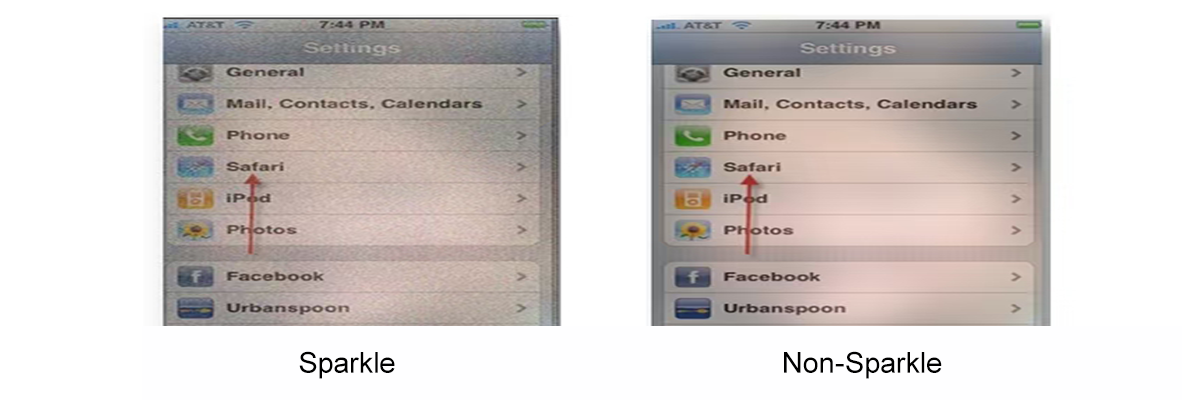
To resolve the sparkle issue that occurs when bonding AG glass cover panels to high-resolution display modules, the following approaches can be adopted:
① Optimize Process Parameters:Optimize the parameters during the AG surface treatment process to reduce the surface roughness (Ra and Rsm) of the AG glass. This results in smaller peak-to-valley height differences and a finer, denser surface texture, minimizing the interference with pixels.
② Adopt Advanced AG Processes:Utilize more advanced AG surface treatment technologies, such as "Photolithography AG" (or "Yellow Light AG"). This process fabricates micro-surface structures with smaller dimensions, high randomness, and uniform distribution. The core principle is to ensure that the size of the surface micro-structures is significantly smaller than the pixel size of the display module, thereby breaking the regularity that causes optical interference.
③Utilize Diffusion-type Optical Adhesives:Using "Diffusion-type OCA (Optically Clear Adhesive)" can also reduce the degree of sparkle or achieve a completely sparkle-free effect by scattering the light and blurring the interference pattern.