There are numerous optical performance indicators for TFT-LCD display modules. Common parameters include luminance, luminance uniformity, contrast ratio, saturation, and viewing angle. Less common parameters include luminance decay rate, contrast decay rate, color shift, chromaticity uniformity, and color accuracy. This article focuses on explaining these five less common indicators.
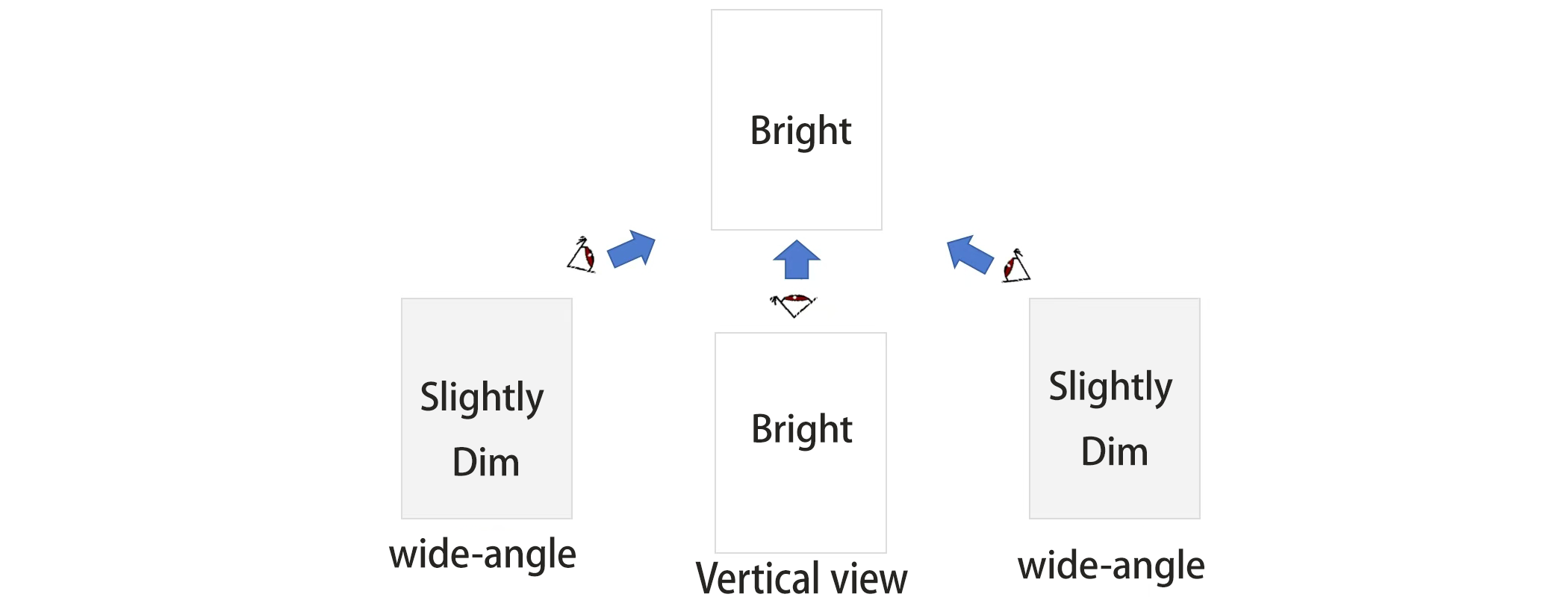
1.Luminance Decrease Ratio refers to the ratio of the white screen luminance at a specific viewing angle to the white screen luminance at the perpendicular (0°) viewing angle for an LCD module.

The Luminance Decrease Ratio directly determines the user experience when viewing the LCD module from the side. A high Luminance Decrease Ratio can cause the LCD module to appear 'washed out' or 'dim,' thereby degrading the visual experience.
In the automotive display sector, drivers and passengers often view the center console LCD module from significantly different angles. Therefore, ensuring that the LCD module delivers a good visual experience across all viewing angles is critical.
① Luminance Decrease Ratio Test Procedure:
●Environment Setup: The test must be conducted inside a darkroom, ensuring the ambient light is less than 1 lux.
●Thermal Stabilization: Power on the LCD module and switch the display to an L255 full-white pattern. Keep it running for more than 5 minutes to reach a thermally stable state (optical performance stabilized).
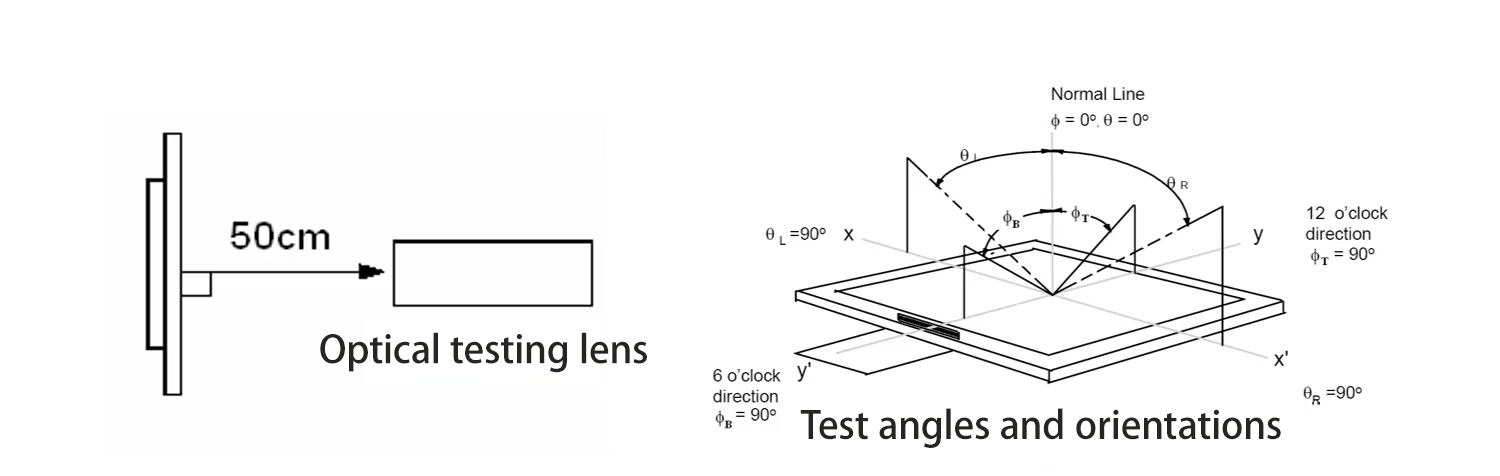
●Reference Measurement (0⁰): Position the test lens of the spot meter perpendicularly (90⁰) to the surface of the LCD module, allowing a deviation within 1⁰. Align the lens with the center of the module at a distance of 50cm, and record the luminance value of the L255 white pattern.
●Angular Measurement: Rotate the test platform sequentially upwards, downwards, left, and right. Adjust the angle so that the normal line of the LCD module's surface forms 30⁰, 45⁰, and 60⁰ angles with the test lens. Continue to record the luminance values of the L255 white pattern at these respective angles.
 ② Recommended Acceptance Criteria for Luminance Decrease Ratio:
A lower Luminance Decrease Ratio indicates clearer and brighter images over a wider viewing range, resulting in a broader viewing angle. Currently, the mainstream control standard recommends maintaining the Luminance Decrease Ratio at ≤70% for the four directions (up, down, left, and right) at a 30⁰ viewing angle.
Of course, the following two points should be noted:
●Angular Dependency: The larger the observation angle (the angle between the viewer and the normal direction of the LCD module surface), the higher the Luminance Decrease Ratio will be.
●Material Impact: Different material selections within the LCD module, such as the use of APF, DBEF, or high-brightness light-enhancing films, have a significant impact on the Luminance Decrease Ratio.
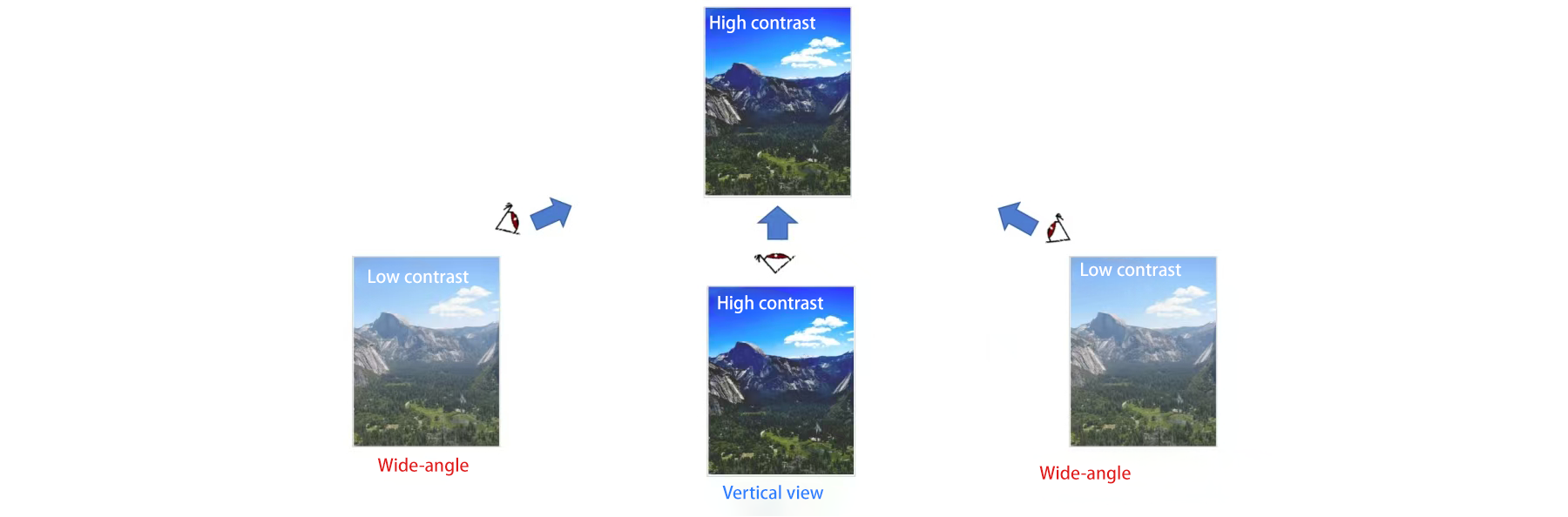
2. Contrast Decrease Ratio refers to the ratio of the contrast at a specific viewing angle to the contrast at the perpendicular (0°) viewing angle for an LCD module.
The higher the contrast of an LCD module, the clearer the image, the stronger the sense of depth, and the more vivid the colors. A greater contrast attenuation (or a higher Contrast Decrease Ratio) means that when viewing the module from the side, the image will appear "washed out" or "hazy/gray," causing the displayed details to suffer from severe distortion.
① Contrast Decrease Ratio Test Procedure:
●Environment Setup: The test must be conducted inside a darkroom, ensuring the ambient light is less than 1 lux.
●Thermal Stabilization: Power on the LCD module and switch the display to an L255 full-white pattern. Keep it running for more than 5 minutes to reach a thermally stable state (optical performance stabilized).
●Reference Measurement (0⁰): Position the test lens of the spot meter perpendicularly (90⁰) to the surface of the LCD module, allowing a deviation within 1⁰. Align the lens with the center of the module at a distance of 50cm. Measure the luminance values of both the L255 white pattern and the L0 black pattern, and then calculate the contrast ratio.
●Angular Measurement: Rotate the test platform sequentially upwards, downwards, left, and right. Adjust the angle so that the normal line of the LCD module's surface forms 30⁰, 45⁰, and 60⁰ angles with the test lens. Continue to measure the luminance values of the L255 white pattern and the L0 black pattern at these respective angles, and calculate the contrast ratio.
The contrast values measured at different viewing angles and directions are substituted into the aforementioned Contrast Decrease Ratio formula to calculate the Contrast Decrease Ratio at various observation angles and directions.
② Recommended Acceptance Criteria for Contrast Decrease Ratio:
Currently, the mainstream industry control standard for LCD modules recommends maintaining the Contrast Decrease Ratio at ≤70% for the four directions (up, down, left, and right) at a 30⁰ viewing angle.
Of course, the Contrast Decrease Ratio is not only related to the Luminance Decrease Ratio discussed above but is also significantly influenced by the selection of the LCD panel and polarizer. The core objective is to ensure that the "black state" of the LCD module remains "sufficiently black."
3. Color Shift is a metric used to evaluate whether an LCD module can display "true-to-life" visuals at wide viewing angles. It refers to the color difference observed at large viewing angles compared to the perpendicular (0°) viewing angle. In the industry, JNCD (Just Noticeable Color Difference) is generally used to characterize this color shift.
Imagine multiple people viewing the same LCD module from different angles; a significant color shift would cause each person to see different colors, thereby compromising the consistency of the visual experience. Even for a single viewer, if the module exhibits severe color shift, the display may appear "yellowish," "bluish," or "reddish" when viewed from the side. This inconsistency will negatively impact the user experience.
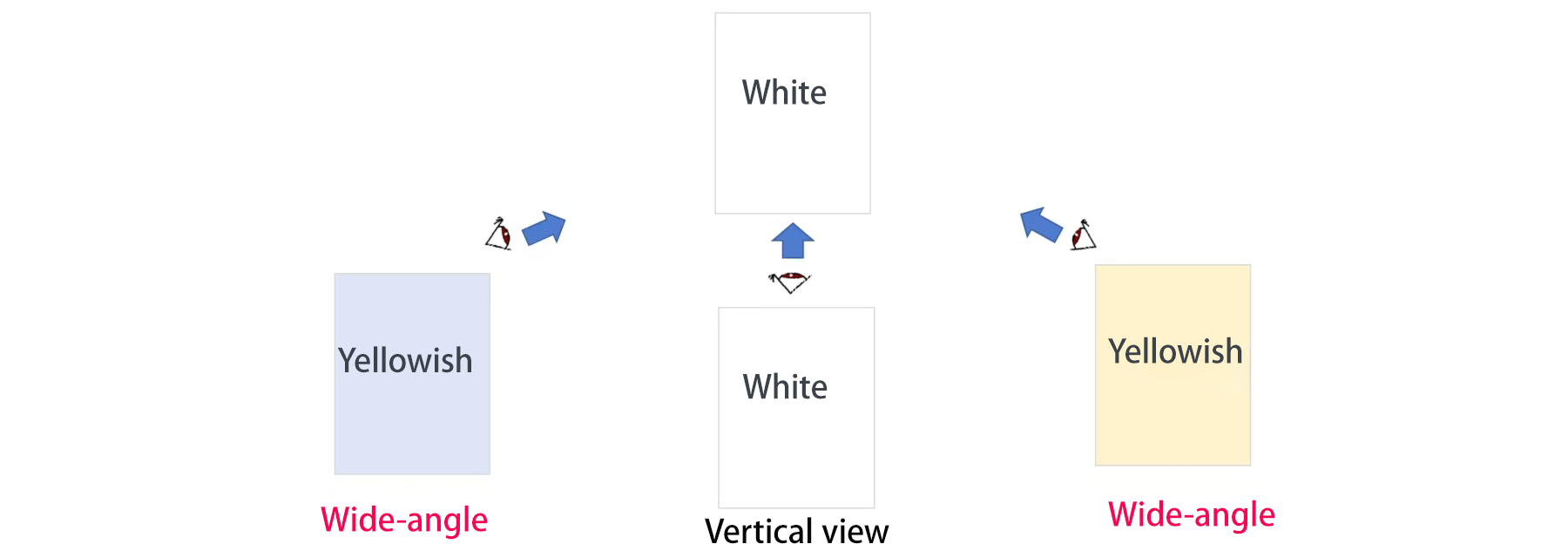
① Color Shift Test Procedure:
●Environment Setup: The test must be conducted inside a darkroom, ensuring the ambient light is less than 1 lux.
●Thermal Stabilization: Power on the LCD module and switch the display to an L255 full-white pattern. Keep it running for more than 5 minutes to reach a thermally stable state (optical performance stabilized).
●Reference Measurement (0⁰): Position the test lens of the spot meter perpendicularly (90⁰) to the surface of the LCD module, allowing a deviation within 1⁰. Align the lens with the center of the module at a distance of 50cm. Measure the white point chromaticity coordinates ( ′u′ , ′v′ ) of the L255 white pattern under the CIE 1976 standard, and record them as ′u1′ , ′v1′. ●Angular Measurement: Rotate the test platform sequentially upwards, downwards, left, and right. Adjust the angle so that the normal line of the LCD module's surface forms 30⁰, 45⁰, and 60⁰ angles with the test lens. Continue to measure the white point chromaticity coordinates ( ′u′ , ′v′ ) of the L255 white pattern under the CIE 1976 standard, and record them as ′u2′ , ′v2′ .
Substitute the measured u, v coordinate values at different viewing angles and azimuths into the aforementioned color shift calculation formula to compute the color shift under various observation angles and azimuths.
② Recommended Criteria for Color Shift:
The smaller the color shift of the LCD module (i.e., the lower the JNCD value), the smaller the color difference, and consequently, the better the color reproduction fidelity.
Currently, according to mainstream market testing standards:
●For the four directions (up, down, left, right) at a 30° viewing angle, the color shift is recommended to be controlled within ≤3 JNCD.
●For the four directions (up, down, left, right) at a 45° viewing angle, the color shift is recommended to be controlled within ≤4 JNCD.
Generally, the larger the viewing angle, the greater the corresponding color shift will be.
4. Color Uniformity
Color uniformity refers to the degree of consistency of color across different regions of an LCD module, as there is inevitably some color difference (chromatic aberration) between different positions. Color uniformity is generally characterized using JNCD.
① Color Uniformity Testing Procedure:
●Environment: The LCD module must be tested in a darkroom environment, ensuring that the ambient light is less than 1 lux.
●Stabilization: Power on the LCD module, switch the test pattern to a full-white (L255) screen, and let it run for more than 5 minutes to reach a thermally stable state (optical stability).
●Measurement Setup:
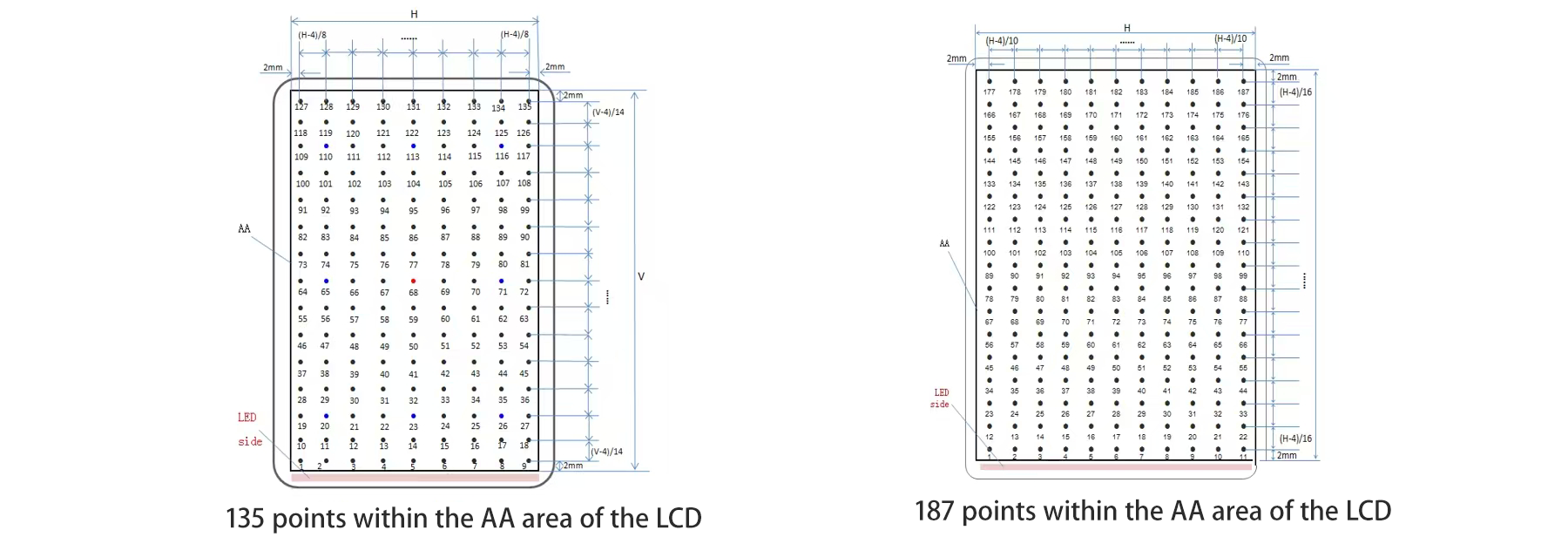
--Test Points: Generally, products ranging from 5 to 7 inches are set with 135 test points, while products larger than 7 inches are set with 187 test points.
--Equipment: Use either an area-measurement device or a spot-measurement device to test the overall surface performance of the LCD module.
Spot Size: The test aperture (spot) diameter is approximately 1.56 mm.
●Prior to testing, confirm that the optical axis of the test lens is aligned at a 0° angle with the normal direction of the LCD module plane (i.e., the test lens is perpendicular to the LCD module plane at 90°, with an allowable deviation of 1°). Maintain a distance of 50 cm between the test lens and the display module. Measure the white point chromaticity coordinates (u, v values) of all points across the entire LCD module under a full-white (L255) screen based on the CIE 1976 color space.
Substitute the u, v coordinate values of all test points within the LCD's Active Area (AA) into the aforementioned color uniformity calculation formula to compute the color difference between any two points and between any two adjacent points among all the test points.
② Recommended Control Criteria for Chromaticity Uniformity:
According to the current mainstream testing and control standards in the market:
●The color difference between any two points among all test points, denoted as ∆u'v'-A, is recommended to be controlled within ≤3.75 JNCD (≤0.015).
●The color difference between any two adjacent points among all test points, denoted as ∆u'v'-B, is recommended to be controlled within ≤1.5 JNCD (≤0.006).
5.Delta E is generally applied to fully-laminated LCD modules that have the "Monolithic Black" requirement. It is used to evaluate the chromaticity difference between the ink printing area of the CG cover glass and the LCD's Active Area (AA), which is commonly referred to as "color difference."
The smaller the color difference between the CG cover glass ink area and the LCD AA area, the better the Monolithic Black effect will be, and consequently, the lower the corresponding color accuracy value (Delta E) will be. Of course, the color difference mentioned here usually refers to color accuracy under a perpendicular (0°) viewing angle, which is different from the color shift discussed previously that occurs as the viewing angle changes.
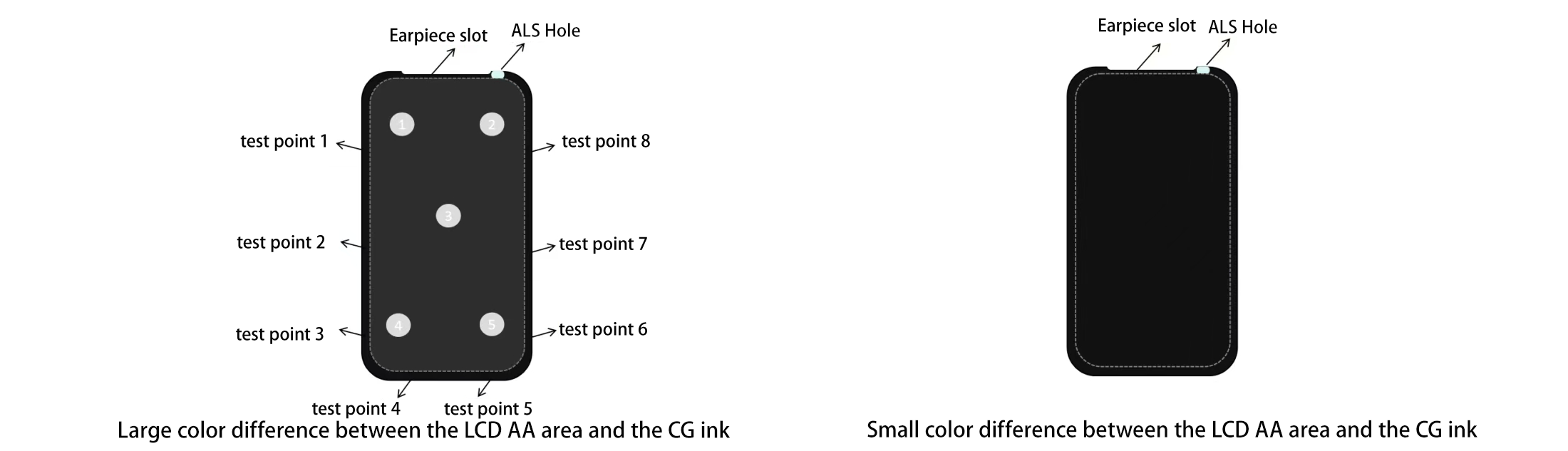
① Color Accuracy Testing Procedure:
Step 1 (Cover Glass Ink Area): Using a color difference meter, test the L, a, b values of the ink printing area on the CG cover glass of the LCD module. Test points are generally distributed evenly around the periphery of the CG ink area. Calculate the average L, a, b values of all test points and denote them as L1, a1, b1.
Step 2 (LCD Active Area): Continue to use the color difference meter to test the L, a, b values of the LCD module's Active Area (AA). Distribute test points evenly across the LCD AA, calculate the average L, a, b values of all test points, and denote them as L2, a2, b2.
② Recommended Control Criteria for Color Accuracy:
For fully bonded LCD liquid crystal display modules, the ΔE of conventional fully bonded LCD display modules should be ≤ 3-4; if there is a requirement for an integrated black effect, when ΔE < 2, the integrated black effect is good; when Δ ≤ 1, an excellent integrated black effect can be achieved.