
Time:2026-01-08 Browse: 1
Common surface treatment technologies for polarizers include HC (hard coating) scratch-resistant treatment, AR/LR anti-reflection treatment, and AG anti-glare treatment.
1. Polarizer HC Scratch-Resistant Treatment (Hard Coating), abbreviated as HC
HC scratch-resistant treatment is the most common and widely used among the three surface treatment technologies for polarizers. Its primary function is to improve the surface scratch resistance of the polarizer.
① Structure and characteristics of the HC scratch-resistant coating on polarizers
The HC scratch-resistant coating is located on the surface of the TAC layer.
If the upper polarizer has an HC coating, the HC layer is on the surface of the upper TAC layer.
If the lower polarizer has an HC coating, the HC layer is on the surface of the lower TAC layer.
The HC scratch-resistant coating is generally formed using a roller transfer coating process. A layer of HC coating is applied to the surface of the TAC layer of the polarizer. Specifically, the TAC roll material passes through a roller transfer process together with the HC coating solution, allowing the HC solution to be evenly coated on the TAC surface, thereby providing the polarizer with scratch-resistant performance.
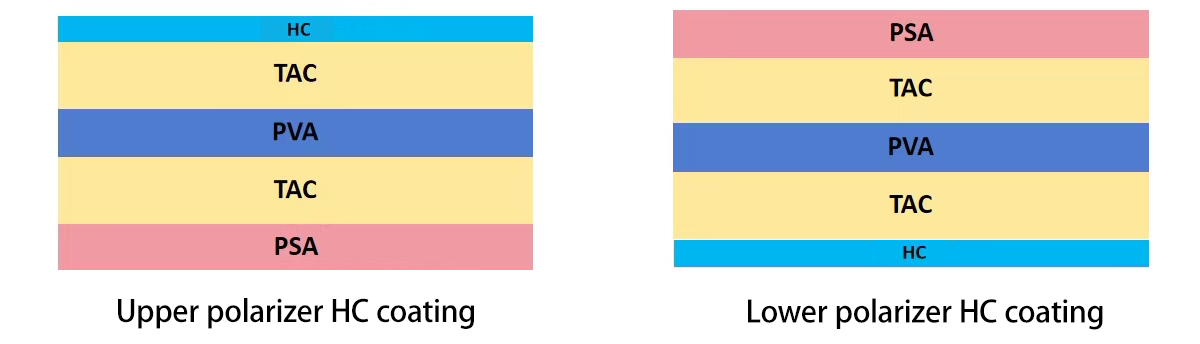
The thickness of the HC coating is approximately 3–5 μm, which has a relatively small impact on the overall thickness of the polarizer. Meanwhile, polarizers with an HC coating typically achieve a surface pencil hardness of about 2H–3H, whereas ordinary polarizers without an HC coating generally have a surface pencil hardness of only around 1H.

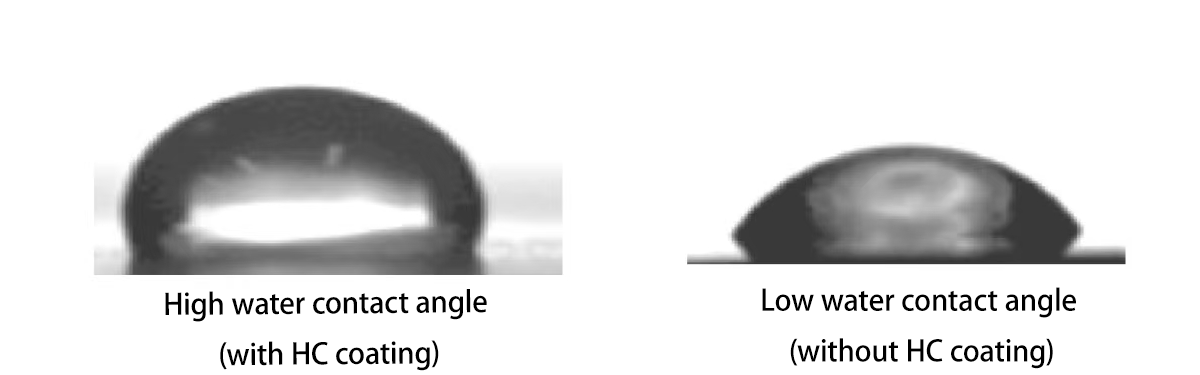
Applying an HC coating to the surface of a polarizer can increase surface hardness and thus improve scratch resistance. However, it should be noted that polarizers with an HC coating typically have a water contact angle of about 60–90°, whereas polarizers without an HC coating have a water contact angle of only around 40°.
The larger the water contact angle on the polarizer surface, the poorer its adhesion performance, and the higher the risk of peeling between the polarizer and the bonded material.
② Selection principles for HC scratch-resistant polarizers
Medium-size LCD display modules (such as monitors and automotive instrument panels) without lamination:
It is recommended to use an upper polarizer with an HC scratch-resistant coating.
Small- and medium-size fully laminated LCD display modules (such as smartphones and tablets):
It is recommended to use an upper polarizer with an HC scratch-resistant coating to reduce the risk of scratching the upper polarizer surface when cleaning OCA optical adhesive during rework.
Small- and medium-size LCD display modules (lower polarizer):
It is generally not recommended to use a lower polarizer with an HC scratch-resistant coating. This helps reduce the risk of peeling and light leakage between the backlight shading adhesive and the lower polarizer, especially in narrow-bezel designs.
2. Polarizer AG Anti-Glare Treatment (Anti Glare), abbreviated as AG
The primary purpose of AG treatment is to prevent excessive light concentration. By processing the surface of the TAC layer of the polarizer into a micro-rough (textured) structure, light is evenly scattered, thereby achieving an anti-glare effect. Its function is similar to the AG treatment applied to the surface of CG cover glass.
① Structure and characteristics of the AG anti-glare coating on polarizers
AG anti-glare treatment is also applied to the surface of the TAC layer.
If the upper polarizer has an AG coating, the AG layer is located on the surface of the upper TAC layer.
If the lower polarizer has an AG coating, the AG layer is located on the surface of the lower TAC layer.
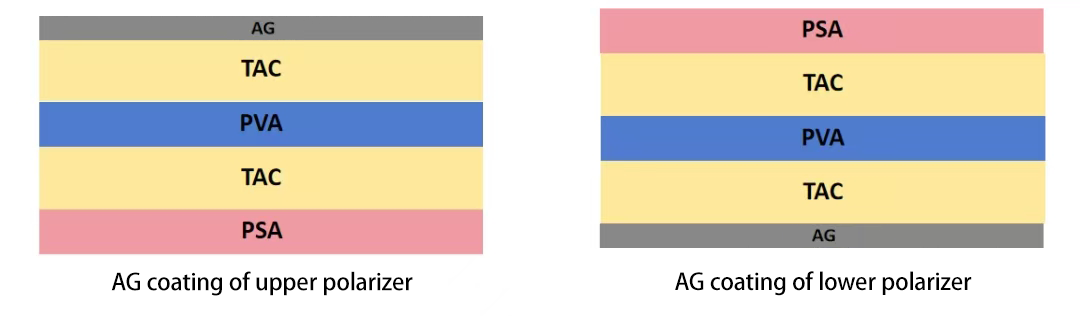
AG anti-glare treatment for polarizers is generally performed by transferring AG coating solution onto roll-form TAC material using a roller coating process, allowing the AG solution to be evenly applied to the surface of the TAC material. This process forms a micro-uneven structure on the TAC surface, causing differences in light refraction and reflection angles, which scatters the light and ultimately achieves an anti-glare effect. The thickness of the AG anti-glare coating is typically about 3–5 μm.
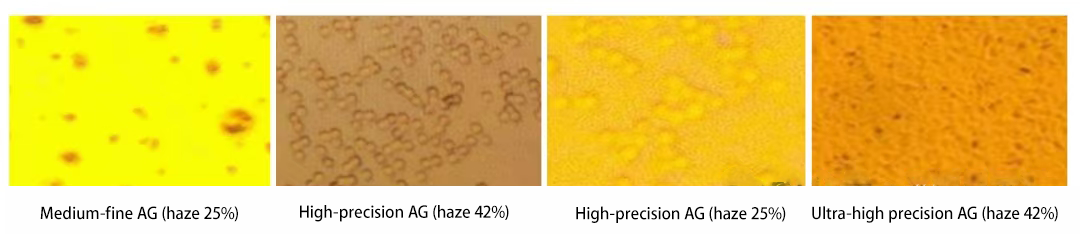
According to the degree of AG anti-glare treatment, polarizers are usually classified into clear (glossy) polarizers and matte polarizers. Among them, matte polarizers can be further divided into coarse matte and fine matte types based on the roughness of the AG treatment. The mainstream haze levels are typically 25% and 42%.
② Selection principles for AG anti-glare polarizers
When the LCD display module is in a single-module state or uses frame bonding:
The upper polarizer is usually selected with an AG anti-glare coating.
For single-module configurations, a matte polarizer is used, which not only provides an anti-glare effect but also helps resist fingerprints and contamination.
For frame-bonded projects, AG treatment helps prevent adhesion between the upper polarizer and the touch panel (TP).
When the LCD display module requires full OCA lamination:
The upper polarizer should avoid AG anti-glare coatings, as they may affect the clarity of fully laminated products. If AG must be used, a fine-matte upper polarizer is recommended.
For the lower polarizer:
It is generally recommended to select a lower polarizer with AG anti-glare coating, which can reduce the risk of adhesion between the lower polarizer and the upper brightness enhancement film, and to some extent help avoid the formation of Newton rings.
Of course, in order to control costs, the lower polarizer can also be selected without AG anti-glare coating, i.e., a standard polarizer.
3. Polarizer AR/LR Anti-Reflection Treatment (Anti Reflection), abbreviated as AR
A treatment with a function similar to AR is LR (Low Reflection) treatment. The principles and functions of AR and LR are similar; however, AR treatment has a higher cost and provides better reflection reduction performance.
① Structure and characteristics of AR/LR anti-reflection coatings on polarizers
When the polarizer surface does not undergo AR/LR treatment, approximately 5%–6% of incident light is lost due to surface reflection. Light loss and external reflected light will reduce the contrast and readability of LCD display modules.
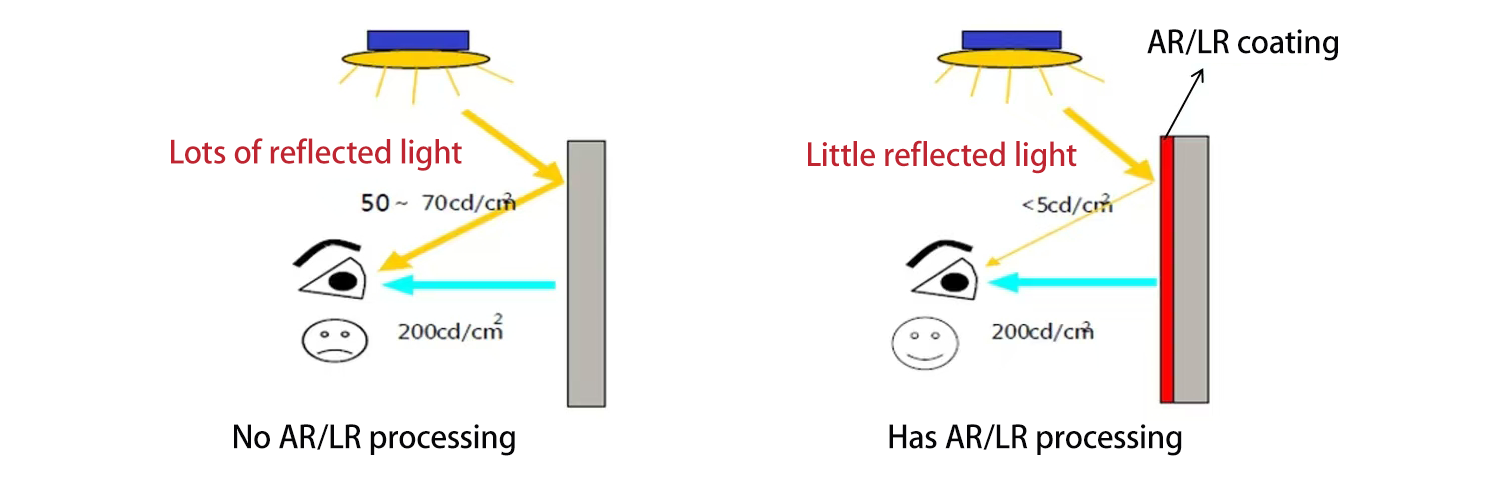
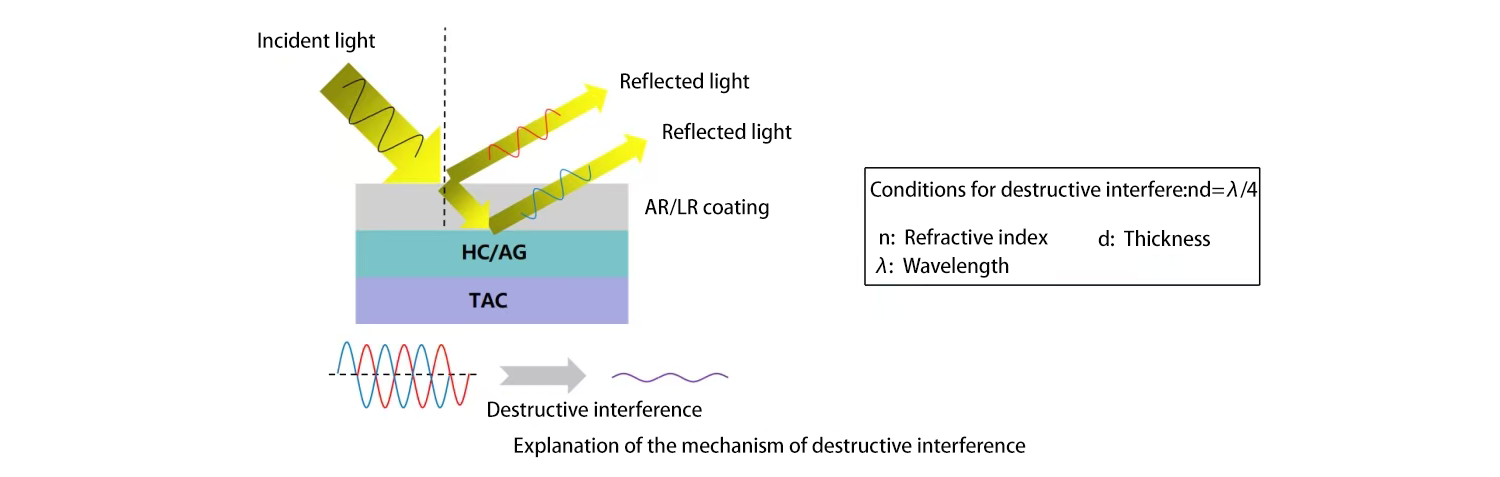
To address this issue, the current mainstream solution is to use a roller coating process to apply one or multiple layers of coatings with specific refractive indices onto the surface of the polarizer. The total coating thickness is approximately 5 μm. By utilizing the phase difference between the light reflected from the upper and lower interfaces of the coating, destructive interference occurs, thereby suppressing light reflection and reducing the reflectance.
After LR (low-reflection) treatment, the surface reflectance of the polarizer can be reduced to below 1%.
With AR (anti-reflection) treatment, the surface reflectance can be further reduced to approximately 0.3–0.5%.
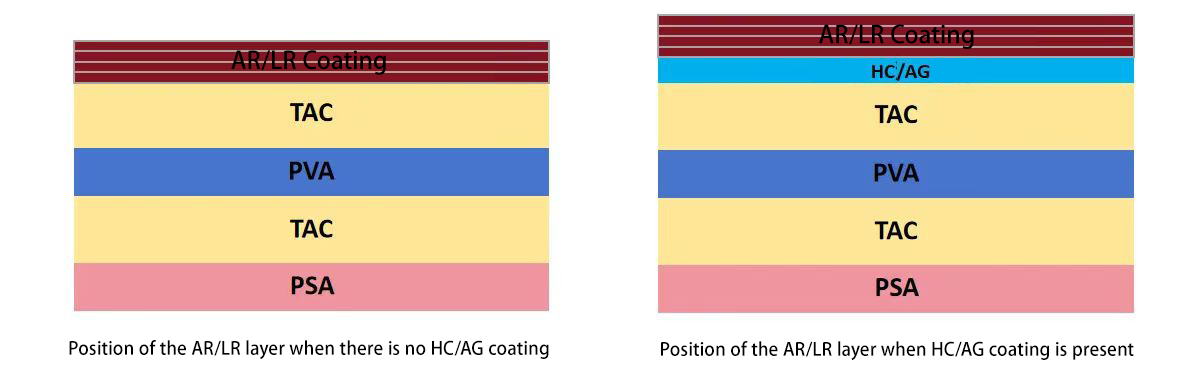
It should be noted that when the polarizer surface does not have an HC scratch-resistant coating or an AG anti-glare coating, the AR/LR anti-reflection coating is applied directly on the surface of the TAC layer.
However, when the polarizer surface has an HC or AG coating, the AR/LR anti-reflection coating is applied on top of the HC/AG coating.
② Selection principles for AR/LR anti-reflection–coated polarizers
Compared with polarizers that have HC scratch-resistant or AG anti-glare coatings, polarizers with AR/LR anti-reflection coatings are used relatively less frequently.
Polarizers with AR/LR anti-reflection coatings are mainly used as upper polarizers, and are primarily applied in medium- to large-size single LCD display modules.