
Time:2025-07-24 Browse: 1
Structure of LCD--The core components of an LCD include the backlight unit, lower polarizer, liquid crystal glass, and upper polarizer.
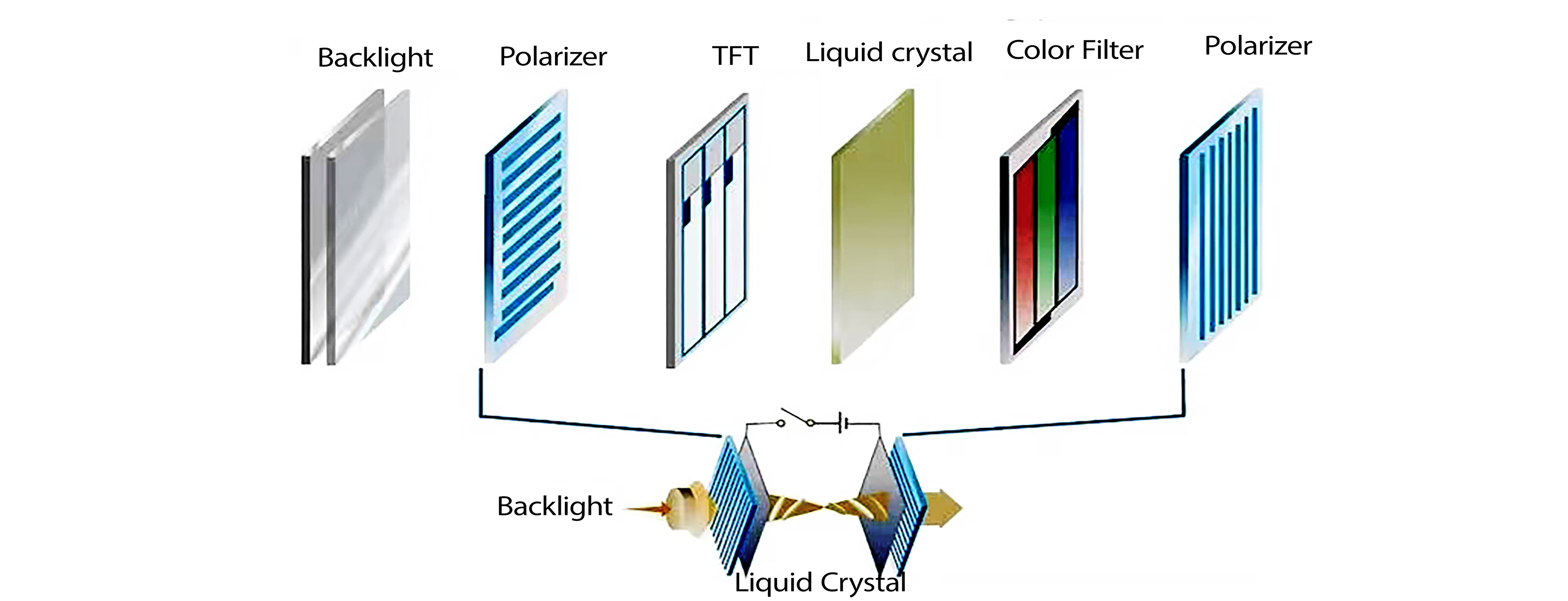
●Backlight Unit (BLU): Composed of LED strips, light guide plate, optical films, and a reflective sheet. Its main function is to provide uniform light source.
●Lower Polarizer: Converts the natural light from the backlight into linearly polarized light, allowing only light waves aligned with its transmission axis to pass through.
●Liquid Crystal Glass Layer: Made of two glass substrates (upper and lower) sealed together with liquid crystal material injected in between. The inner surfaces are typically coated with ITO (Indium Tin Oxide), a transparent conductive layer serving as electrodes. By applying an electric field, the alignment of liquid crystal molecules is controlled to regulate light transmittance, enabling image display.
●Upper Polarizer: Allows only light polarized perpendicular to the lower polarizer to pass through, ultimately producing the displayed image.
Display Principle of LCD--LCD screen itself only filters light and does not emit light. The essence of LCD display is a journey of light. LED light passes through the light guide plate, which redirects the parallel light into vertical light. The lower polarizer then converts the light into linearly polarized light in a specific direction, which is projected onto the liquid crystal glass. The rotation angle of the liquid crystal molecules determines whether the light can pass through the upper polarizer, thus creating differences in light transmittance. Since liquid crystals themselves have no color, color filters are used to produce different colors. A single pixel consists of three basic RGB subpixels, which together form the desired full-color image.
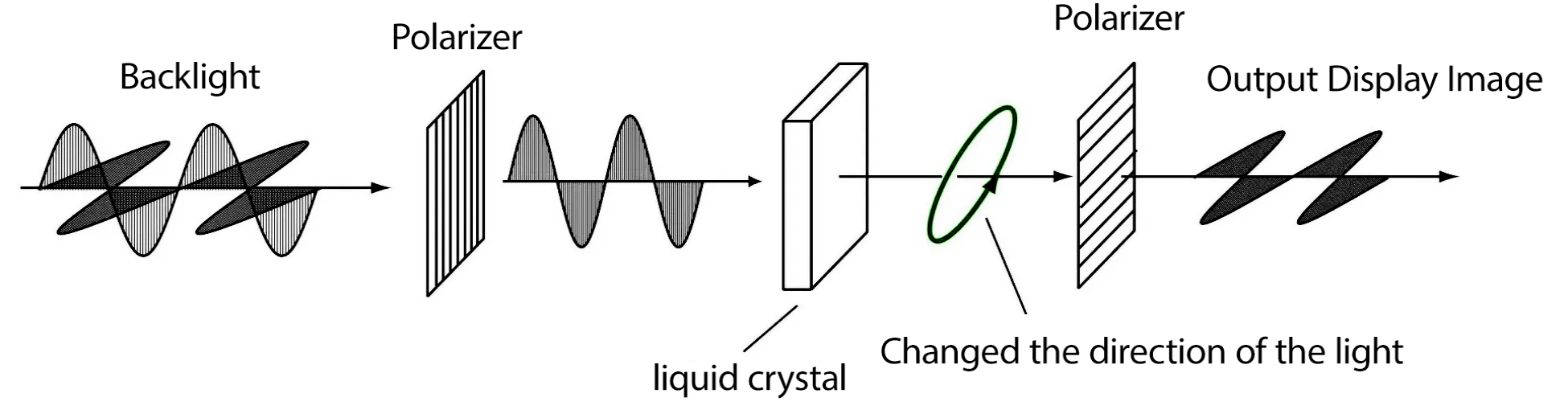
Natural light emitted by an LED light source has multiple vibration directions. After passing through a polarizing film, it becomes light vibrating in a single direction. If the light wave is perpendicular to the polarization direction of the polarizer, it will be completely blocked, resulting in the weakest light. If the light is parallel to the polarization direction, it passes through with the strongest intensity. Of course, if the angle is neither perpendicular nor parallel, the intensity of the transmitted light depends on the angle between the light’s vibration direction and the polarizer’s axis — the smaller the angle, the greater the intensity of the transmitted light.
The liquid crystal alters the polarization direction of light passing through the glass layer, allowing it to pass through the upper polarizer. This enables the viewer to see light of varying brightness on the screen. Combined with color filters, different colors are produced, resulting in the display of various images.