
Time:2025-08-11 Browse: 1
OCA optical adhesives used in full-lamination display modules are often limited by application areas and varying functional requirements, causing most people to only encounter the "tip of the iceberg" of OCA optical adhesives.
In fact, OCA optical adhesives can be classified into many different types—based on material composition, functional properties, application scenarios, and curing methods—though there may be some overlap among these categories.
● OCA optical adhesives can be classified by material type into: polyurethane-based OCA, rubber-based OCA, acrylic resin-based OCA, and silicone-based OCA. Currently, acrylic resin-based OCA and silicone-based OCA are the mainstream types in use.
● OCA optical adhesives can be classified by functional properties into: dyed OCA (colored OCA), UV-CUT OCA, high refractive index OCA, and high & low dielectric constant OCA, etc.
● OCA optical adhesives can be classified by application scenarios into: waterdrop screen OCA, blind hole screen OCA, PC & PMMA bonding OCA, flexible & foldable OCA, automotive display OCA, outdoor display OCA, etc.
● OCA optical adhesives can be classified by curing method into: UV-curable OCA, non-UV curable OCA (self-curing OCA), thermally curable OCA, and moisture-curable OCA, etc.
This article mainly discusses the differences between UV OCA and non-UV OCA in full-lamination display modules:
1.UV OCA is cured through exposure to UV light.
UV-type OCA typically requires two UV curing processes. The first curing is performed at the OCA manufacturer's end, where UV light is applied to cure the adhesive immediately after the OCA coating is applied. The second curing is carried out at the laminating facility, where UV light is used to cure the OCA after the optical adhesive has been bonded and de-bubbling is completed.
Generally, the raw materials of OCA optical adhesive are composed of liquid prepolymers, resin monomers, various additives, and photoinitiators, which are mixed and stirred together. The OCA adhesive is then coated onto a PET base film and subjected to UV light for the first curing process. The principle is as follows:
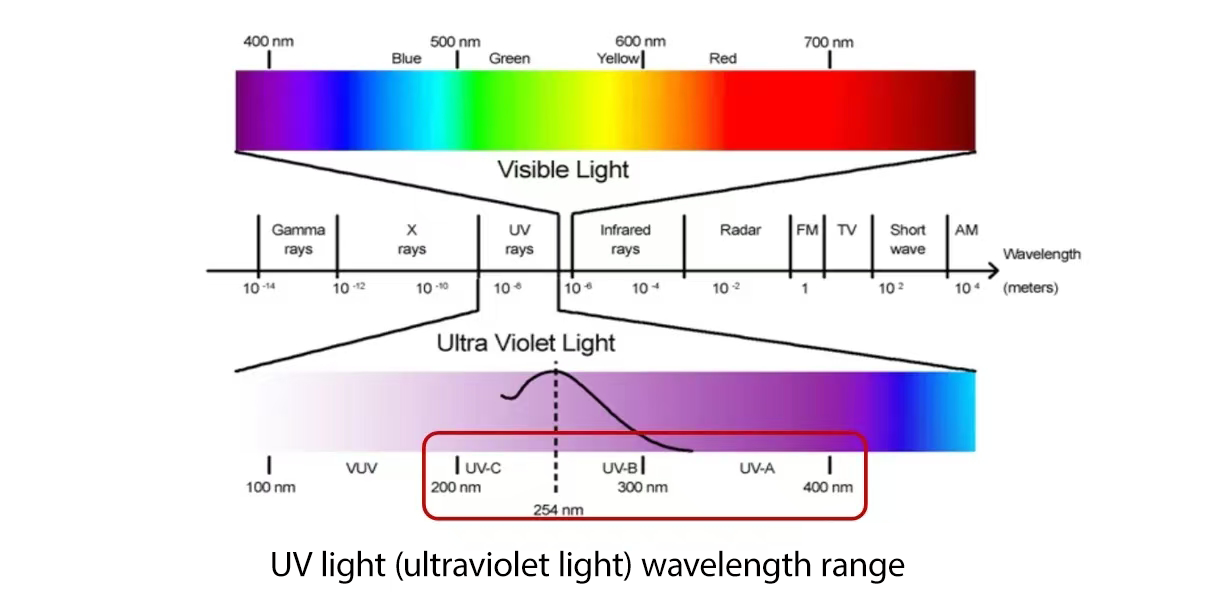 ---When the OCA optical adhesive is exposed to UV light (ultraviolet light) of appropriate wavelength and intensity, the photoinitiator in the OCA decomposes to generate free radicals (the photoinitiator breaks down into free radicals upon exposure to UV light in the 200–400 nm wavelength range). These free radicals initiate a rapid addition polymerization reaction of the unsaturated groups present in the prepolymers and resin monomers.
---Due to the presence of multifunctional monomers and prepolymers in the OCA adhesive, as well as the chemical characteristics of free radical reactions (rapid addition polymerization), the adhesive coating quickly transforms into an insoluble cross-linked network structure.
After the OCA optical adhesive completes the first curing process and subsequent manufacturing steps, the manufacturer can deliver the cut-sheet OCA optical adhesive to customers for display module lamination, de-bubbling, and related processes at the laminating facility.
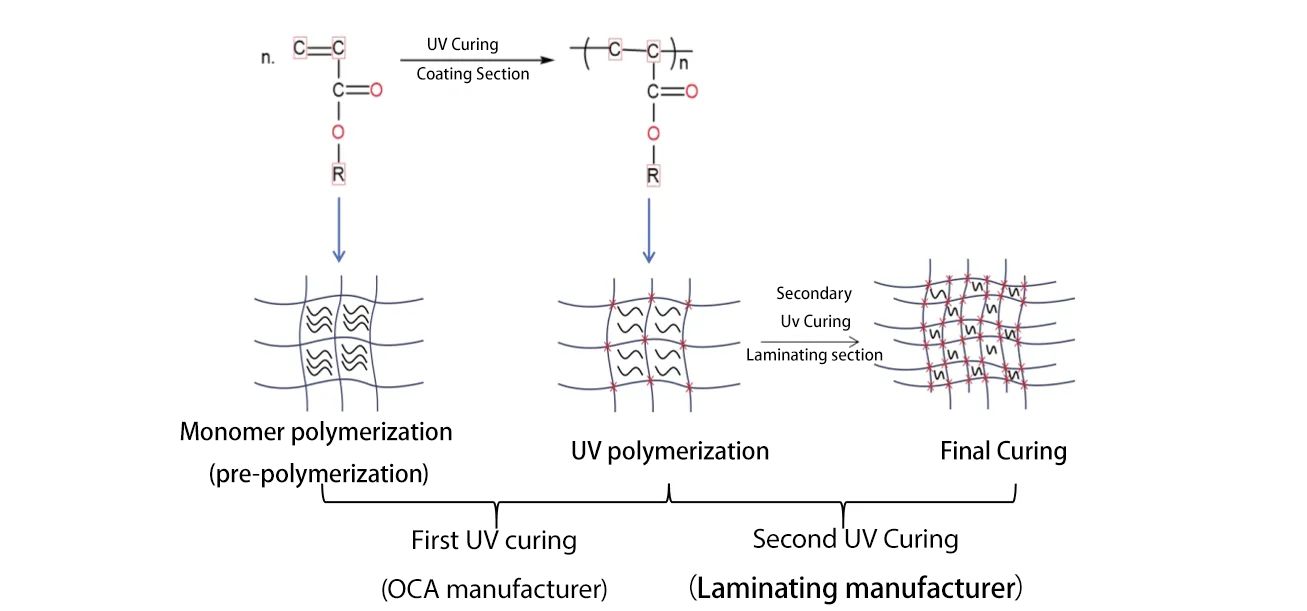 After the first UV curing, a certain amount of photoinitiator still remains in the OCA optical adhesive, and there are also some substances present in a small molecular state. Therefore, a second UV irradiation curing is required for the fully laminated display module to further tighten the spatial network structure of the OCA optical adhesive, thereby enhancing its bonding performance.
2.Non-UV OCA refers to OCA optical adhesive that is fully cured by the OCA manufacturer before (leaving the factory), in a single curing step. This process completely consumes the photoinitiators within the adhesive and allows small-molecule substances to fully cross-link. As a result, no secondary UV curing is required at the laminating facility. We refer to this type of OCA optical adhesive as "non-UV OCA," also known as self-curing OCA.
So, what specific application scenarios can non-UV OCA optical adhesive meet that UV OCA cannot? I have summarized four such applications, as follows:
● EPD modules with PC/PMMA front light:
In EPD (electronic paper display) modules, since EPD uses reflective display technology, it performs well in daylight by reflecting ambient light. However, in darker environments or at night, a front-light guide plate (LGP) must be laminated above the EPD display module to provide illumination, thereby meeting the requirements for use in low-light conditions.
In front-lit EPD display modules, the light guide plate (LGP) is typically made of PMMA or PC. When exposed to UV light, PMMA or PC materials may turn yellow and release gases.
Therefore, to avoid this risk, OCA used in EPD display modules is typically required to be "non-UV," and the OCA must also be compatible with bonding to PMMA/PC materials.
● Display modules for outdoor direct sunlight exposure: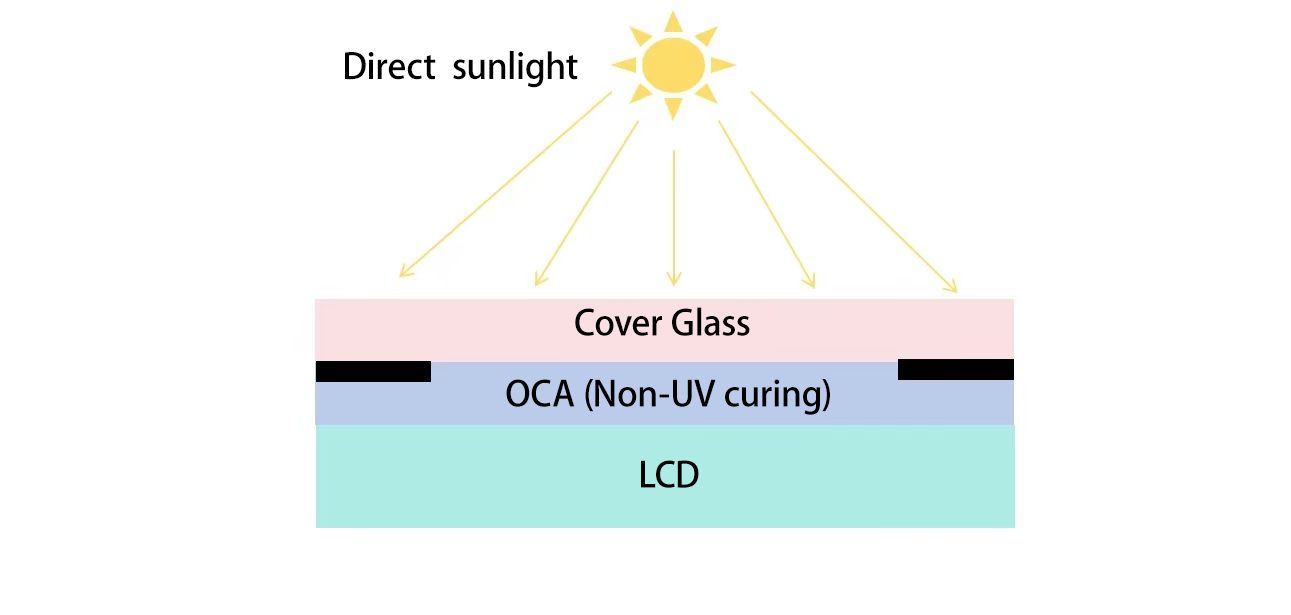 The ultraviolet (UV) radiation in outdoor sunlight is typically intense. When fully laminated display modules are used outdoors for extended periods, many materials may degrade under continuous UV exposure, affecting the normal operation of the display. To extend the service life of fully laminated display modules in outdoor applications, materials must be carefully selected to meet UV resistance requirements.
Generally, for OCA optical adhesives used in outdoor fully laminated display modules, it is recommended to use "non-UV type." Non-UV type OCA contains little to no photoinitiators, thus significantly reducing the risk of yellowing under prolonged UV exposure.
● Display modules with UV-blocking capability:
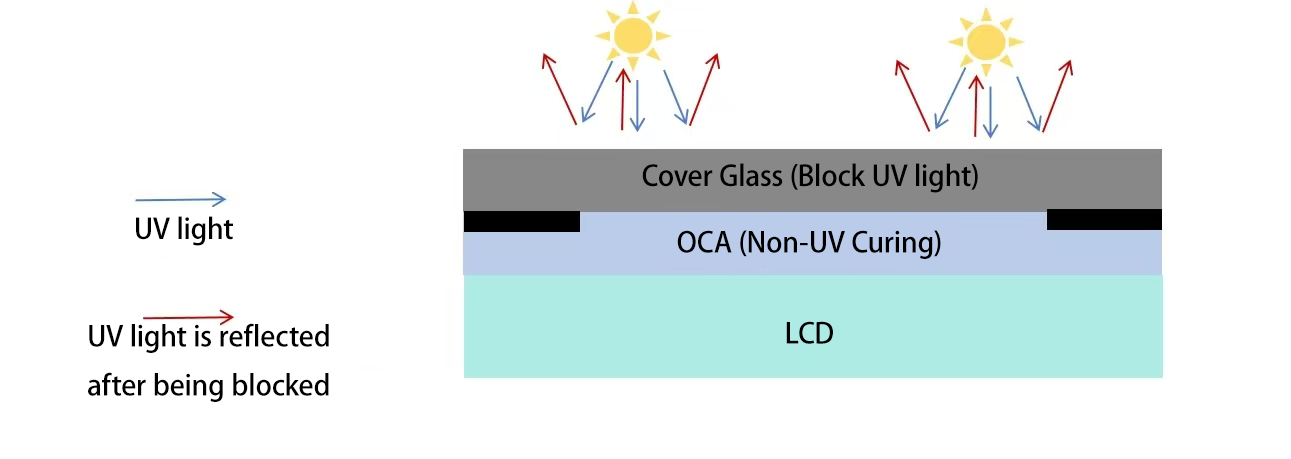 In special application scenarios, such as outdoor billboards, medical equipment emitting strong ultraviolet radiation, or aerospace equipment, the protective cover lens in a fully laminated display module may need to have UV-blocking capability. In such cases, "non-UV" OCA optical adhesive is typically used to avoid the issue of insufficient curing that can occur with UV OCA when UV light cannot penetrate to initiate the curing process.
● Display modules with curved or irregular (non-rectangular) structures:
When the structure of a fully laminated display module is complex, such as curved or irregular (non-standard) shapes, UV curing equipment may be limited in illumination range, making it difficult to ensure uniform and complete curing of UV OCA. In such cases, "non-UV" OCA optical adhesive can be selected.
3. Performance Differences Between UV OCA and Non-UV OCA.
In addition to differences in the number of curing steps, UV OCA and non-UV OCA also differ in lamination processes, step-height filling capability, and mechanical performance under high-temperature conditions.
● Lamination Process: UV OCA manufacturers perform only one UV curing step before shipment, whereas non-UV OCA manufacturers complete two curing steps prior to delivery. Therefore, the usage processes for UV and non-UV OCA at the downstream laminating facilities are different.
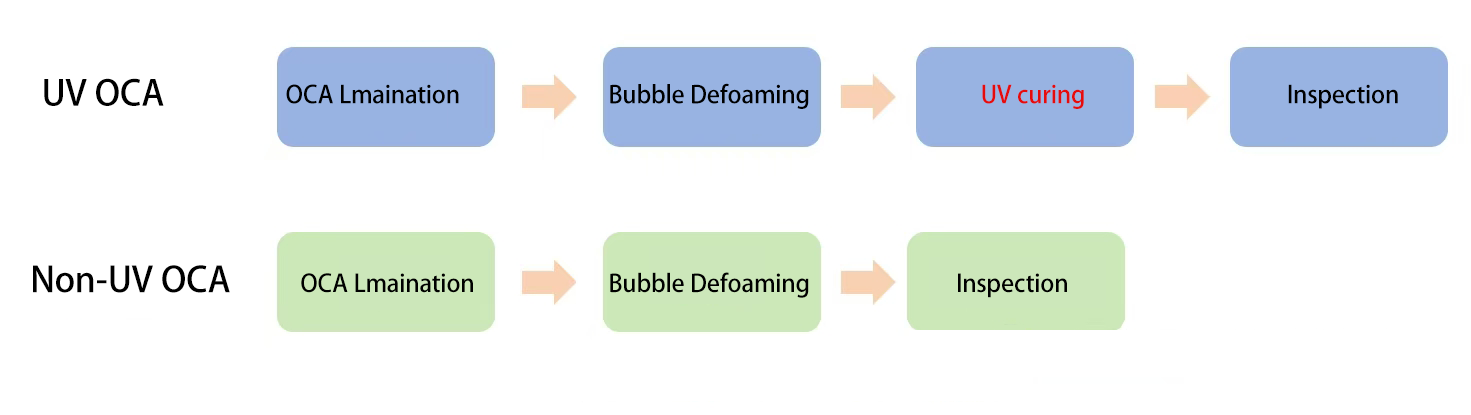
● Step-height filling capability:
---UV OCA undergoes only one UV curing process before shipment, with a curing rate of approximately 45% to 55%. Due to its lower curing rate, UV OCA has relatively lower hardness, resulting in better flowability and filling capability, as well as superior Mura absorption compared to non-UV OCA.
---Non-UV OCA undergoes a secondary curing process before shipment, achieving a curing rate of approximately 65% to 70%. Due to the higher curing rate, non-UV OCA has relatively higher hardness, resulting in slightly poorer flowability and filling capability, as well as reduced Mura absorption compared to UV OCA.
Generally, under the same OCA thickness, the step-height filling capability of UV OCA is approximately 30%–35% of its own thickness, while that of non-UV OCA is about 10%–15% of its thickness. To improve the step-height filling capability of non-UV OCA, a thicker OCA layer is typically selected.
● Mechanical performance under high temperature:
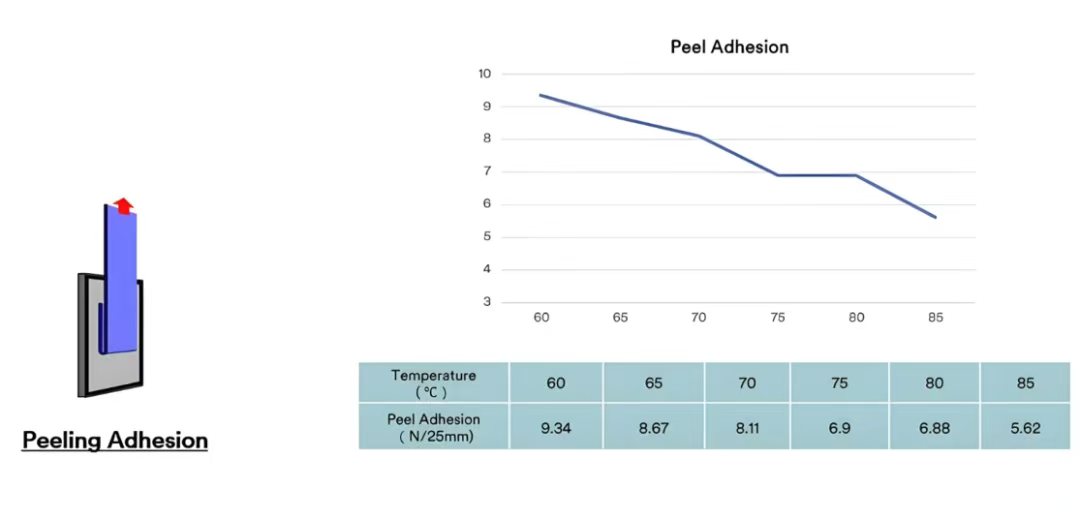 Compared to UV-type OCA, non-UV-type OCA offers little advantage in terms of mechanical performance. When simply comparing OCA peel strength, non-UV-type OCA exhibits low values both at room temperature and under high temperature. Therefore, when using non-UV-type OCA, special attention must be paid to bubble rebound issues after high-temperature testing.
The above are shared insights—any different opinions are welcome and can be discussed at any time.