Time:2025-08-18 Browse: 1
First, share the differences among IPS, TN, and VA panel types, and through computer monitor applications, introduce the working principles and characteristics of two of these panel technologies.
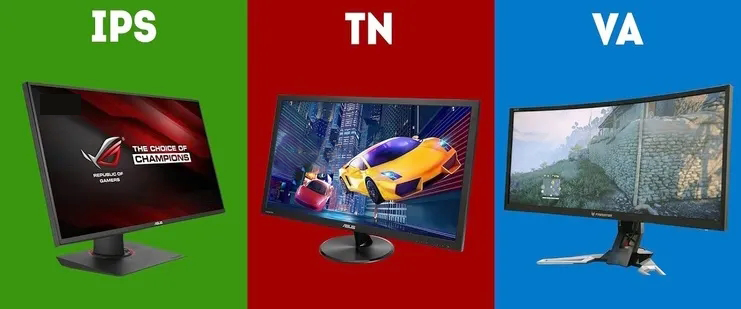
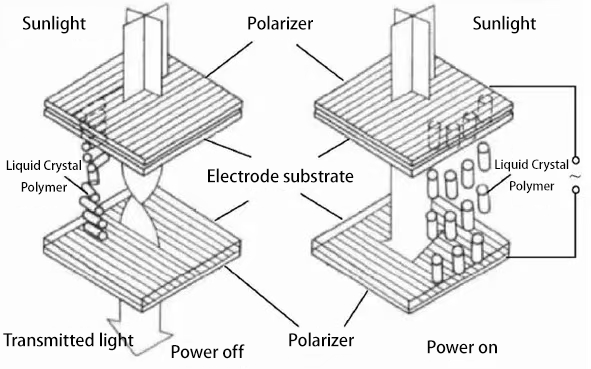
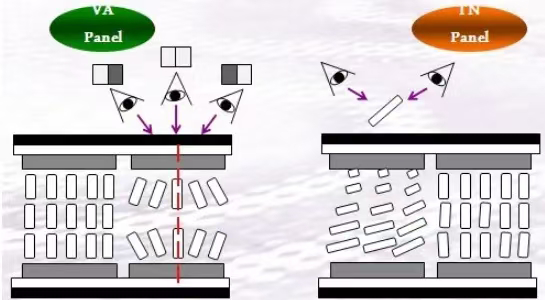 Currently, TN panel technology has been widely adopted and is relatively inexpensive. As we know, all light emitted from an LCD is polarized, so the displayed image appears differently when viewed from various angles. This characteristic is known as the display's viewing angle.
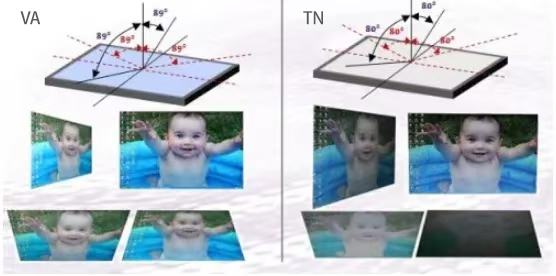
In addition, TN panels typically have a contrast ratio of only 1000:1 and native color depth of just 6 bits, resulting in a washed-out appearance when displaying pure black and generally mediocre color performance. However, TN panels have one significant advantage: their response time is around 1ms, enabling very fast refresh rates. In comparison, IPS screens are more prone to screen tearing. Screen tearing occurs when a display shows parts of two or more frames in a single screen, causing a visual split or discontinuity due to a mismatch between the frame rate of the content and the display's refresh rate. With sufficiently high refresh rates, TN panel displays can achieve response times as low as 1ms. Currently, most high-refresh-rate monitors on the market use TN panels.
Advantages of TN panels: low cost, low power consumption at the same brightness level, fast response speed, and support for high refresh rates.
Disadvantages of TN panels: narrow viewing angles, obvious color distortion and tendency to appear washed out, and poor color and contrast performance.
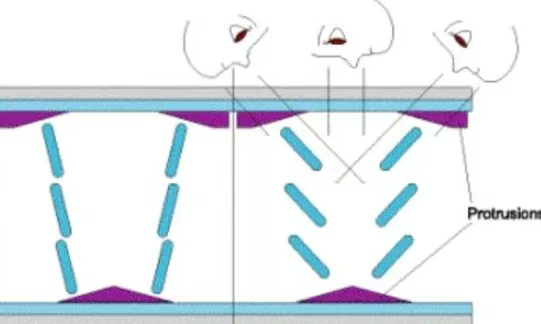 VA panels were developed to improve upon the narrow viewing angles and low contrast of TN panels. Since the liquid crystal molecules are not completely vertically aligned in the static state, applying a voltage can reorient the molecules to a more horizontal alignment. This allows light to pass through the layers and reach the human eye, thereby increasing the viewing angles of VA panels to over 160º.
In addition to wider viewing angles, VA panels have also made further improvements in image quality. Native color depth reaches 8-bit, and even up to 10-bit, while contrast ratio has been enhanced to 3000:1, resulting in purer solid colors and stronger visual depth. Additionally, VA panels are often associated with screen curvature—the smaller the curvature, the better the experience, although there are physical limits (the current mainstream curvature is 1800R). The biggest drawback, however, is their relatively slow response time, typically around 6ms under normal conditions and can be improved to about 4–5ms at best, which is significantly slower compared to the 1ms response time of TN panels.
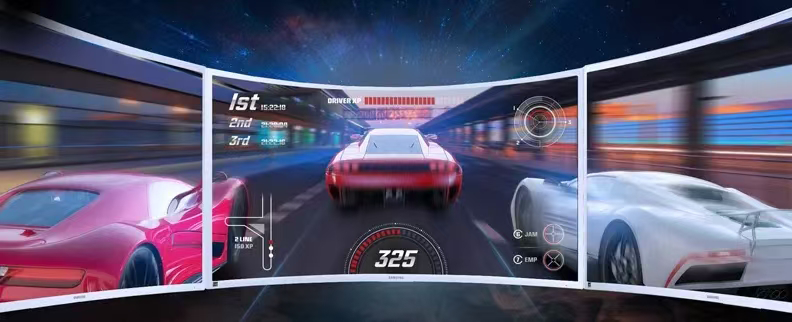
Advantages of VA panels: high contrast, strong image depth, wide viewing angles, and broad color gamut.
Disadvantages of VA panels: slow response speed, prone to motion blur or screen tearing, and higher cost and power consumption.
IPS panels are products of In-Plane Switching (lateral electric field effect) display technology, and thus IPS is also known as SuperTFT. Like VA panels, IPS was developed to address the issue of narrow viewing angles, but it employs a different approach.
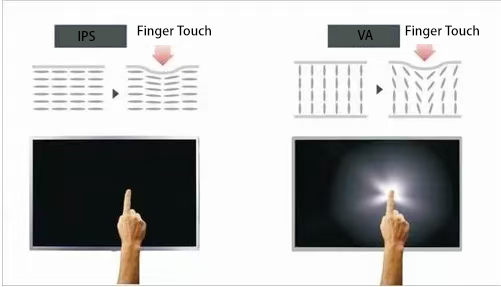
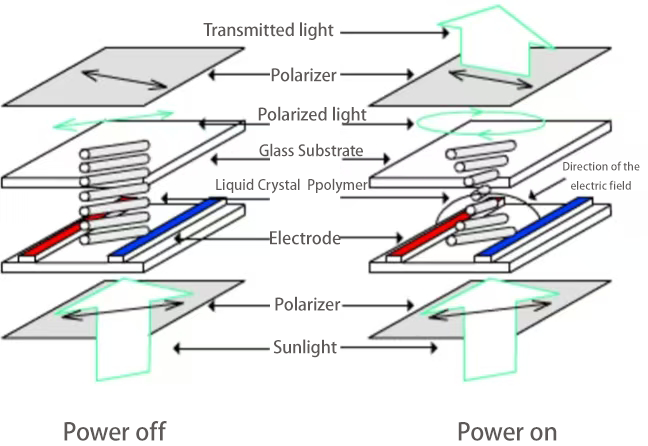 The key feature of IPS panels is that the electrodes are placed on the same plane (whereas in VA and TN panels, the electrodes are arranged vertically on the top and bottom substrates). This technology aligns the liquid crystal molecules in a horizontal orientation. When external pressure is applied, the molecular structure slightly shifts downward but remains largely horizontal. This structure is why IPS panels are commonly referred to as "hard screens," as they offer superior protection for image quality, making them less prone to image distortion and color degradation.
Thanks to the advantages of the hard screen design, the liquid crystal molecules in IPS panels are more finely distributed, resulting in more accurate color reproduction. Native color depth can reach 8-bit and even 10-bit, comparable to VA panels, enabling more realistic and vivid image rendering. Additionally, IPS panels offer viewing angles of up to 178°, ensuring consistent image quality no matter the viewing angle.
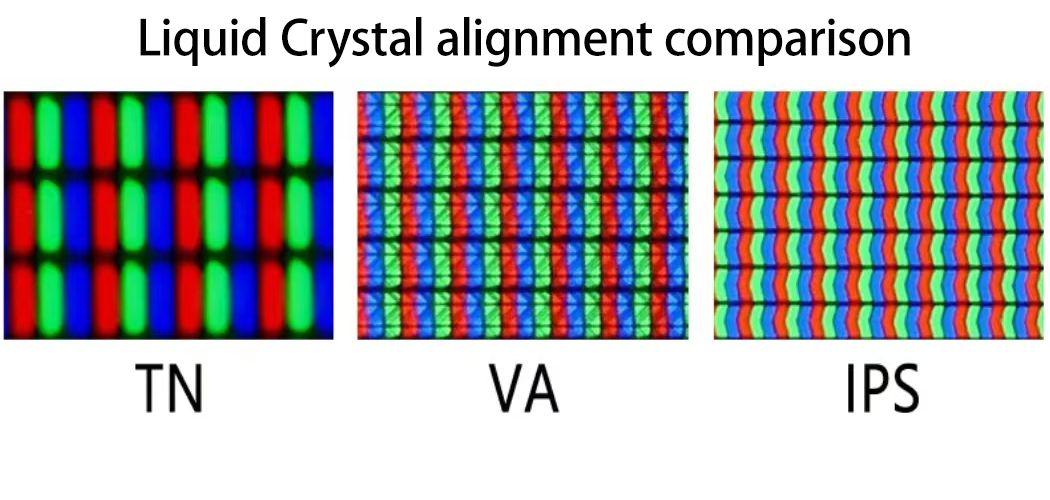
In addition, IPS panels have also improved in terms of response time. Standard IPS response time is around 4ms, but with the introduction of overdrive (gray-to-gray response acceleration), it can nearly reach 1ms—on par with TN panels. When combined with a high refresh rate, this ensures smooth and dynamic visuals with minimal motion blur, offering a better overall viewing experience. However, the main drawback is its relatively low contrast ratio (typically around 1000:1). Since IPS relies on backlighting for brightness, improper control can lead to a washed-out appearance and light leakage, particularly noticeable in dark scenes or when displaying pure black.
Advantages of IPS panels: wide viewing angles, accurate and true-to-life colors, and minimal motion blur.
Disadvantages of IPS panels: low contrast, prone to light leakage, and screen washout (appearing whitish) when displaying pure black images.
Finally, here is a summary of the performance of the three technologies across various aspects:
Image Quality/Visual Performance:IPS>VA>TN
Response Time:TN≥IPS>VA
Contrast Ratio:VA>TN>IPS
Among the three major panel types, TN and VA are considered soft panels, while IPS is classified as a hard panel (soft panels are more prone to scratches from sharp objects). To distinguish between them, gently press the screen surface with your finger: if the resulting indentation or pattern disappears quickly, it is a hard panel; if it fades slowly or lingers, it is a soft panel.