Time:2025-08-28 Browse: 1
Discussion on the Mechanism of Yellow spot Formation in TFT-LCD Display Modules and Improvement Countermeasures
In TFT-LCD display modules, there are many optical display-related defects, such as white float or light leakage in all-black images, COG mura in moving images, gray-scale frame mura, and yellowing, bluing, or darkening in white images. There are numerous causes behind these defects, and the impact and acceptability of each vary significantly. Some defects are stable and do not worsen over time, while others may gradually deteriorate as time progresses. Therefore, for optical display-related defects, it is essential to first identify the root cause, followed by a risk assessment based on the underlying mechanism, in order to prevent potential significant losses.
This article focuses on the analysis of defects related to LCD optical display performance, specifically "LCD yellow spots." It is mainly divided into three parts: the phenomenon and characteristics of LCD yellow spots, the mechanism of yellow spot formation, and the common causes and improvement countermeasures for LCD yellow spots.
1. Phenomenon and Characteristics of LCD Yellow Spots
LCD yellow spots: Typically, under a white screen, certain localized areas appear yellow or yellowish-brown compared to surrounding areas in terms of display appearance. This phenomenon usually has several key characteristics:
●LCD yellow spots are irregular in shape and appear as localized defects, commonly presenting as spot-shaped, stripe-shaped, or frame-shaped patterns. Moreover, the occurrence is regional, not uniform yellowing across the entire surface. Based on shape and location, they are typically classified as spot yellowing, yellowing at corner areas, or yellowing along the four edges. Different shapes and locations of LCD yellow spots are caused by different underlying factors.
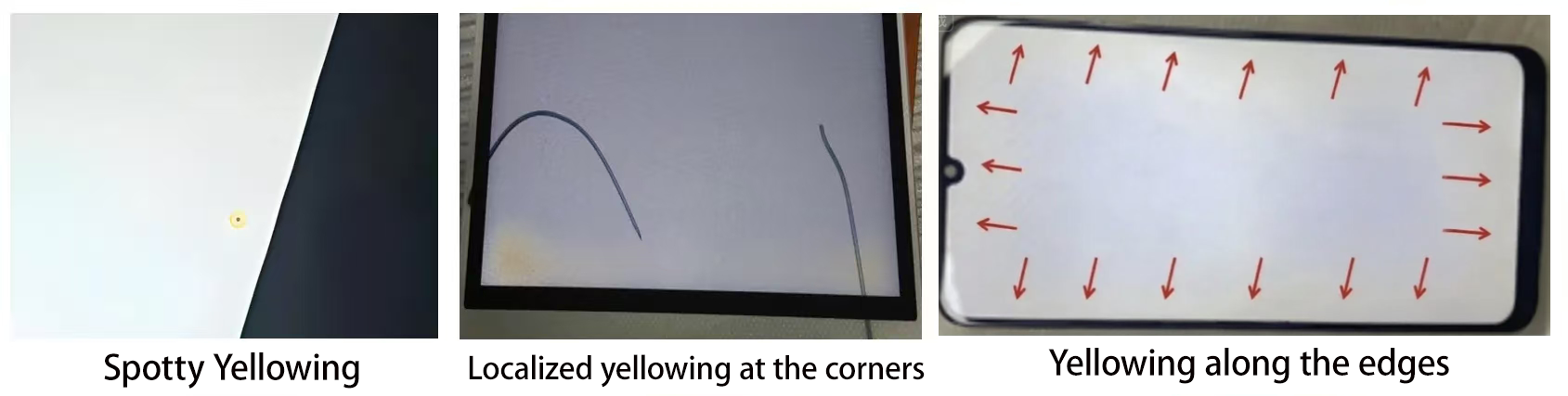
● Irreversibility of LCD yellow spots. LCD yellow spots typically occur after the LCD module is subjected to external pressure, causing physical damage inside the LCD panel. Once this damage occurs, it is usually permanent and does not disappear spontaneously. Therefore, the phenomenon of LCD yellow spots is characterized by irreversibility.
●The color of LCD yellow spots is distinctly yellow and prominent. LCD yellow spots usually appear as noticeable yellow, light yellow, or yellowish-brown, creating a clear contrast with the white areas around the LCD display module.
2. Mechanism of LCD Yellow Spot Formation
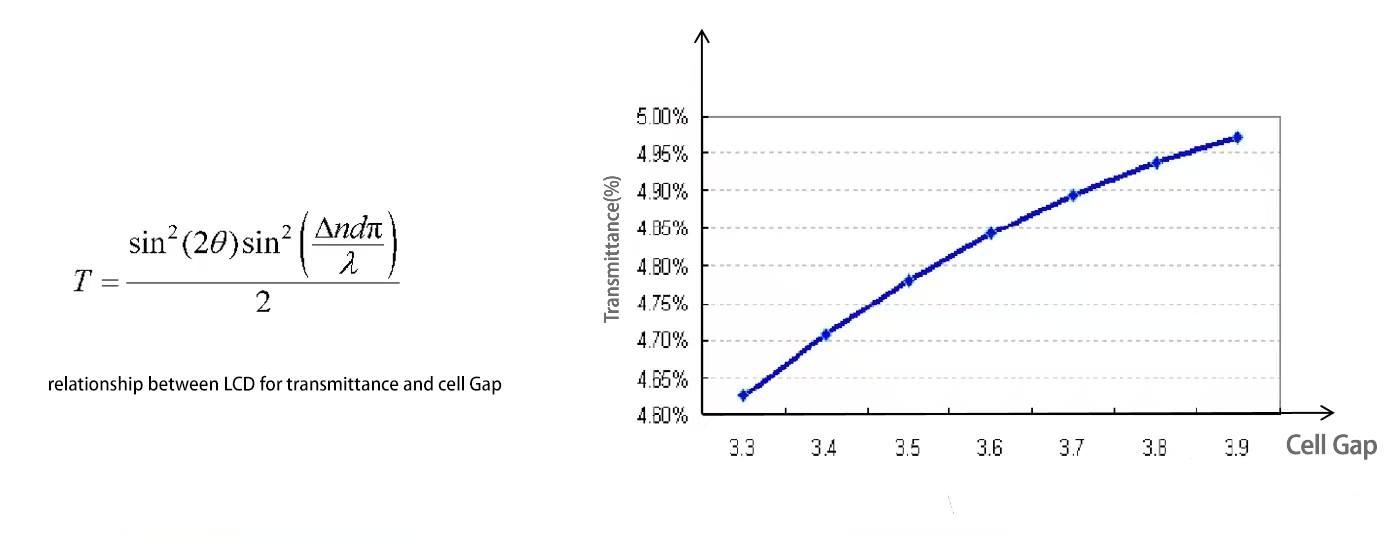 Regardless of the appearance, location, or severity of LCD yellow spots, their underlying mechanism is essentially the same. Before discussing the mechanism of yellow spot formation, it is important to first explain the relationship between the transmittance of an LCD panel and its Cell Gap. There is a definite relationship between LCD transmittance and cell Gap. According to the formula relating LCD transmittance to cell Gap, when the effective birefringence of the liquid crystal is constant, the greater the cell Gap, the higher the transmittance of the LCD. When the cell thickness is at its optimal value, the transmittance of the three primary colors—red, green, and blue (RGB)—is also at its ideal level. As a result, the mixture of these three colors produces white light, and the LCD module displays a white image.
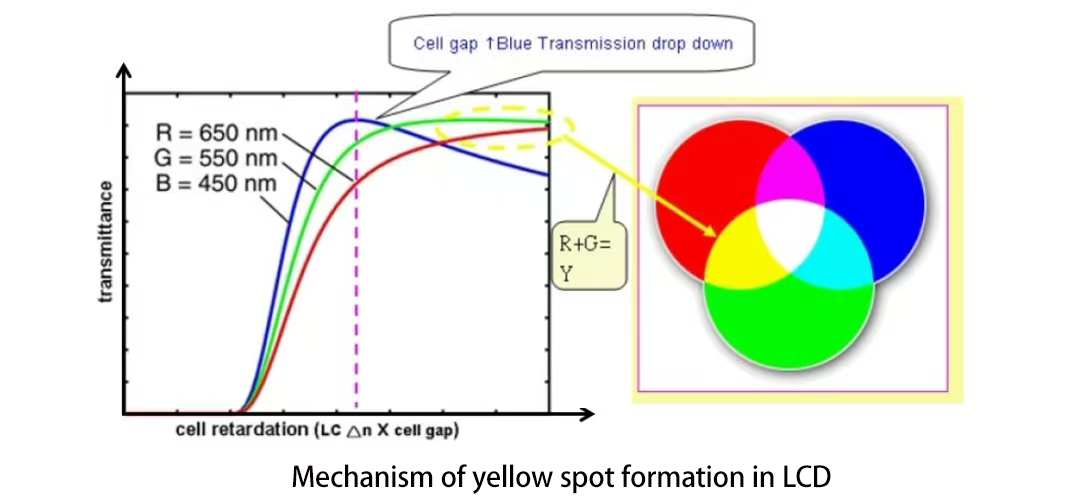
Therefore, the mechanism of LCD yellow spot formation is an increase in LCD cell gap. The primary cause of this increased cell gap is external mechanical pressure applied to the LCD module, which forces the liquid crystal inside the cell to migrate toward the surrounding areas of the compressed region. In these areas where liquid crystal accumulates, the cell gap is locally stretched or widened, leading to reduced blue light transmittance and resulting in localized yellowing—appearing as yellow spots or yellowish patches on the display.
3. Common Causes of LCD Yellow Spots and Improvement Countermeasures
During the entire manufacturing process of LCD display modules and in final product testing, the LCD module may be subjected to mechanical pressure from various sources. However, the most common causes of yellow spots due to compression typically arise from:
- Mechanical compression during end-product reliability testing
- Compression during OCA (Optically Clear Adhesive) bonding process
- Compression during LCD cell assembly (cell attaching process)
● Compression on LCD during end-product mechanical testing (Yellowing around the edges)
After final assembly, the complete device typically undergoes various mechanical tests to evaluate its mechanical performance. These tests generally include drum rotation, micro-drop, controlled drop, and compression tests. During these mechanical tests, factors such as the amount of liquid crystal inside the LCD panel, the height and density of the main PS (pillar spacers), the flatness of the LCD module and the device housing, the Z-direction gap between the LCD module and the housing, and the structural strength of the housing can lead to mechanical compression on the LCD module. This compression may cause local deformation of the cell gap, resulting in yellow spots—particularly around the four edges of the display.
--- Cause of peripheral yellowing: The specific process by which mechanical testing of the complete device leads to yellow spots on the LCD module is as follows (the risk of yellow spot formation is highest during micro-drop testing of the complete device).
① If the overall thickness of the LCD display module is too large or its flatness is poor, it will result in a smaller Z-direction gap between the module and the device housing. During repeated mechanical tests on the complete device, this small gap can lead to compression of the LCD display module by the housing.
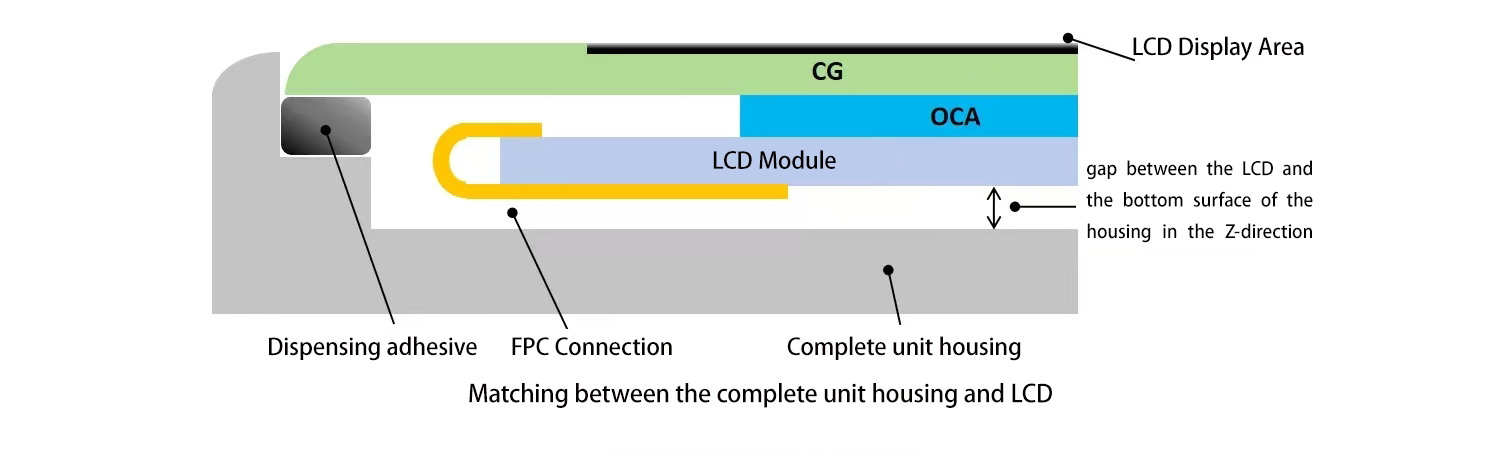
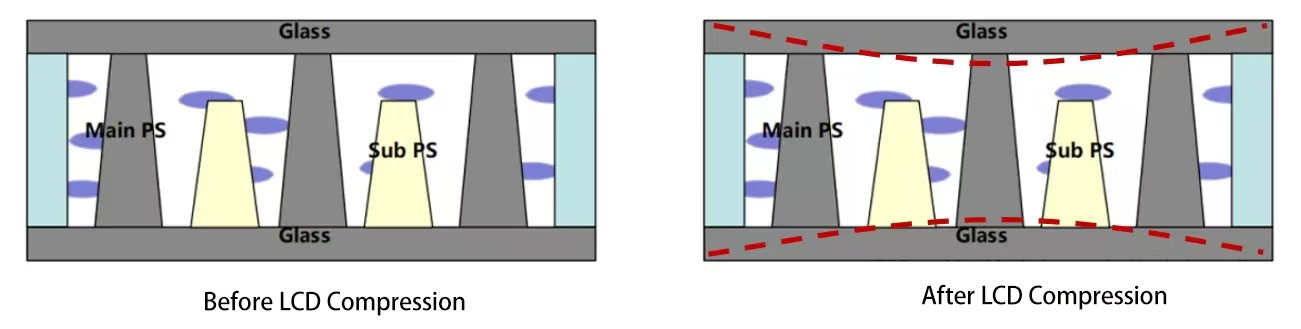
② When the LCD display module is compressed, the main PS (pillar spacers) in the central area of the LCD are typically compressed, causing the cell gap in the center to decrease. However, the sealant frame at the periphery of the LCD contains PS that provide support, so the main PS in the surrounding areas remain largely uncompressed.
③ After the central area of the LCD is compressed and the cell gap decreases, the liquid crystal flows and accumulates toward the edges of the LCD. This accumulation increases the cell gap at the periphery, ultimately leading to yellowing defects around the edges of the LCD.
--- Improvement Countermeasures for Peripheral Yellowing:
To address yellowing around the edges of the LCD, improvements are typically made in two aspects: 1. Enhancing the LCD panel itself, specifically improving the stability of the LCD cell gap; 2. Optimizing the compatibility between the LCD module and the device housing.Common improvement measures:
① Reduce the amount of liquid crystal inside the LCD cell. When the liquid crystal volume is reduced (weakening its ability to support the cell gap, with the PS becoming the primary support), the main PS will be compressed more readily under initial conditions, thereby reducing the height difference between the main PS and sub PS. When the LCD is subjected to external pressure, the main PS can quickly deform and compress, allowing the sub PS to rapidly provide effective support to resist the external force.
② Keep the liquid crystal quantity unchanged, but increase the height of the main PS. After increasing the height of the main PS, when the LCD is subjected to external pressure, the compressible margin of the main PS is effectively increased. This helps suppress the reduction of the cell gap in the central area of the LCD during mechanical testing of the complete device, ultimately ensuring better stability of the cell gap across all regions within the LCD cell.
③ Increase the PS density per unit area. By increasing the PS density, the LCD's resistance to compression and deformation is enhanced, helping to maintain the stability of the cell gap across all regions within the LCD cell

④ Ensure proper Z-direction clearance between the LCD and the device housing. Maintaining the total LCD thickness toward the lower to middle end of the tolerance range, controlling the flatness of both the LCD and the device housing, and enhancing the structural strength of the housing are also common improvement measures to reduce yellowing around the edges of the LCD.
● Compression on LCD during full OCA lamination (localized yellowing)
Local unevenness and residual stress during the OCA laminating process are common causes of localized yellowing on the LCD. Additionally, internal interference within the LCD—such as excessive silicone glue thickness, over-thick UV adhesive or conductive silver paste protruding beyond the polarizer—can also commonly lead to localized yellowing.
--- Cause of Localized Yellowing:
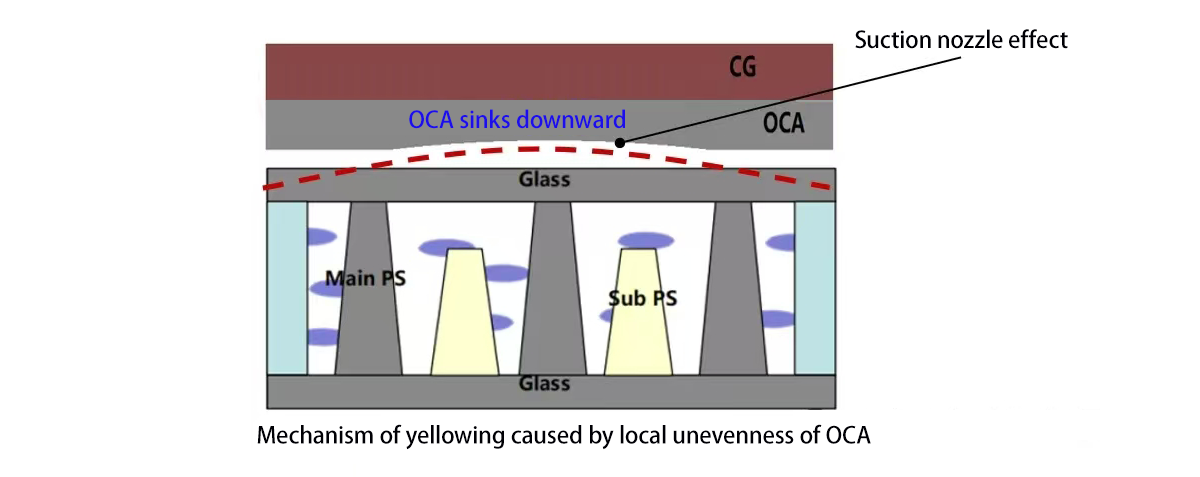 Taking unevenness after OCA lamination as an example, when uneven pressure is applied during the soft-to-hard bonding process, it can cause local concave deformation in the OCA. During the subsequent hard-to-hard lamination and vacuum pressing stages, these concave areas may pull on the LCD panel, leading to an increase in the cell gap (similar to the suction nozzle effect). As a result, the transmittance of blue light (B) decreases significantly, while the transmittance of red light (R) and green light (G) remains relatively unchanged. The combined effect of R and G light dominance produces yellow, ultimately causing localized yellow spots on the LCD.
--- Improvement Countermeasures for Localized Yellowing:
Conduct DOE (Design of Experiment) verification during the full OCA lamination process to prevent localized yellowing caused by unevenness or residual stress in the OCA.
- In the soft-to-hard lamination process, verify and establish the optimal bonding pressure and speed, while ensuring the flatness of the bonding platform.
- In the hard-to-hard lamination process, verify and set the optimal bonding pressure, duration, and vacuum level, while confirming the parallelism of the bonding chamber.
These measures help reduce the risk of localized yellowing due to OCA-induced compression on the LCD.
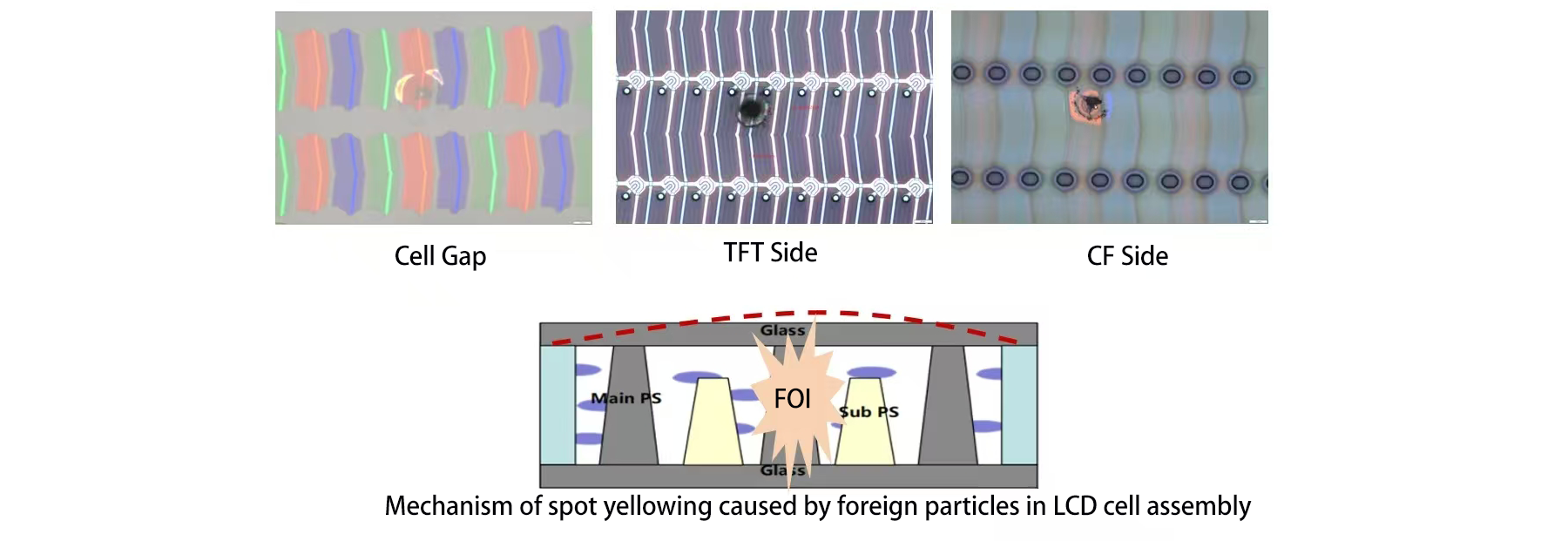
● Compression during Cell Assembly Process (Spot Yellowing):
During the LCD Cell assembly process, yellow spots caused by foreign particle compression are relatively rare; ensuring proper cleanliness control during the Cell assembly process is key to preventing this issue.
The mechanism of LCD spot yellowing is similar to what has been described above: during the cell assembly process when the CF and TFT substrates are bonded together, foreign particles generated by equipment wear can cause local lifting of the LCD cell. At the positions lifted by the foreign particles, the Cell Gap increases, ultimately leading to spot yellowing. Generally, users cannot implement improvements at this process stage, and should instead focus on the improvement measures outlined in the previous two sections regarding yellowing issues.