
Time:2025-09-08 Browse: 1
After the full-device compression test, black spot defects appeared on the LCD display module. However, when the housing was disassembled, the black spot defect became fainter and eventually disappeared. This article mainly analyzes the phenomena and test conditions, root causes, and improvement measures for black and blue spots on LCDs.
1. Phenomenon and Test Conditions of LCD Black Spots and Blue Spots
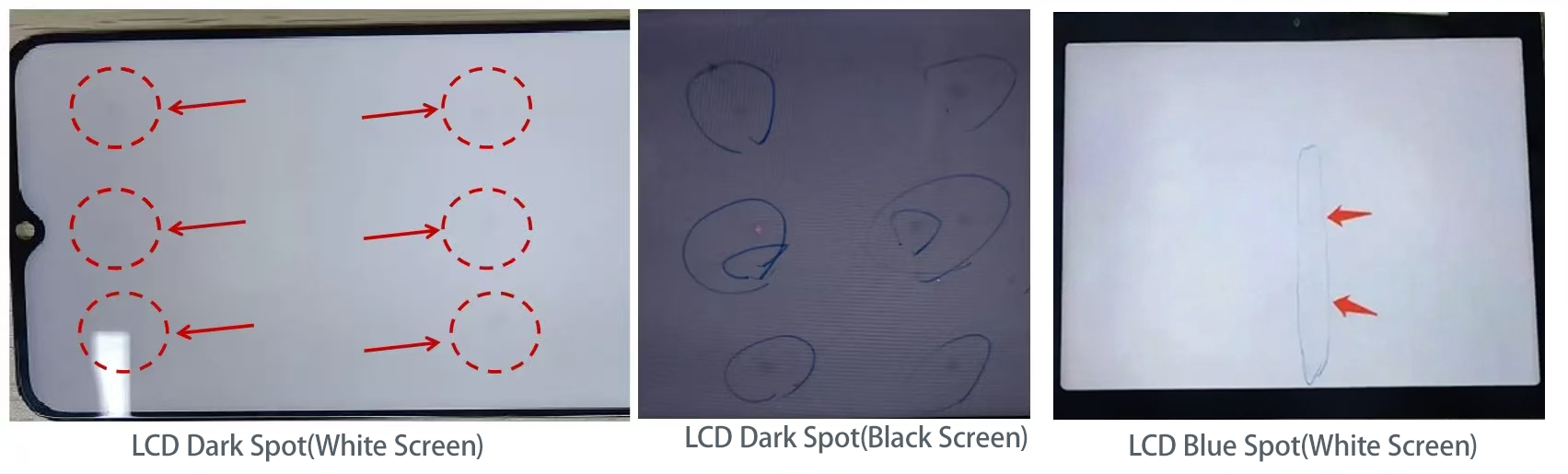
① Phenomenon Description: LCD black spots and blue spots typically refer to defects that occur on an LCD panel when it is subjected to external pressure, resulting in one or more localized areas—such as blotches, streaks, or patches—appearing darker in color than the surrounding regions within the display area.
Depending on the magnitude of the applied pressure, the color of the spots appearing on the LCD surface may vary. Generally, the pressure required to cause black spots on an LCD is greater than that needed to produce blue spots.
LCD black and blue spots are typically more noticeable on white, gray-scale, or black display patterns. The shapes of these spots are irregular and their sizes vary. The location where black or blue spots appear corresponds directly to the area of the LCD module that has been subjected to external pressure—there is a close match between the defect location and the point of mechanical stress.
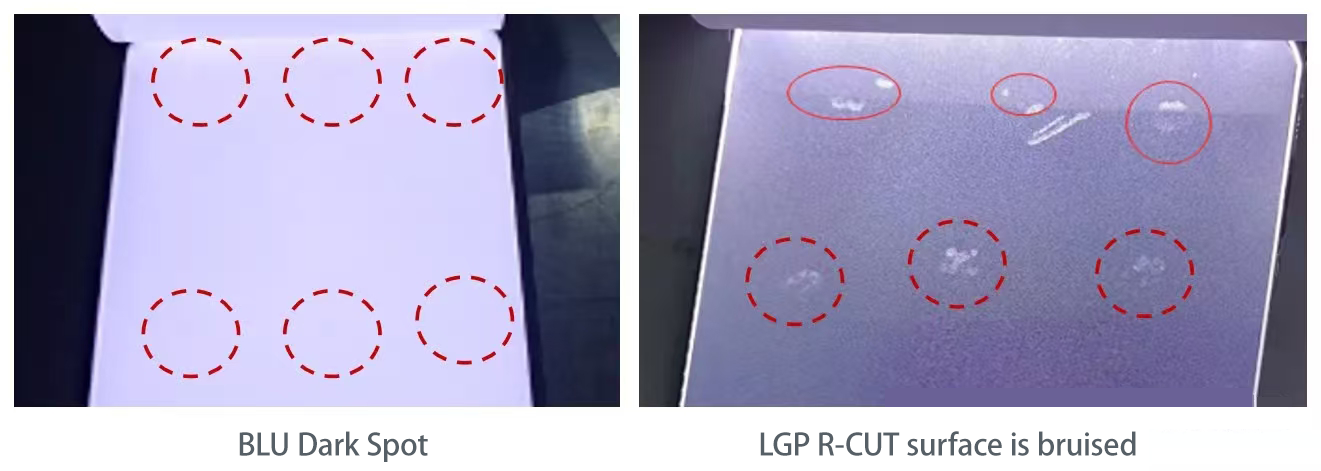
In addition to the LCD panel itself causing black spots, external pressure on the light guide plate (LGP) within the backlight unit can also lead to defects. Such pressure may damage the LGP’s R-cut structure and micro-dots, ultimately resulting in black spot abnormalities in the LCD display module. This issue can be specifically identified and verified through cross-validation methods.
②Test Conditions
Black and blue pressure marks on LCDs occur as a result of external impact or compression applied to the LCD display module. These defects typically appear during various mechanical tests on the finished device, such as drop tests, micro-drop tests, tumbling tests, and soft compression tests.
In the industry, the primary method for evaluating the risk of LCD black and blue spot formation is to perform a compression test on the front surface of the LCD display module. The specific requirements are as follows:
● Test Conditions: Use a spherical indenter with a radius R = 10 mm (indenter material: stainless steel) to apply a pressure of 10 kgf on 9 evenly distributed points within the viewing area of the LCD display module (with cover glass). The pressing speed is 10 mm/min, with the indenter positioned 10 mm from the edge of the LCD display area. The load is held for 5 seconds at each point, and the test is repeated 5 times.
● Fixture Design Requirements:
The fixture material shall be Bakelite. The cutout area of the fixture shall extend 0.4 mm (d) beyond each side of the LCD display module's outline. The Z-direction gap between the fixture's inner surface and the LCD display module shall be 0.3 mm (a). The outer groove of the fixture shall extend 0.08 mm (e) beyond the outline of the cover glass. The fixture's border width shall be 1.5 mm (c), and the bottom thickness of the fixture shall be 2 mm (b).
● Acceptance Criteria: The cover glass appearance of the LCD display module, display performance when powered on (no black or blue spots), and electrical functions must all be normal.
2. Mechanism of LCD Dark Spot and Blue Spot Formation
The formation mechanism of LCD Dark spots and blue spots is related to changes in the LCD cell gap. Specifically, when the LCD display module is subjected to external pressure, the cell gap at the pressed area decreases, ultimately leading to the appearance of Dark and blue spot defects.
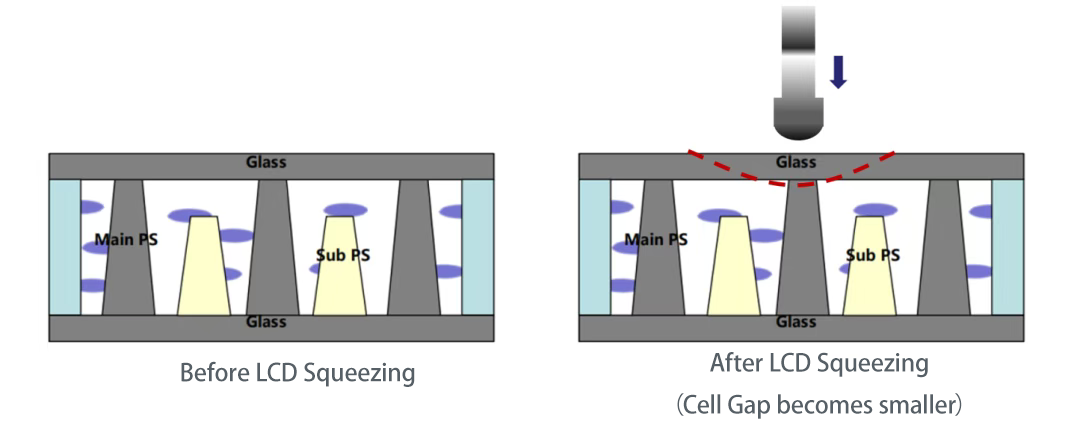
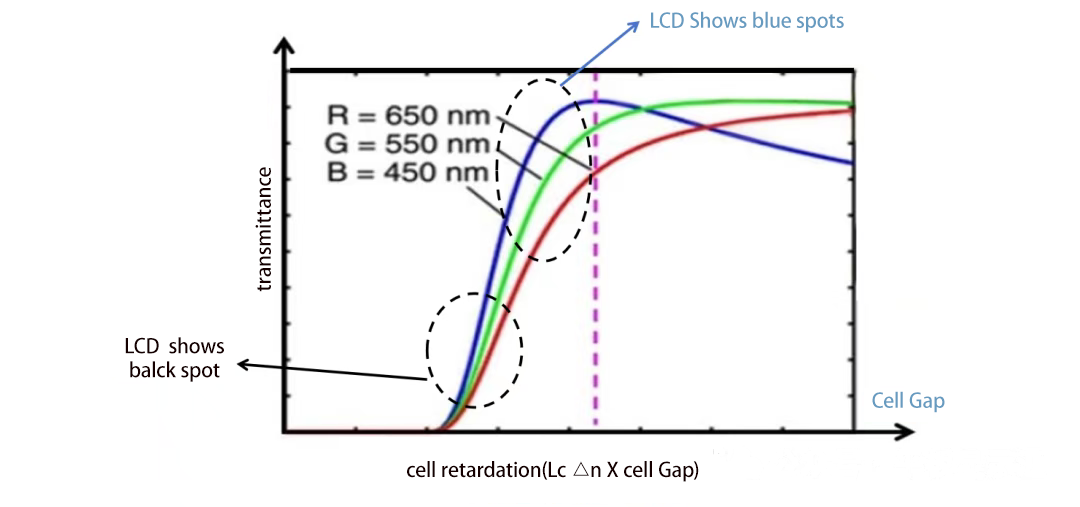 ① Mechanism of LCD Dark Spot Formation: When the LCD display module is subjected to localized external pressure (with relatively high force), the LCD cell gap (cell thickness) decreases. As a result, the transmittance of red (R), green (G), and blue (B) light all decrease. The brightness at the pressed area becomes lower compared to surrounding areas, causing the image to appear locally darker.
② Mechanism of LCD Blue Spot Formation: When the LCD display module is subjected to localized external pressure (with relatively lower force), the LCD cell gap (cell thickness) decreases. This reduces the transmittance of red (R) and green (G) light, while blue (B) light maintains relatively higher transmittance. As a result, the affected area appears locally bluish on the screen.
Therefore, the underlying mechanism for the formation of LCD Dark spots and blue spots is the same; the difference lies in the magnitude of external pressure—Dark spots are caused by greater pressure compared to blue spots.
3.Improvement Strategies for LCD Dark Spots and Blue Spots
Regarding the Dark and blue spot defects caused by LCD compression, specific improvement strategies are analyzed from the following aspects.
① LCD Panel Aspect:
● The thicker the LCD panel design, the better the resistance to pressure. Within the allowable total thickness of the LCD module, the thickness of the LCD cell should be controlled toward the upper middle limit during the thinning process to enhance its anti-compression performance. After all, under the same conditions, a thicker glass substrate has higher mechanical strength, exhibits less deformation under the same external pressure, and thus reduces the risk of dark and blue spot defects.
● Increase the particle spacer (PS) density per unit area inside the LCD cell. Increasing the PS density within the LCD cell enhances its resistance to compression. While this approach is effective, it also comes with significant trade-offs. For example, higher PS density may reduce LCD transmittance and require changes to the CF (Color Filter) mask, which can increase costs. Therefore, this strategy is typically implemented in newly designed LCD panels, and is introduced only after a comprehensive evaluation based on the customer’s compression test requirements.
② Cover Glass (CG) Aspect:
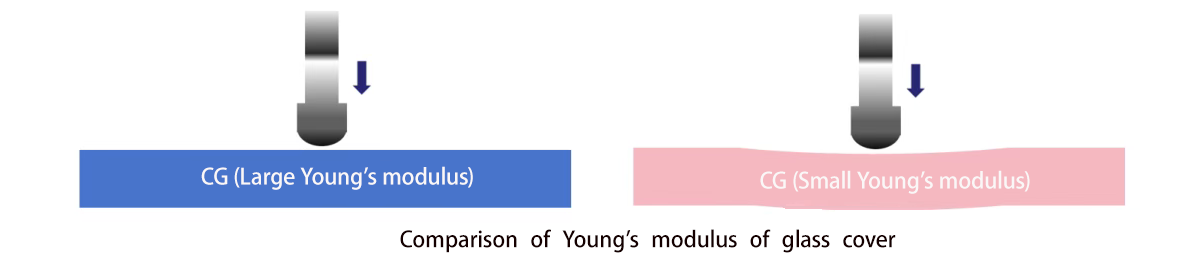
Among the performance parameters of cover glass, there is an important indicator—Young’s modulus, also known as elastic modulus. It is a physical quantity that measures a solid material's ability to resist deformation, reflecting the material's stiffness.
In the case of cover glass, a higher Young’s modulus indicates greater rigidity and stronger resistance to deformation. Under the same applied stress, a higher Young’s modulus results in smaller deformation. Therefore, using a cover glass with a higher Young’s modulus can effectively reduce the risk of LCD dark and blue spots caused by external pressure.
When the LCD display module is subjected to compressive force from the front outer side, using a cover glass with a higher elastic modulus (Young’s modulus) can help reduce the impact of external pressure on the LCD module. In this case, the cover glass provides better protection for the underlying LCD panel, thereby lowering the risk of compression-induced dark spots and blue spots.
③ Backlight Light Guide Plate (LGP) Aspect:
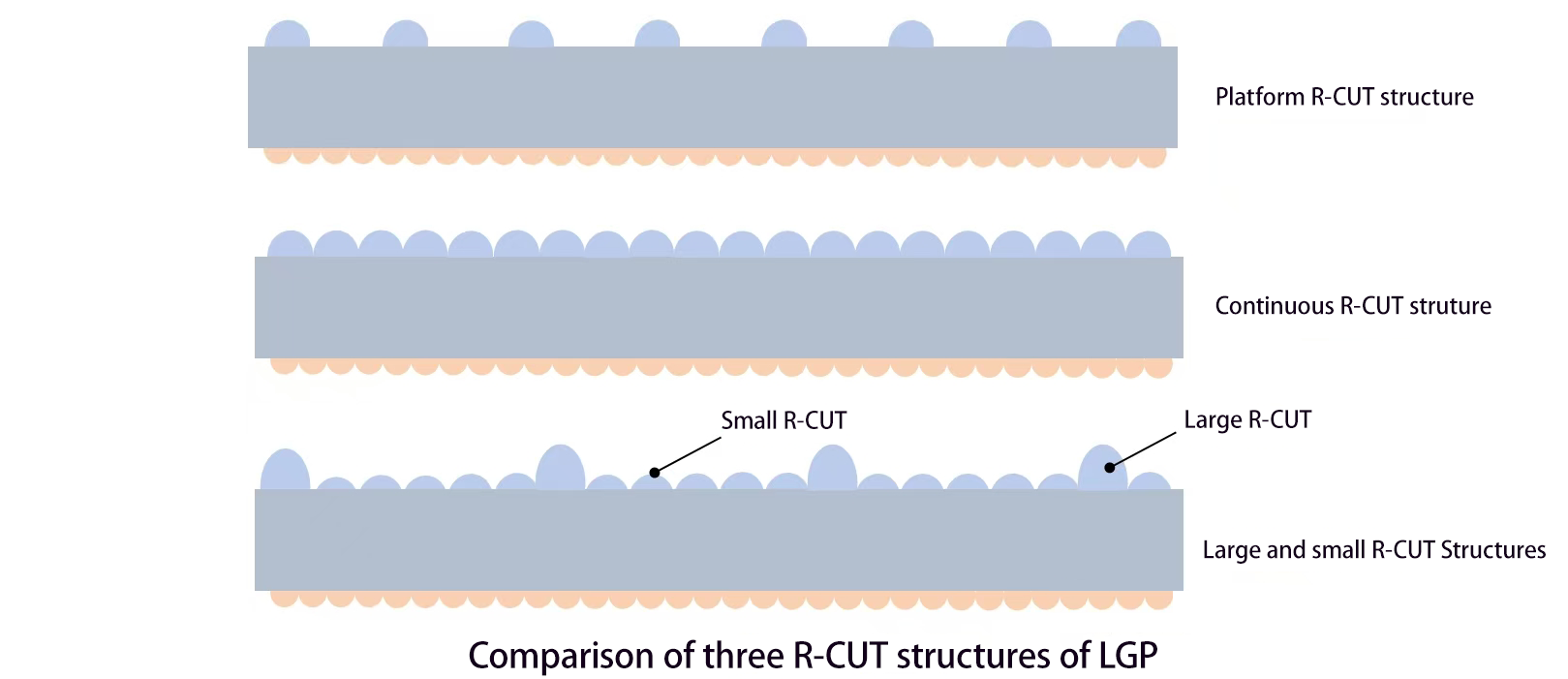 As mentioned earlier in the discussion of LCD pressure-induced black spots, when the light guide plate (LGP) in the backlight unit is subjected to external pressure, the structure of the LGP’s R-CUT surface and its micro-patterned dot surface can be damaged, leading to dark spot defects in the backlight unit (BLU).
Different LGP R-CUT structures exhibit varying levels of resistance to compression and have different impacts on backlight brightness. The overall conclusion is that, in terms of compressive strength, the LGP R-CUT structures rank from highest to lowest as follows: Continuous R-CUT > Step (Platform) R-CUT > Large/Small (Size-varied) R-CUT.
Therefore, to enhance the backlight's resistance to compression and reduce black spot issues caused by damage to the LGP R-CUT structure, it is recommended to prioritize the use of LGP with a continuous R-CUT design.
④ Matching Between the Full Device and Display Module Structure:
When the LCD display module has an excessive overall thickness, out-of-spec warpage, insufficient housing strength, noticeable step differences at local housing positions, or housing warpage beyond tolerance, it can result in an insufficient Z-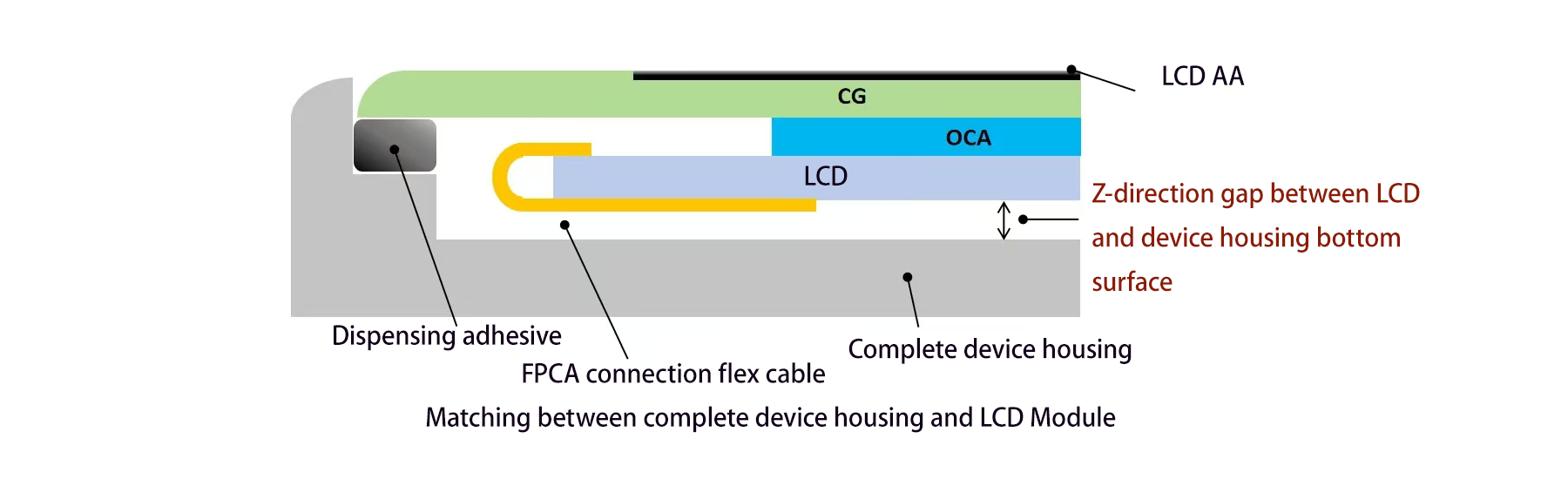 direction clearance (air gap) between the LCD display module and the device housing. During mechanical testing of the finished device, this small gap may cause the housing to press against the back of the LCD module, leading to dark or blue spot defects on the LCD.
To prevent the device housing from compressing the back of the LCD display module, on one hand, it is essential to strictly control the factors mentioned above that could lead to such issues; on the other hand, where structural space permits, the Z-direction gap between the LCD display module and the housing should be increased as much as possible, with a recommended clearance of ≥0.3 mm.
⑤ Module Manufacturing Process Control:
Throughout the LCD module manufacturing process, there are numerous steps that may exert pressure on the LCD panel. The most typical process stages where compression occurs are: the LCD bonding (mounting) process and the full lamination (full optical bonding) process.
If there are protruding foreign particles on the platform during the LCD mounting or full lamination process, these particles can press against the LCD panel under the influence of bonding pressure and vacuum-induced compression force, ultimately causing dark or blue spots on the LCD. Therefore, to prevent this issue, it is critical to ensure the cleanliness of the mounting and full lamination platforms. Strict cleaning procedures for equipment, platforms, production lines, etc., must be followed in accordance with standard operating instructions.