Time:2025-10-15 Browse: 1
Image persistence is a commonly observed defect in LCD liquid crystal modules. However, many people are not fully clear about the phenomenon, test conditions, and underlying mechanisms of "LCD image persistence." When encountering this issue, it is often mistakenly assumed to be an inherent problem of the LCD display panel itself, or considered unavoidable and difficult to resolve due to a lack of understanding of proper troubleshooting methods. In fact, there are numerous causes of image persistence, involving various factors such as material selection and process control in the front-end manufacturing of the LCD panel, process control during the back-end module assembly, and improper handling or operation of the LCD module that fails to meet specified requirements. The following discussion will focus on explaining the phenomenon of LCD image persistence, the test conditions for detecting it, and the underlying mechanisms that cause it.
1. LCD Image Persistence Phenomenon:
LCD image persistence, also known as afterimage or image retention (Image Sticking), refers to the phenomenon where an LCD liquid crystal module displays the same static image for an extended period, and after switching to a new image, remnants of the previous image remain visible on the screen. In the industry, the standard test pattern for evaluating LCD image persistence typically involves switching from a black-and-white checkerboard pattern to a full gray-scale screen.
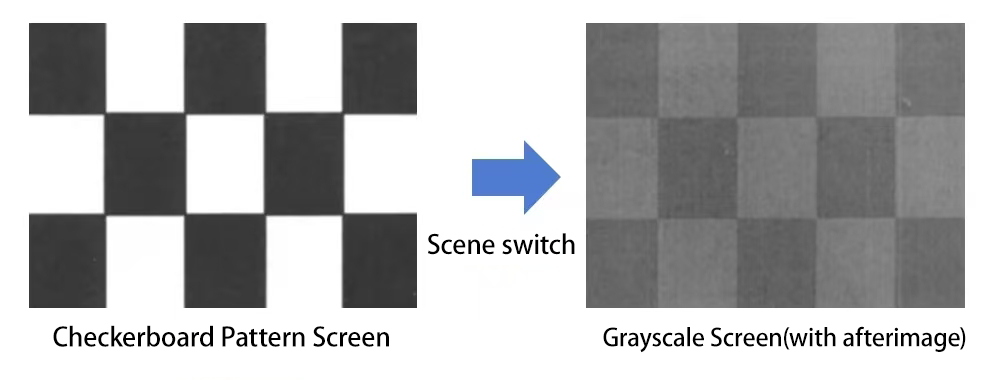
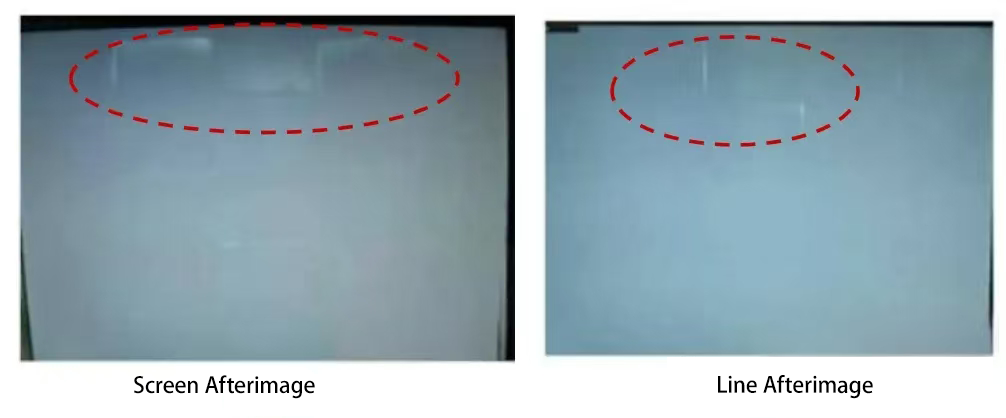
LCD image persistence defects can be categorized differently based on their duration and appearance. According to the duration of persistence, they are classified as: long-term image persistence and short-term image persistence. Based on the shape of the persistence, they are classified as: area-type (or "surface") image persistence and line-type image persistence.
① Long-term image persistence: This refers to a persistence defect formed when an LCD display module remains on the same static image for an extended period. In such cases, the afterimage typically takes a long time to fade, or may not disappear at all.
② Short-term image persistence: This refers to a persistence defect caused by the LCD display module showing the same static image for a relatively short duration. In these cases, the afterimage usually disappears quickly.
③ Area-type image persistence: This refers to image persistence that appears in a broad, surface-like pattern, covering a relatively large area of the display.
④ Line-type image persistence: This refers to image persistence that appears in a narrow, line-shaped pattern, affecting a relatively small region of the display.
In practice, the most commonly encountered LCD image persistence defect is long-term area-type image persistence. This is because the affected area is relatively large and the afterimage either takes a very long time to disappear or does not fade at all. Therefore, in this article, when referring to LCD image persistence defects, the focus is primarily on long-term area-type image persistence.
2. LCD Image Persistence Test Conditions
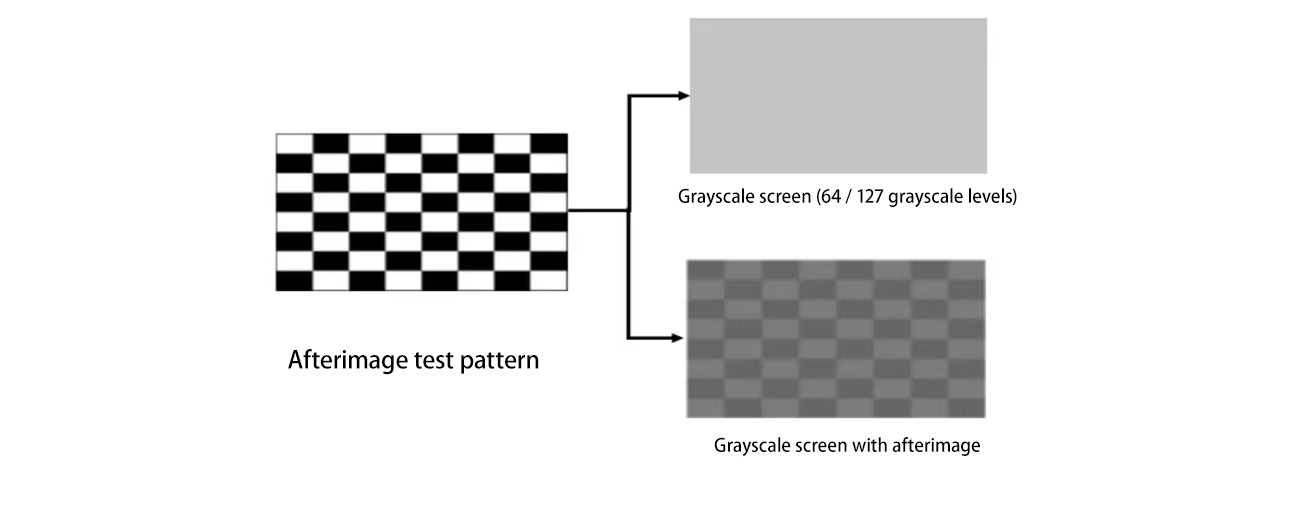
The standard test pattern for LCD image persistence involves switching from a black-and-white checkerboard pattern to a full gray-scale screen. The specific procedure is as follows: transition from an alternating checkerboard pattern to a uniform gray-scale image, where the black areas correspond to gray level L0, the white areas to L255, and the uniform gray screen corresponds to intermediate levels such as L32, L64, or L127.
Several critical factors in the test conditions for LCD image persistence must be carefully controlled, as they directly influence the testing process and ultimately affect the test results. These factors include:
● The number of squares in the black-and-white checkerboard pattern
●The duration for which the LCD module remains displayed on the checkerboard pattern
●The operating environment during testing (room temperature or high temperature)
●The specific gray level used in the post-switch uniform gray screen (e.g., L32, L64, L127)
● The time required for any observed image persistence to disappear
● The acceptable threshold or tolerance level for the visibility of image persistence
Variations in these key parameters lead to different test conditions and acceptance criteria. The following examples are provided for reference:
① 6×8 black-and-white checkerboard pattern is displayed at room temperature for 1 hour, then switched to uniform gray-level screens of L127, L64, and L32, respectively. After each switch, the presence of image persistence is inspected and the time required for the afterimage to disappear is recorded.
② 8×8 black-and-white checkerboard pattern is displayed at room temperature for 1 hour, then switched to an L127 gray-level screen. The presence of image persistence is recorded; if the afterimage disappears within 3 minutes, the module is judged as acceptable (pass).
③ 6×8 black-and-white checkerboard pattern is displayed at room temperature for 2 hours, then switched to an L64 gray-level screen. The presence of image persistence is recorded; if the afterimage disappears within 5 seconds, the module is judged as acceptable (pass).
④ 20×20 black-and-white checkerboard pattern is displayed under high temperature (70°C) for 3 minutes, then switched to an L127 gray-level screen. The presence of image persistence is recorded; if the afterimage disappears within 5 minutes, the module is judged as acceptable (pass).
Since different customers have varying test methods and acceptance criteria for LCD image persistence defects, specific projects must be tested according to the respective customer requirements.
3. Mechanism of LCD Image Persistence
The primary mechanisms currently recognized for the occurrence of LCD image persistence involve two key factors: the presence of ion-type impurities within the LCD panel, and the generation of DC offset voltage.
① Presence of ion-type impurities inside the LCD cell:
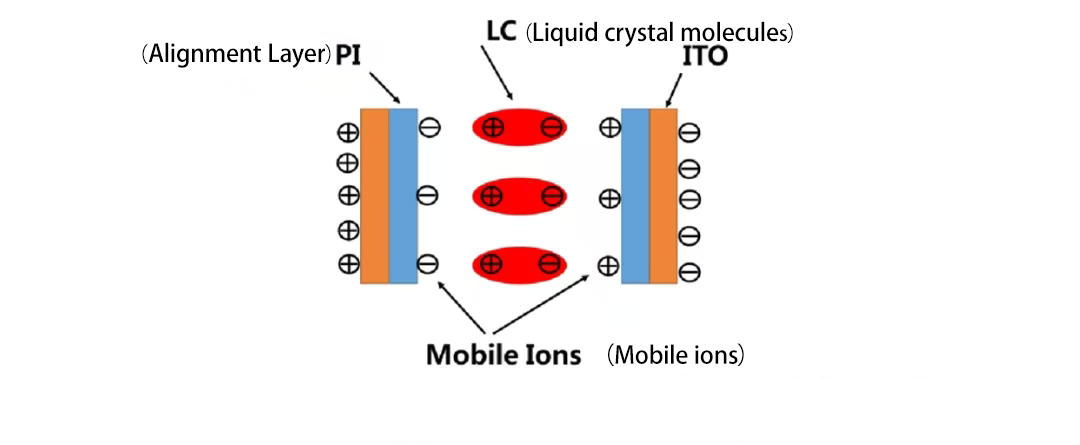
Ideally, liquid crystal material should be a perfect insulator. However, in practice, trace amounts of ion-type impurities are inevitably present in the liquid crystal materials used. Besides the liquid crystal itself, other materials within the LCD cell may also contain ionic impurities, such as the polyimide (PI) alignment layer, sealant adhesives, and the overcoat (OC) planarization layer. When an electric field is applied to the LCD panel, positively charged ions migrate toward the negatively charged electrode, while negatively charged ions move toward the positively charged electrode.
② Mechanism of DC Offset Voltage and Image Persistence:
Before understanding DC offset voltage, it is necessary to understand the formation of parasitic capacitance coupling, known as Feed-through voltage.
In an LCD panel, there is a parasitic capacitance (Cgs) between the gate and source electrodes. At the moment when the gate signal switches from "on" to "off," this Cgs parasitic capacitance creates a coupling effect, which induces a voltage shift known as the feed-through voltage (also referred to as ΔVlc).
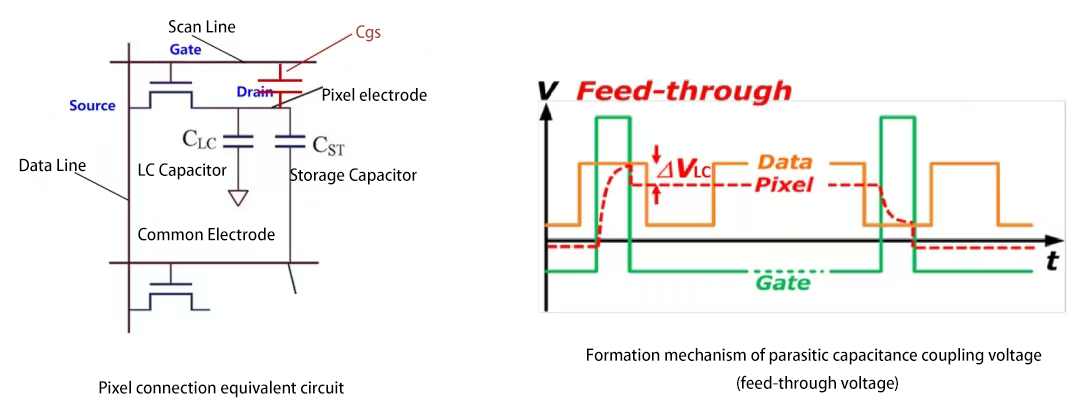
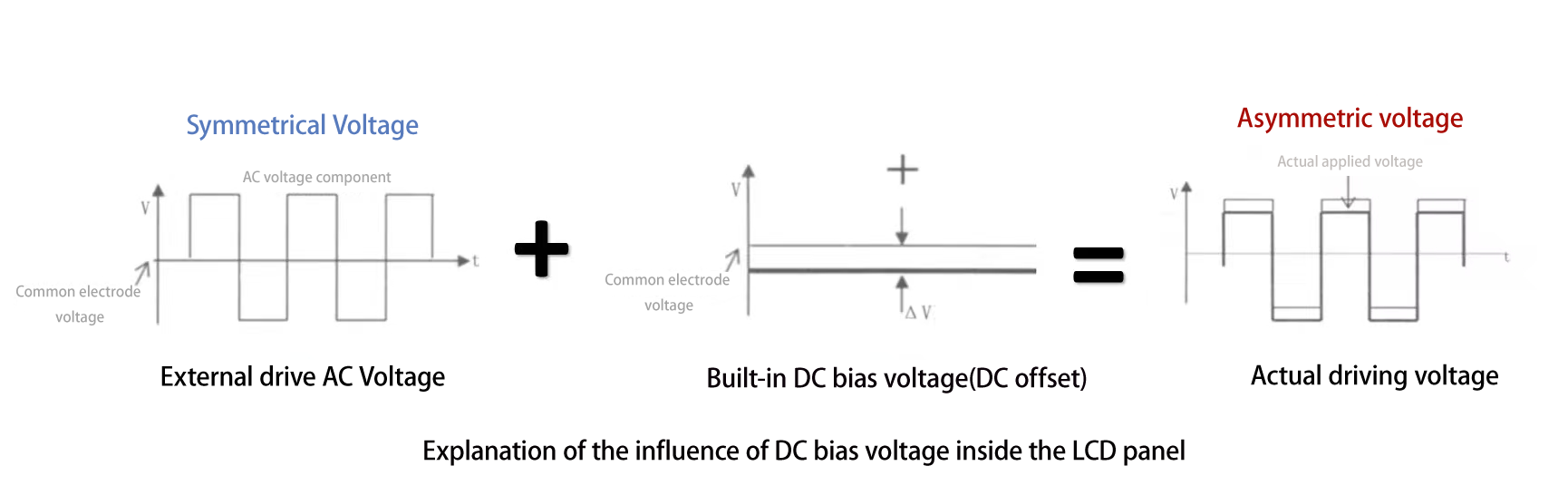
Due to the presence of parasitic capacitance coupling voltage (Feed-through) and ion-type impurities within the LCD cell, the mechanism of LCD image persistence proceeds as follows:
●When an AC voltage is applied to the LCD panel, the ion-type impurities respond to the electric field, causing positive and negative ions to accumulate on opposite sides of the electrodes within the LCD cell.
● The positive and negative ions adsorbed onto the electrodes do not dissipate immediately. These trapped charges create a weak but stable internal DC offset voltage within the LCD cell.
●Due to the influence of this internal DC offset voltage, the positive and negative half-cycle voltages applied to the liquid crystal molecules via the source electrode become unequal (asymmetric). This imbalance causes the liquid crystal molecules to rotate differently compared to those in other areas, ultimately resulting in the appearance of image persistence on the LCD display.