Time:2025-10-23 Browse: 1
In TFT-LCD display modules, "bright spot" defects are frequently observed. Since bright spot issues in LCD modules are relatively common, if the defect ratio is low and the severity is mild, acceptance criteria may be appropriately relaxed depending on product requirements. In fact, LCD bright spots can be classified into different types, each with distinct underlying mechanisms and corresponding improvement measures. For example: bright spots caused by foreign particles in the polyimide (PI) layer (foreign-particle bright spots), non-foreign-particle bright spots resulting from impurities affecting alignment during the PI alignment process, and pixel bright spots caused by line short circuits during the Array substrate fabrication. Among these, foreign-particle and non-foreign-particle bright spots are relatively rare in LCD panels, as PI alignment layers nowadays mostly employ "photo-alignment technology," which significantly reduces the occurrence of bright spots compared to traditional "rubbing alignment technology," where PI debris generated during rubbing used to be a major cause.
This paper focuses on the analysis of "LCD pixel bright spots," and is structured into three main sections: common classification and phenomena of LCD bright spots, the mechanism of LCD pixel bright spot generation, and improvement strategies for LCD pixel bright spots.
1. Common Classification and Phenomena of LCD Bright Spots
LCD bright spots can generally be classified into two types: pixel bright spots and irregular bright spots. Irregular bright spots can be further subdivided into foreign-particle bright spots and non-foreign-particle bright spots. The following analysis addresses these three types of bright spots.
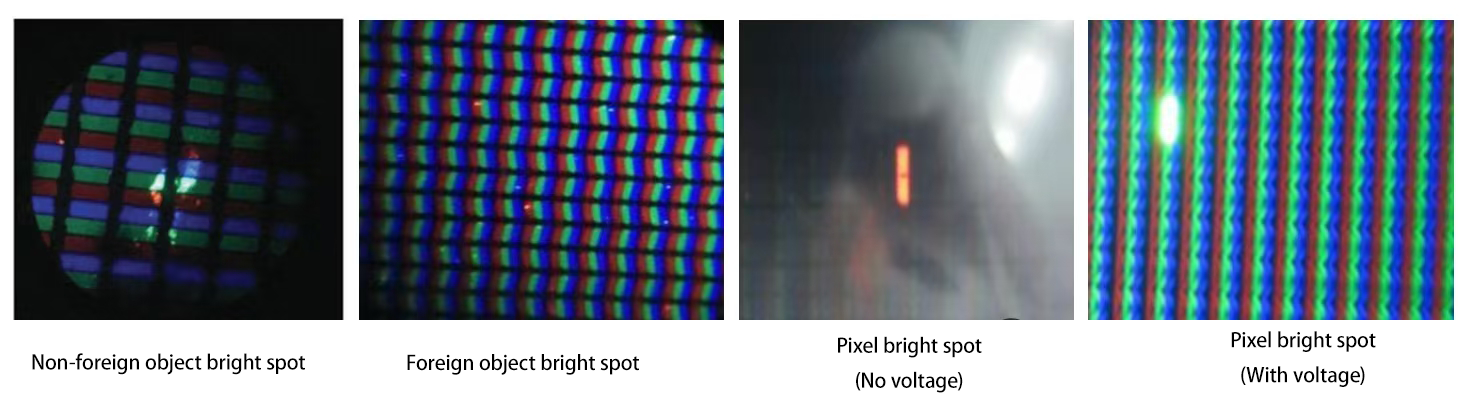
① LCD Non-Foreign-Particle Bright Spots:
The cause of this type of LCD bright spot is not directly related to foreign particles. This type of bright spot typically exhibits the following characteristics:
●The size and shape of the bright spot are irregular—it may be smaller than a single sub-pixel or span across several sub-pixels, with an uneven, non-uniform edge.
● The distribution of these defects on the glass motherboards or cut panels shows no concentration or clustering.
● When observed under a microscope, slight adjustments in focus do not produce a halo effect around the bright spot, and changes in its apparent size are minimal.
Common causes of non-foreign-particle bright spots include: uneven rubbing force during PI rubbing alignment, or impurities present during the PI alignment process that interfere with proper alignment.
② LCD Foreign-Particle Bright Spots:
These typically occur during the LCD Array substrate fabrication or Cell assembly processes, such as PI debris generated during the rubbing alignment process of the PI alignment layer, foreign particles introduced during the deposition of various thin films on the Array substrate, or contaminants introduced during the Cell panel bonding process.
● The size of the bright spot generally corresponds directly to the particle size of the foreign material.
● The shape of the bright spot is mostly circular or near-circular.
●The size of the bright spot is usually smaller than that of a single sub-pixel.
Additionally, bright spots caused by PI debris generated during the rubbing alignment of the PI alignment layer may appear as a single spot or multiple spots. When there are numerous such spots, this defect is commonly referred to in the industry as "starfield" or "starry sky" (literally "full sky of stars").
③ LCD Pixel Bright Spots:
These typically refer to failures in the TFT device area, usually caused by unintended electrical connections (short circuits) occurring in the TFT device region, between the TFT device and signal lines, between signal lines and pixel electrodes, or between adjacent pixels. Such short circuits cause a sub-pixel to remain continuously lit, ultimately resulting in the appearance of an LCD pixel bright spot.
LCD pixel bright spots are typically visible as bright points in black, gray-scale, red (R), green (G), blue (B), and other test patterns. However, the bright spot is not visible in its own color field—specifically, a red bright spot cannot be seen in a red image.
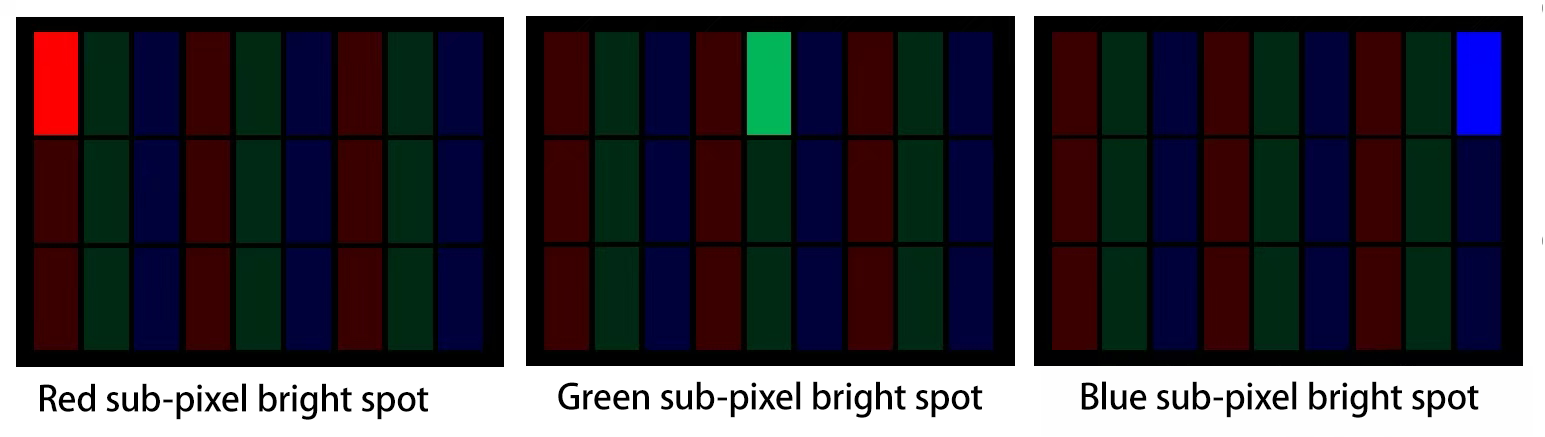
Additionally, LCD pixel bright spots can also be classified according to the number of affected pixels: single-pixel bright spots, two consecutive pixel bright spots, three consecutive pixel bright spots, and three or more consecutive pixel bright spots.
2. Mechanism of LCD Pixel Bright Spot Generation
In IPS (In-Plane Switching) LCD modules, the primary cause of pixel bright spots is "short circuits."
During the fabrication process of the Array substrate, several process steps can lead to short-circuit defects in the TFT switching device area. Common short-circuit locations and the corresponding mechanisms for bright spot formation are described as follows:
① Short circuit between pixels:
The main cause is incomplete etching of the final Pixel ITO layer, resulting in residual ITO material connecting two adjacent pixels. This creates an electrical short between them. When the Gate voltage is applied and the TFT turns on, the two shorted ITO pixel electrodes become abnormally conductive, forcing voltage equalization between them. This leads to an uneven electric field, causing abnormal tilting of liquid crystal molecules and resulting in a pixel bright spot.
In this case, the LCD pixel bright spot exhibits the following behavior: the display appears normal (dark) in the off-state (no voltage, black screen), but a bright spot appears when voltage is applied during operation.
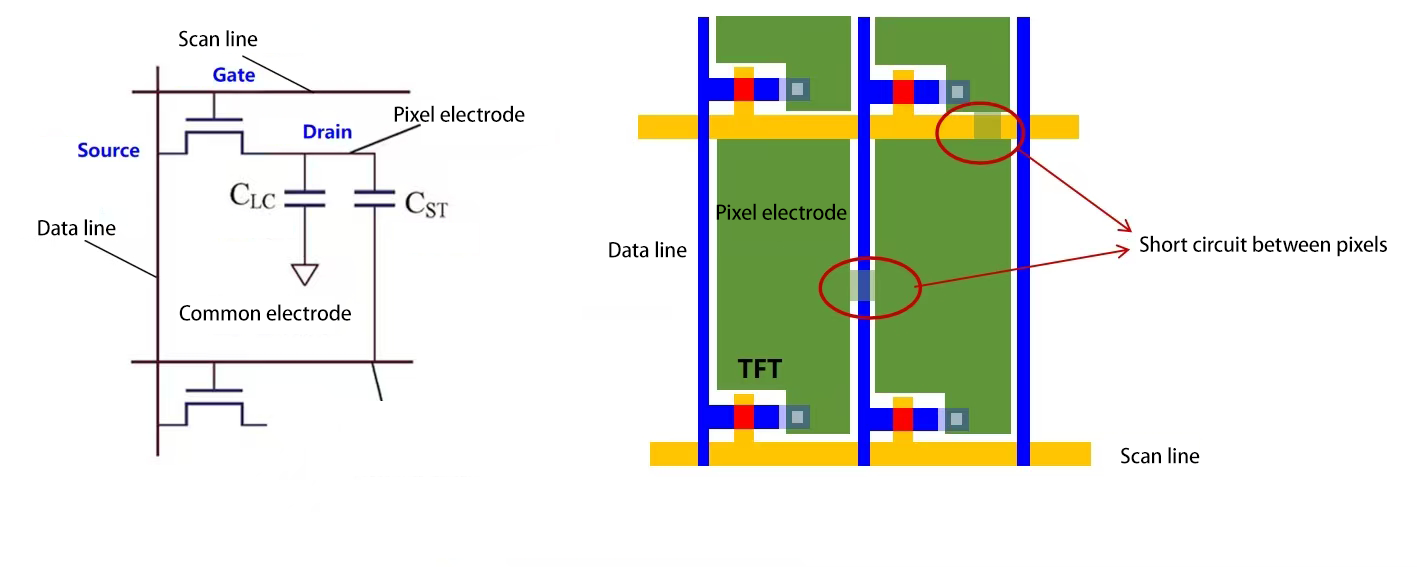
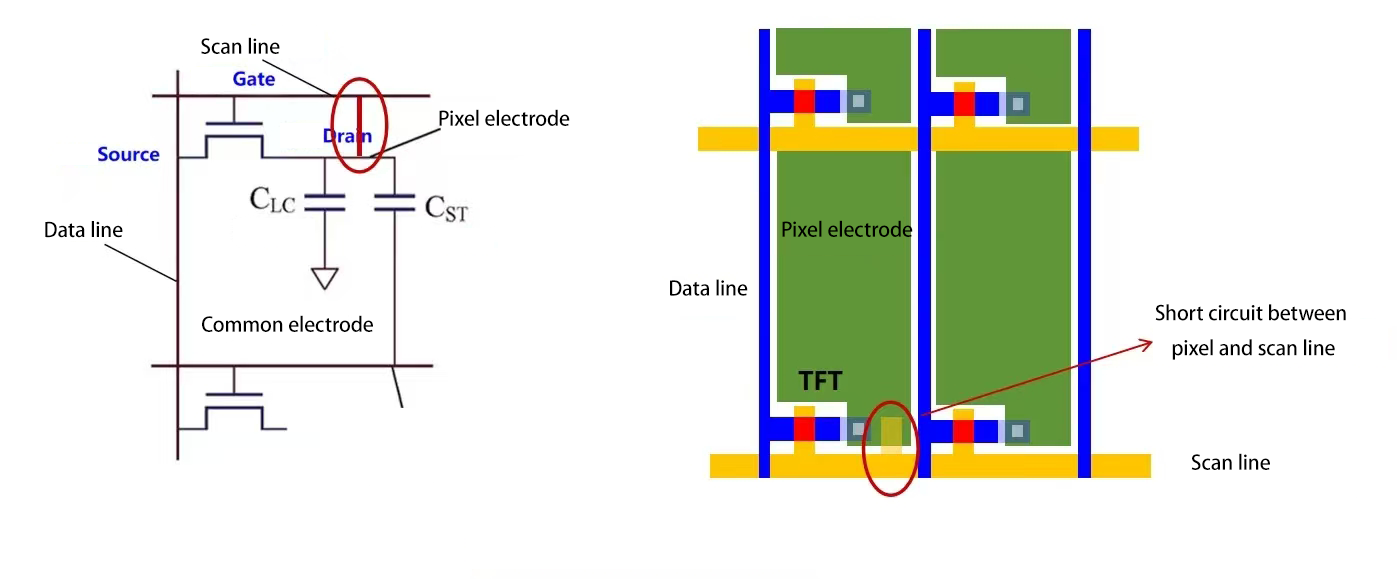
② Short circuit between pixel and scan line:
This is mainly caused by incomplete etching of the scan line, leaving residual conductive material that bridges and shorts to the ITO pixel electrode. As a result, the Gate voltage is directly transmitted to the ITO pixel electrode, forcing the voltage of the ITO pixel electrode to be clamped at the Gate voltage level. When the Gate voltage turns off, the ITO pixel electrode is pulled down to a low potential, creating a reverse electric field with respect to Vcom. This causes abnormal liquid crystal molecule rotation, ultimately leading to the formation of an LCD pixel bright spot.
In this short-circuit condition, the resulting LCD pixel bright spot appears as a bright point even in the unpowered black state (i.e., a bright spot is visible when no voltage is applied).
③ Short circuit between pixel and data line:
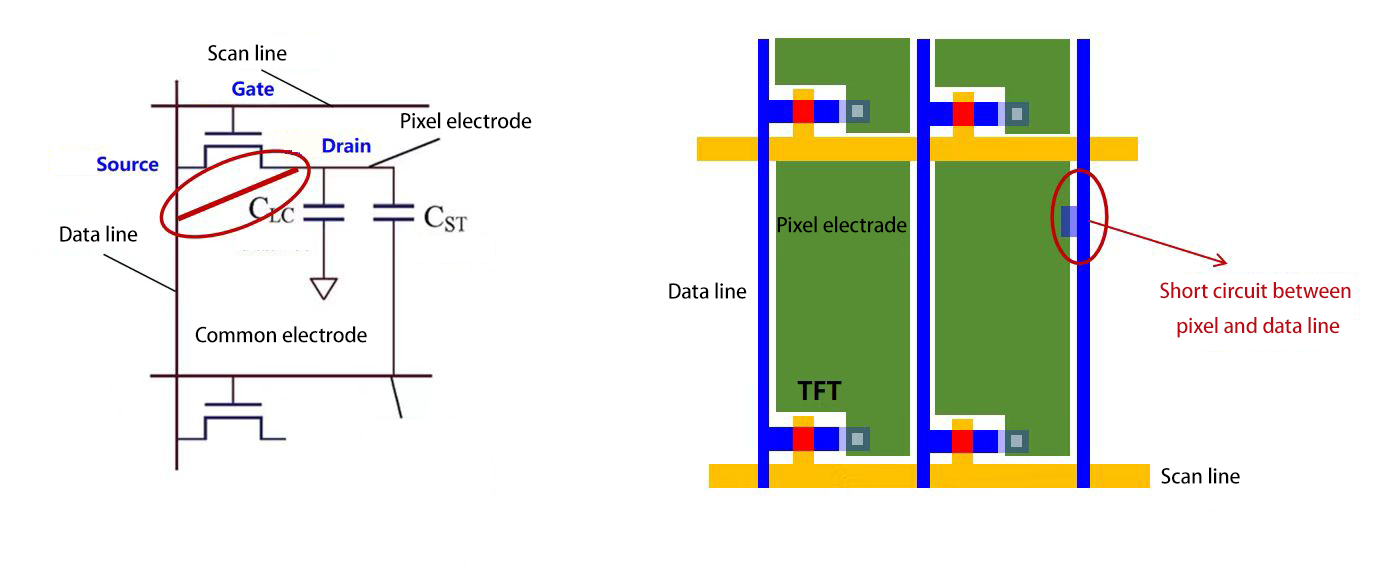
This is primarily caused by incomplete etching of the data line, leaving residual material that creates a conductive bridge (short) to the ITO pixel electrode. As a result, the Source voltage is directly transferred to the ITO pixel electrode, forcing its voltage to be clamped at the level of the Source voltage. When the Source voltage is applied, the voltage on the ITO pixel electrode fluctuates accordingly, preventing the liquid crystal molecules from stabilizing due to continuous voltage variations. This ultimately leads to the formation of an LCD pixel bright spot.
In this short-circuit condition, the resulting LCD pixel bright spot behaves as follows: the display appears normal (dark) in the unpowered black state, but a bright spot becomes visible when voltage is applied during operation.
④ Short circuit between source and drain:
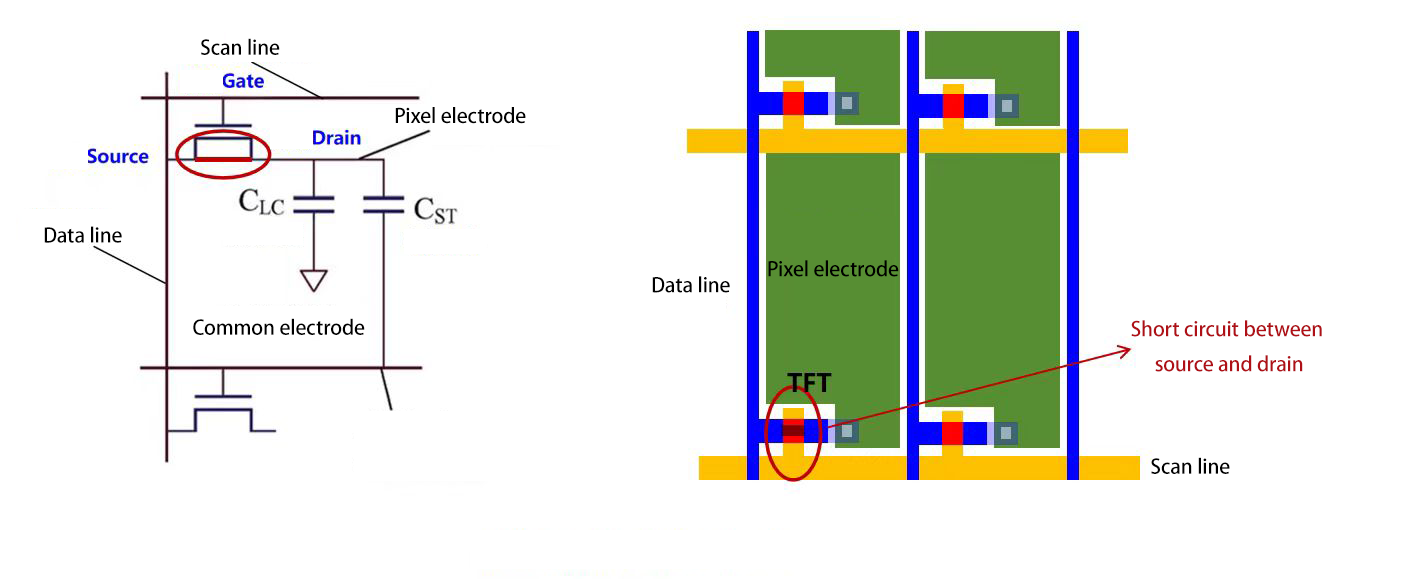
This is mainly caused by incomplete etching of the source and drain metal layers, resulting in a residual conductive path between them. When a short occurs between the source and drain, the voltage of the ITO pixel electrode becomes essentially identical to the Source voltage. As a result, regardless of whether the Gate voltage is at a high or low level, the ITO pixel electrode remains continuously connected to the Source electrode, causing the liquid crystal molecules to remain in a constantly deflected state. This ultimately leads to the formation of an LCD pixel bright spot.
In this short-circuit condition, the resulting LCD pixel bright spot appears normal (dark) in the unpowered black state, but becomes visible as a bright spot when voltage is applied during operation.
⑤ Short circuit between gate and drain:
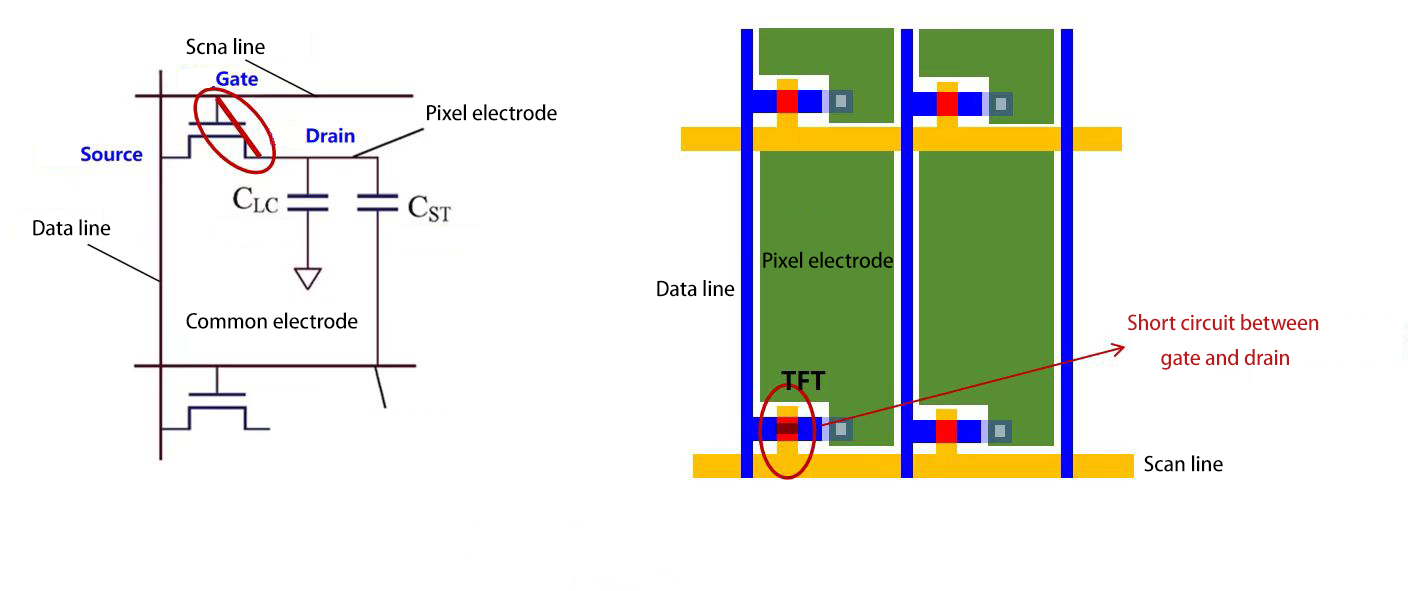
This mainly occurs in the channel region of the active layer, where residual etching byproducts or incomplete etching create a conductive path between the gate and drain, resulting in a short circuit. When a short forms between the gate and drain, the Gate voltage is directly transmitted to the ITO pixel electrode, forcing its voltage to be clamped at the Gate voltage level. When the Gate voltage turns off, the ITO pixel electrode is pulled down to a low potential, creating a reverse electric field with respect to Vcom. This causes abnormal liquid crystal molecule rotation, ultimately leading to the formation of an LCD pixel bright spot.
In this short-circuit condition, the resulting LCD pixel bright spot is visible as a bright point even in the unpowered black state (i.e., a bright spot appears without applied voltage).
3. Improvement Solutions for LCD Pixel Bright Spots
Some customers adopt the "different transmittance ND masking method" to control LCD pixel bright spots. For example, if a bright spot becomes invisible when covered with an ND6% filter, it may be judged as acceptable (OK). However, if the bright spot remains visible after applying the ND6% filter, acceptance is determined based on a comprehensive evaluation of the number of bright spots, their diameter, and the distance between them.
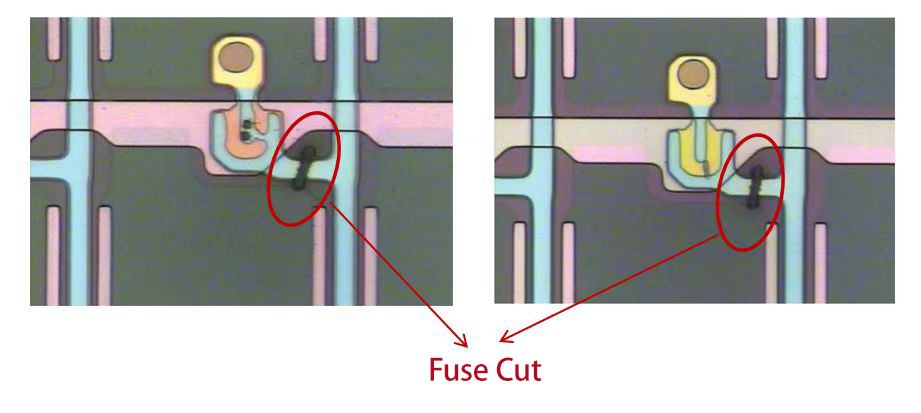
LCD pixel bright spots primarily occur during the LCD Array substrate manufacturing process, caused by unintended electrical connections (short circuits) between conductive lines and thin films. Therefore, the main improvement approach involves using laser repair technology to cut off the short-circuited line via laser ablation, converting the bright spot into a dark spot, thereby achieving the goal of repairing the defect.