In the fields of electronics and optoelectronic displays, there exists a pervasive yet often overlooked "invisible killer"—ESD—that can lead to severe consequences.
When ESD occurs on a TFT-LCD display module, it may result in functional defects such as black screen, white screen, mura (image distortion), horizontal/vertical lines, flickering screen, flickering horizontal lines, or image shadows.
●In mild cases, a "soft failure" occurs, where the module can be restored by restarting.
●In severe cases, it causes permanent functional loss, resulting in a "hard failure" that damages the TFT-LCD panel, driver ICs, or electronic components.
ESD is characterized by its ubiquity, diverse generation mechanisms, suddenness, latency, and imperceptibility. Therefore, while it is impossible to completely eliminate ESD, we can only strive to prevent or minimize its impact on electronic and optoelectronic display devices during the discharge process.
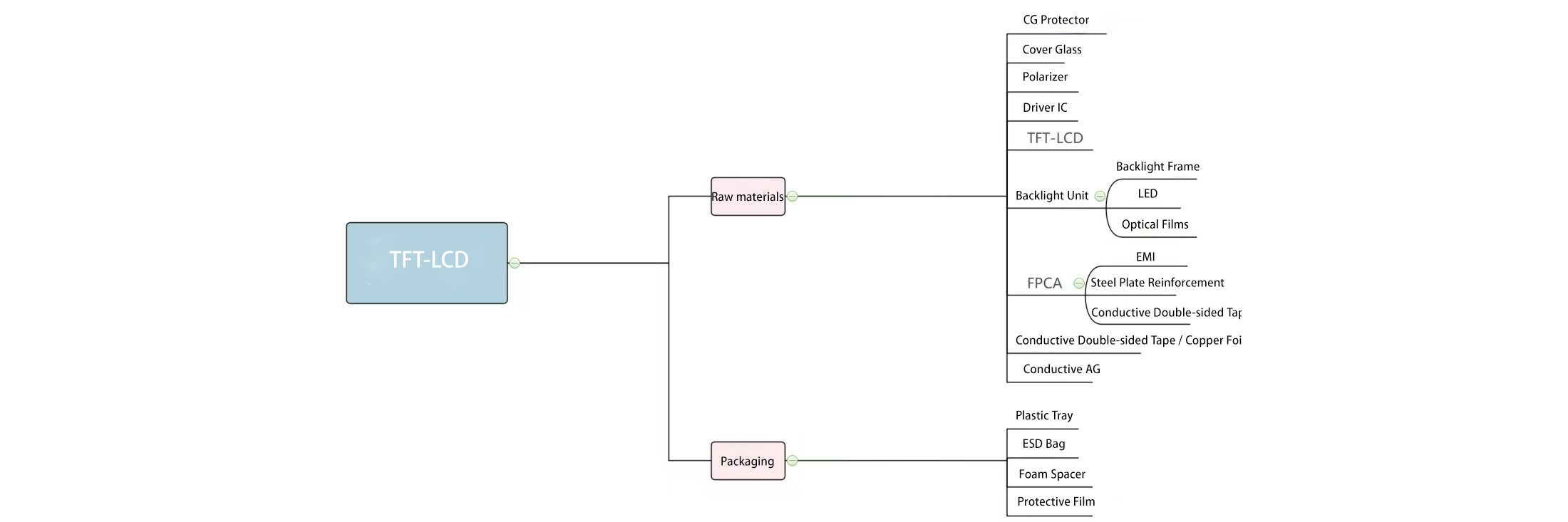
Of course, in TFT-LCD modules, materials that conduct static electricity extend far beyond coated films, conductive silver paste, and polarizers. Based on the specifications summarized during project development, this document outlines the ESD control standards for key materials used in TFT-LCD display modules.
These materials primarily fall into two categories: raw materials and packaging materials, specifically including:
The following section explains the mechanisms by which several core parameters influence electrostatic discharge (ESD) in materials:
①Material Resistivity: The higher the resistance (or sheet resistance) of a material, the poorer its conductivity, and the lower the charge mobility rate. This results in a very slow ESD process, thereby increasing the impact of ESD on the product. According to Ohm's Law ( I=U/R ), when the resistance R is high, the current I passing through the material will be very small under the same static voltage U . This implies a very low charge transfer rate, causing the ESD process to be extremely sluggish.
②Tribovoltage / Peeling Voltage: The higher the friction or peeling voltage of a material, the more electrostatic energy it accumulates. This makes ESD more difficult and increases its impact on the product. Based on the fundamental principles of electrostatics, the electrostatic energy W=1/2CV² (where C represents capacitance and V represents voltage). When the voltage V increases, the electrostatic energy W increases quadratically.
Given the large number of materials involved, this article focuses on the following key components: cover lens protective film, cover lens, polarizer, driver IC, TFT-LCD display panel, and backlight unit (BLU).
1. Cover Lens Protective Film
Protective films applied to glass cover lenses require strict control over the sheet resistance of the adhesive surface and the peeling voltage. If these two parameters exceed the specified range, removing the protective film after it has been laminated onto the surface of an LCD display module may result in defects such as "peeling shadows" or "peeling spots."
Generally, the sheet resistance of the adhesive side of the cover lens protective film is controlled within the range of 10⁵ ~ 10⁹ Ω/◻︎, and the peeling voltage is controlled to be ≤ 500V (Peeling speed > 20 cm/s; Distance between the cover lens surface and the measuring instrument: 5 ~ 20 cm).
Some customers may require both the surface of the cover lens and the adhesive side of the protective film to meet the criterion of ≤ 500V. This represents a relatively higher requirement for the protective film. Actual testing and verification are necessary, taking into account the specific material of the paired cover lens. This is because the measured peeling voltage can vary when the same protective film is paired with cover lenses of different materials.

2. Cover Lens
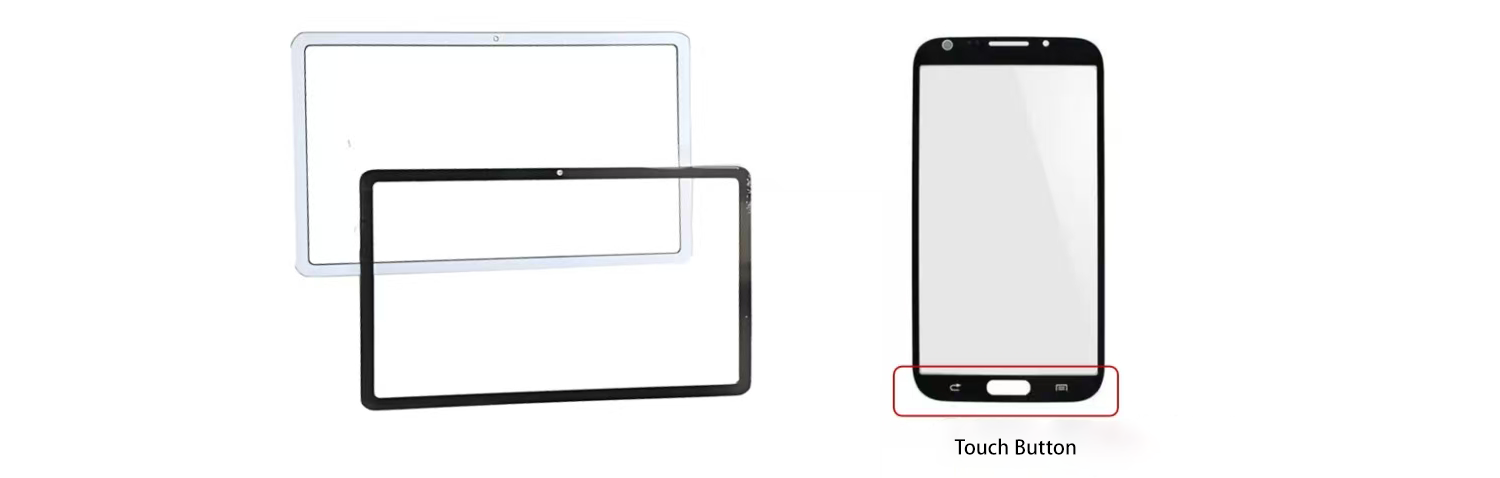
The glass substrate of the cover lens itself does not affect ESD performance. The primary influencing factor is the ink used for printing on the lens. The impedance of this ink can interfere with touch functionality, especially in smartphones with touch keys. This is particularly evident in colored cover lenses, such as "Tuhao Gold" or "Rose Gold," where the ink's impedance is relatively low. (This reduction in impedance is caused by adding metal powder or carbon black to the ink), thereby affecting the touch sensitivity.
Theoretically, a higher ink impedance is preferable, with the ideal state being close to insulation. Ink impedance is generally controlled to be ≥ 10⁹ Ω (1000 MΩ) (Test voltage range: 1000 V; Probe spacing: 10 mm).
3. Polarizer
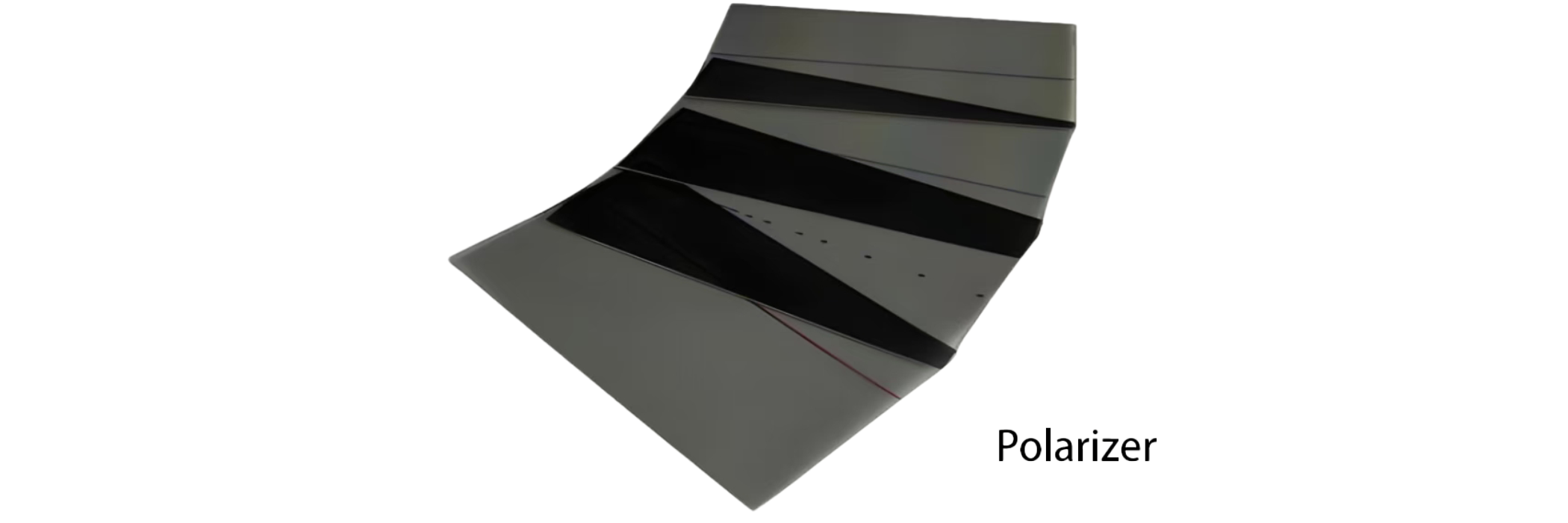
For anti-static polarizers, the core consideration lies in the type and concentration of the anti-static agent added to the PSA (Pressure Sensitive Adhesive). This directly affects the sheet resistance of the PSA and, consequently, the ESD performance of the TFT-LCD display module. There are specific requirements regarding the sheet resistance of the PSA surface on the polarizer.
This is primarily focused on the top polarizer. Based on the impedance of the PSA layer, polarizers can be categorized into three types: Low-Impedance, Normal-Impedance, and High-Impedance. Their respective sheet resistance ranges are as follows:
●Low-Impedance Polarizer: 10⁸ ~ 10⁹ Ω/◻︎
●Normal-Impedance Polarizer: 10¹⁰ ~ 10¹² Ω/◻︎
●High-Impedance Polarizer: ≥ 10¹² Ω/◻︎
It should be noted that a lower sheet resistance for the PSA surface is not always better. The selection must be based on the specific touch type and coating situation of the paired TFT-LCD panel.
4. Driver IC
This section primarily discusses the ESD withstand voltage levels of the IC component under various discharge models. Additionally, from a software perspective, it encompasses related settings aimed at enhancing the IC's ESD robustness. These improvements include adding an ESD Check function, modifying MiPi timing to increase signal transmission stability, and strengthening the IC's anti-interference capability in CMD mode.
●Human Body Model (HBM): The ESD withstand voltage for the IC component is required to be ≥ 2.5 ~ 3.0 kV.
●Machine Model (MM): The ESD withstand voltage for the IC component is required to be ≥ 200 ~ 300 V.
●Charged Device Model (CDM): The ESD withstand voltage for the IC component is required to be ≥ 800 V.
5. TFT-LCD Display Panel
There are numerous design strategies to enhance the ESD robustness of TFT-LCD panels. These include:
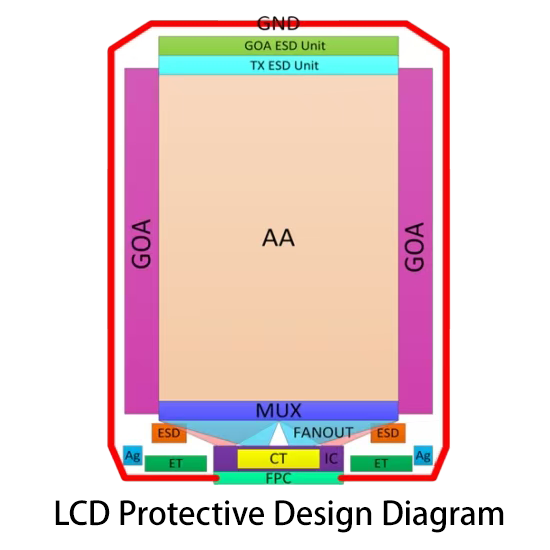
●Implementing GND routing around the AA area of the LCD.
●Incorporating GOA ESD protection circuits.
●Integrating touch layer ESD protection circuits.
●Optimizing the placement of conductive silver paste (AG Pad) on the LCD surface.
●Applying specific coatings/films to the LCD surface.
ESD Control Standards for Coated Films on LCD Surfaces
There are primarily two types of coatings used on LCD surfaces: ATO (Antimony-doped Tin Oxide) and ITO (Indium-doped Tin Oxide).
●ATO Coating (High-Resistance Film): ATO is also known as a high-resistance film. It is typically used in In-cell projects to prevent interference with touch signals while facilitating ESD conduction. The sheet resistance control range after coating is generally 1 × 10⁸ ~ 9.9 × 10⁹ Ω/◻︎, depending on specific customer requirements and manufacturer capabilities.
●ITO Coating (Conductive Film): ITO is also known as a conductive film. It is commonly used in externally laminated projects for IPS display modules, primarily serving the purpose of ESD conduction. The sheet resistance requirement after coating is ≤ 1000 Ω/◻︎. For more stringent applications, the requirement is tightened to ≤ 200 ~ 300 Ω/◻︎.
6. Backlight Unit (BLU)
Within the backlight module, the key materials that affect the TFT-LCD display module's ESD resistance or cause optical film waviness are primarily: LEDs, the metal chassis (housing), and the optical films. The following section details the ESD-related control requirements for these materials.
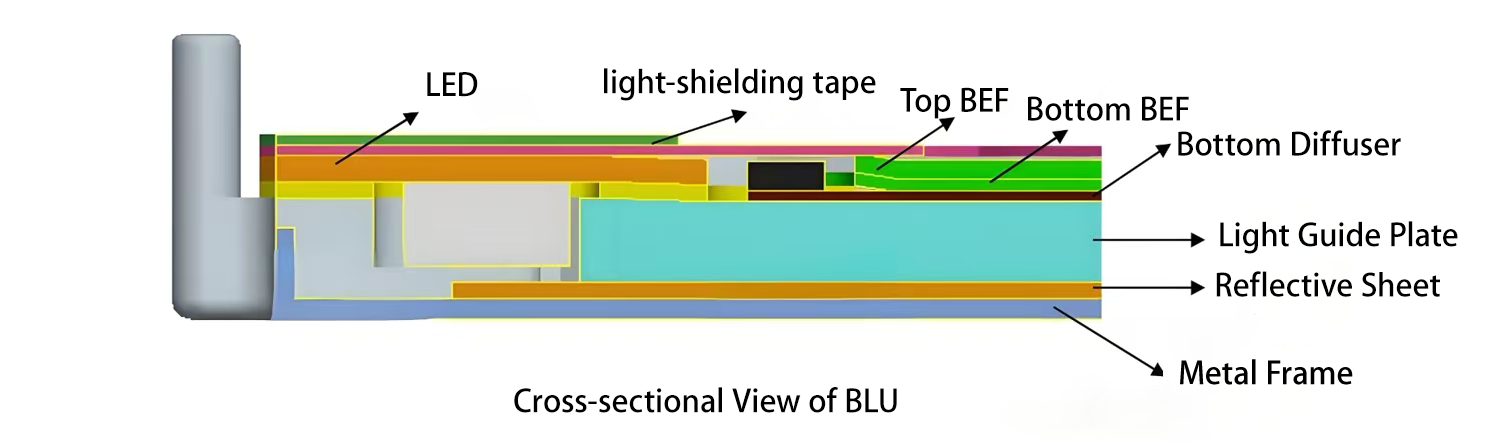
① LED:As the core component providing illumination, the LED's ESD robustness directly determines whether it can emit light normally during an ESD event, thereby deciding if the LCD module displays correctly. Damage to the LED results in functional defects.
For a single LED, the ESD withstand voltage under the Human Body Model (HBM) is typically required to be ≥ 2.0 ~ 3.0 kV, with more stringent requirements demanding ≥ 4.0 kV. If even higher protection is needed, TVS diodes can be added to the LED strip to further enhance its ESD resistance.
② Backlight Metal Chassis:In small-size backlight modules, the chassis material is generally SUS304 or SUS201. The resistivity of this material also has a certain impact on ESD dissipation.
The surface resistance of the backlight chassis is required to be ≤ 3 Ω. For lower resistance requirements, nickel-plated chassis can be considered, achieving a surface resistance of ≤ 1 Ω.
③ Optical Films:The optical films in a backlight module primarily include BEF (Brightness Enhancement Film), diffuser films, and reflective films.
The films themselves generally have minimal impact on ESD performance. The surface sheet resistance of these materials is typically required to be ≥ 10¹³ Ω/◻︎. However, in single-frame backlight designs, the type of reflective film used can influence ESD performance, depending on the specific film selected.
Strict control is required over the voltage level of the films while they are on the dispensing/reeling platform prior to assembly.
●Voltage Requirement: The surface voltage of the optical films on the platform should be ≤ 500 ~ 750 V.
●Impact: The lower this voltage value, the lower the risk of film waviness occurring.